
buddhist-jewelry
How to Set Intentions with Your Jewelry
You check your phone, on average, 96 times a day. Your mind rehearses tomorrow's difficult meeting during tonight's family dinner. You drive entire commutes and realize you remember none of the journey. This is the age of distraction, a time where our attention is the most valuable—and most plundered—resource we possess.
Our focus is fractured into a thousand tiny pieces by notifications, anxieties, and the relentless hum of a world that never sleeps.
In this constant pull away from the present, we search for anchors. We download meditation apps, schedule digital detoxes, and chase productivity hacks, all in an effort to reclaim our own minds. But what if your most powerful anchor wasn't on a screen, but on your skin?
What if the simple, quiet act of fastening a bracelet each morning could become the most grounding ritual of your day? This is the power of mindful adornment: the practice of turning your jewelry from a passive, decorative object into an active, tactile guide back to your center.

The Ancient Roots of Wearable Wisdom
The idea of infusing an object with meaning and power is as old as humanity itself. Long before jewelry was about fashion, it was about function—spiritual, protective, and symbolic. Ancient Egyptians wore amulets of lapis lazuli and carnelian to guard against evil spirits and ensure safe passage to the afterlife.
Roman soldiers carried talismans engraved with images of gods for courage in battle. This practice of wearing your belief was not a superstition, but a profound understanding of the human mind: a physical object can make an invisible intention feel real, present, and powerful.
Nowhere is this tradition more deeply woven into the cultural fabric than in the Himalayas. For centuries, Tibetan communities have understood that what you wear is an extension of your inner world. Jewelry is not mere decoration; it is a form of prayer, a shield, and a story.
Turquoise, with its sky-blue hue, is considered a sacred stone of protection, believed to absorb negativity and guard the wearer's health. Coral, with its deep red color, symbolizes the life-force, vitality, and is thought to quell disturbances in the blood.
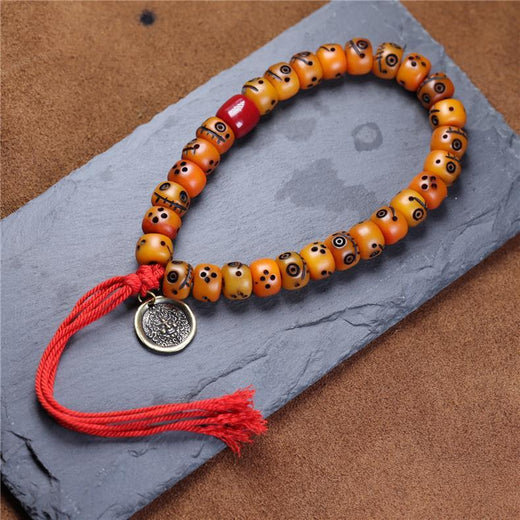
The mysterious and coveted Dzi beads, etched with symbolic "eyes," are considered celestial in origin, offering immense spiritual benefits and protection to their bearer.
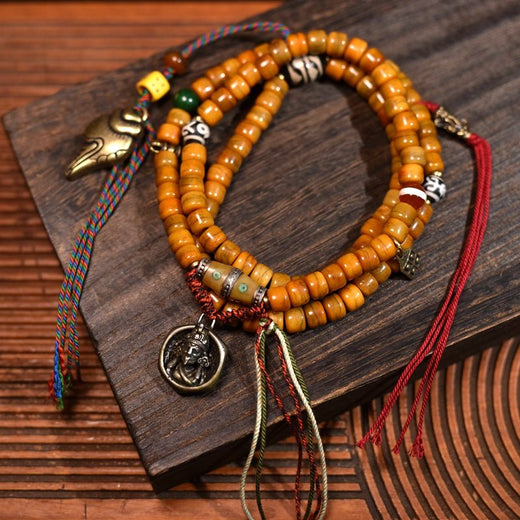
The most recognizable form of this wearable wisdom is the mala. Traditionally used for counting mantras during meditation, each of the 108 beads on a mala necklace or bracelet is a touchpoint for focus, a physical guide to keep the mind from wandering during recitation.
The practice of mindful adornment is a direct descendant of this ancient lineage. It’s not a modern invention but a rediscovery of what these cultures have always known: a beautiful object can be a powerful tool for waking up to your own life.
From Autopilot to Awareness: The Science and Soul of a Tactile Anchor
Most of our day is spent on autopilot. We move through tasks, conversations, and commutes with only a fraction of our conscious attention engaged. This state of mind-wandering, often managed by a part of the brain called the Default Mode Network, is not inherently bad—it conserves mental energy.
However, it's also the state where we are most susceptible to falling into cycles of worry, replaying past regrets, and building future anxieties. We are physically present, but our minds are elsewhere entirely.
Mindful adornment is the deliberate, gentle interruption of this autopilot. The piece of jewelry you choose—a mala bracelet, a thangka pendant, a gemstone ring—is selected not for its trendiness, but for its assignment. It becomes a physical, wearable intention.
When your mind is lost in a past regret or a future worry, this object exists firmly and undeniably in the present. It is here, on your body, a solid fact in a sea of mental chatter.
It has weight, temperature, and texture.
The remarkable quality is in the touch. When you consciously reach for your chosen piece, you engage your sense of touch, one of our most primitive and grounding senses. This simple tactile sensation is a powerful neurological signal.
It pulls your awareness out of the abstract world of thought and plants it firmly in the physical reality of your body. You feel the cool, smooth surface of a stone or the intricate carving of a silver charm.
In that moment, you are not in yesterday's argument or tomorrow's deadline. You are here. You are now. By choosing to feel it, you are making a conscious choice to return to the only moment that ever truly exists.
Choosing Your Messenger: Selecting Jewelry with Intention
The piece you choose for this practice is deeply personal. It is not about monetary value but about resonance. It should be an object that you feel a connection to, something that feels good in your hand and speaks to the intention you wish to cultivate.
This is an invitation to look at jewelry not as a trend to be followed, but as a tool to be chosen with purpose.
Consider what you are calling into your life. Your choice might be guided by several factors:
Symbolism: Tibetan Buddhist symbolism is a rich visual language of enlightenment. Each symbol is a teaching in itself. Are you drawn to the Endless Knot, representing the interconnectedness of all things and the karmic path?
Does the Vajra (or Dorje) call to you, symbolizing the indestructible clarity and brilliance of the awakened mind? Perhaps the Lotus flower speaks to you, a reminder that purity and beauty can grow from the murkiest of waters.
Choosing a piece with a specific symbol infuses your practice with centuries of wisdom.
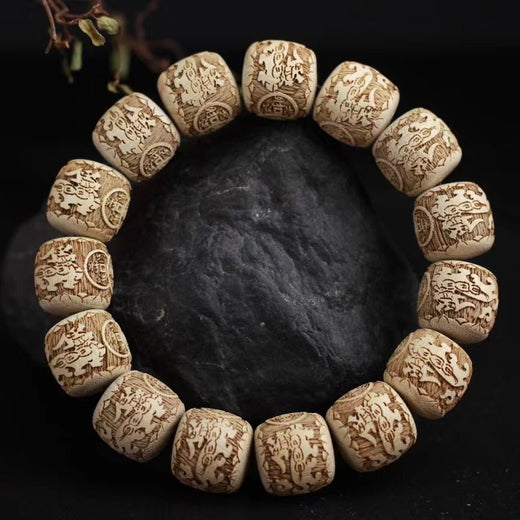
Material & Gemstone: Different materials carry different qualities and associations. Wooden beads, like Bodhi seed or sandalwood, have an earthy, grounding quality and are warm to the touch. Gemstones each have unique traditional meanings.
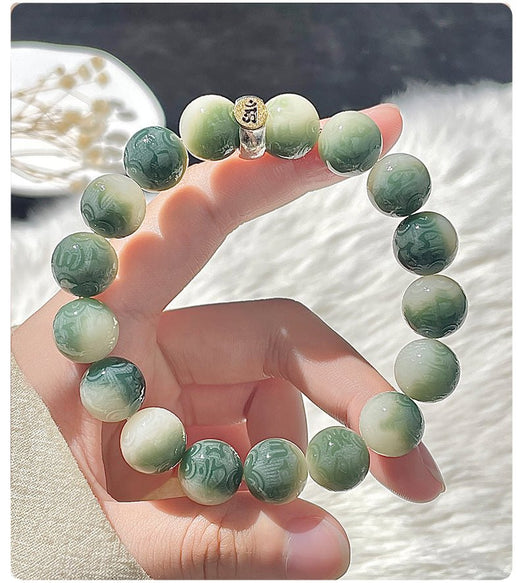
Tiger's Eye is often associated with courage and confidence, a perfect anchor for facing a challenge. Lapis Lazuli is connected to truth, wisdom, and clear communication. Amethyst is a stone of tranquility and spiritual awareness.
Exploring the vast world of Tibetan bracelets, you might find a material that perfectly matches the quality you wish to embody.
Intuition: Sometimes, a piece simply calls to you. You might not know the exact meaning of the stone or the history of the symbol, but you feel an undeniable pull. Trust this feeling. Your intuition is a powerful guide.
The piece that you are most drawn to is often the one you need the most. It might be the weight, the color, or a quality you can't quite name. This intuitive connection will make your practice even more potent.

The Morning Ritual: Programming Your Anchor for the Day Ahead
The power of your mindful adornment is unlocked in a simple, profound ritual that takes no more than a minute each morning. This is where you consciously "program" your piece with the day's intention. This small act transforms the object from a simple accessory into your personal ally.
Step 1: Find Stillness. Before you even pick up your jewelry, take one deep, cleansing breath. Breathe in stillness, breathe out the noise and rush of the morning. Grant yourself this single moment of peace before the day begins.
Step 2: Connect Through Touch. Hold your chosen piece in your hands. Don't just look at it; truly feel it. Feel its weight in your palm. Roll the beads between your fingers. Is the stone cool against your skin?
Is the metal smooth or textured? Notice every detail. This sensory engagement brings you immediately into the present moment.
Step 3: State Your Intention. With your eyes closed, state your intention for the day clearly, either aloud or silently in your mind. This is the heart of the ritual. Your intention should be simple, positive, and specific to what you need. Here are some examples:
- For Emotional Balance: "Today, this bracelet will remind me to breathe deeply and find patience when I feel stressed or frustrated."
- For Mindful Communication: "This pendant will help me to listen fully and speak with compassion in my difficult meeting."
- For Self-Compassion: "This ring is a reminder to be as kind to myself as I am to others."
- For Focus: "When I touch these beads, I will return my focus to the task at hand."
- Single-Word Intentions: Sometimes a single word is the most powerful. "Calm." "Courage." "Presence." "Kindness."
Step 4: Seal the Intention. As you fasten the piece—if you are closing a clasp, tying a knot, or sliding it over your wrist—visualize your intention being sealed into the object. You can imagine a soft, warm light emanating from your hands and being absorbed by the jewelry.
Picture the energy of your chosen word or phrase merging with the stone, wood, or metal. The final click of the clasp or the tightening of the knot becomes a definitive act, locking in your purpose for the day.
Throughout the Day: Activating Your Mindful Reminder
The morning ritual sets the stage, but the true transformation happens in the small, challenging moments scattered throughout your day. Your mindful adornment is your partner in these moments, a silent reminder waiting to be activated.
Think of it as a pattern interrupt. Our brains love to run on familiar, often negative, loops. The anchor is your tool to break the loop and choose a different response. Here are how some real-world scenarios might unfold:
Scenario 1: The Stressful Email. You open an email from your boss, and the tone is critical. Immediately, you feel your jaw clench, your shoulders tighten, and your heart rate quicken. The familiar wave of anxiety and defensiveness begins to rise.
But as your hand moves to the keyboard to type a reactive response, your fingers brush against the cool beads of your bracelet. It's a subtle jolt. You pause. You feel the smooth stones.
Your morning's intention comes back to you: "Patience." You take a conscious breath, just as you promised yourself you would. The initial surge of adrenaline subsides. You are now able to read the email again, more calmly, and formulate a thoughtful, constructive reply instead of an emotional one.
Scenario 2: The Difficult Conversation. You are in a conversation with a loved one, and it's heading toward the same old argument. You can feel yourself preparing your usual defenses, your well-worn lines of attack.
As you cross your arms, your hand touches the pendant resting against your chest. Your intention was "Listen." The warmth of the metal against your skin is a gentle nudge. Instead of interrupting, you stay silent.
You let them finish. You truly listen to their words, not only to the voice in your head formulating a rebuttal. The simple act of touching your anchor created enough space for a different, more compassionate outcome.
Scenario 3: The Mindless Scroll. You sat down for a "five-minute break," but twenty minutes later, you find yourself deep in the endless, numbing scroll of social media. You feel a familiar sense of dissatisfaction and wasted time.
As you shift your position, your thumb rubs against the edge of a ring on your finger. "Presence," you had told it that morning. The contact is a quiet alarm bell. Is this how you want to be spending your present moment?
You close the app, stand up, and stretch, bringing your awareness back to your body and your real-world surroundings.
This is a practice, not a perfect performance. There will be days you forget your anchor is even there. That's okay. The moment you remember is the moment the practice succeeds. Each time you use your adornment to return to the now, you strengthen that neural pathway, making it easier and more automatic the next time.
More Than an Object: Cultivating a Relationship with Your Adornment
Over time, something beautiful begins to happen. Your chosen piece ceases to be just a tool; it becomes a companion. It is there with you through moments of triumph, stress, joy, and sorrow. It becomes infused with the presence of your practice, a silent witness to all the times you chose awareness over autopilot.
It is no longer just a bracelet or a necklace; it is a repository of your presence.
This evolving relationship means your piece deserves care. Just as you would tend to a friendship, you can tend to your adornment. This might involve physically cleaning it, but it can also mean tending to it with intention.
You can leave it in the moonlight overnight, smudge it with sage, or simply run it under cool water while resetting your intention, washing away what no longer serves and preparing it for a new day.
Your piece becomes a physical chronicle of your journey. When you look at it, you may remember the day it helped you stay calm through a crisis, or the week it reminded you to be kinder to yourself.
It is a a sign of your commitment to living a more present, intentional life. Every single item in our collection of authentic Tibetan jewelry is crafted with the potential to become such a lifelong companion, waiting to be filled with your story and your intention.
In a world that constantly pulls you outward, mindful adornment is a gentle, beautiful, and constant invitation to come back home to yourself. It is a reminder, resting on your skin, that the peace, strength, and wisdom you seek are not in an app or an external destination.
They are already within you, waiting for your attention.
Frequently Asked Questions
Does this have to be a special or expensive piece of jewelry?
Not at all. The most important element is your intention and the personal connection you feel with the piece. A simple string bracelet or a smooth stone from a beach can work just as well as a finely crafted silver pendant.
However, pieces with authentic historical and spiritual symbolism, like those from Tibetan traditions, can add a layer of depth and meaning to your practice, connecting your personal journey to a lineage of traditional teachings.
What if I forget my intention or forget to use my anchor during the day?
This is completely normal and part of the process. The goal is not perfection. The practice is not about never getting distracted; it's about what you do when you notice you've been distracted. The moment you remember your intention or touch your anchor is a moment of success.
Be gentle and compassionate with yourself. Every time you remember, you are strengthening the muscle of mindfulness.
Can I have more than one intention or use more than one piece of jewelry?
Absolutely. You might choose to wear one piece with a consistent, long-term intention (like "self-compassion") while using another for a specific, daily intention (like "focus for today's project"). You could have a "work" bracelet and a "home" necklace.
Listen to your intuition. The goal is to create a system that feels supportive and meaningful to you, not to follow a rigid set of rules.
Is this a religious practice?
While the concept is deeply rooted in Buddhist principles of mindfulness and the use of sacred objects, the practice of mindful adornment itself is universal. It does not require you to subscribe to any specific creed or religion.
It is a psychological and spiritual tool for anyone seeking to cultivate more presence, awareness, and intention in their daily life, regardless of their personal belief system.
How do I choose the right intention for the day?
A good way to start is with a moment of quiet reflection in the morning. Ask yourself: "What do I need most today?" or "What is my biggest challenge today?" If you have a difficult presentation, your intention might be "courage" or "clarity." If you've been feeling overwhelmed, it might be "calm" or "ease." If you're feeling disconnected from loved ones, it could be "connection." Let the answer arise from a place of honest self-inquiry.
Your needs will change day to day, and your intention can reflect that.
Keep reading