
buddhist-jewelry
Tibetan Handmade Bracelets: Auction Records & Collectib
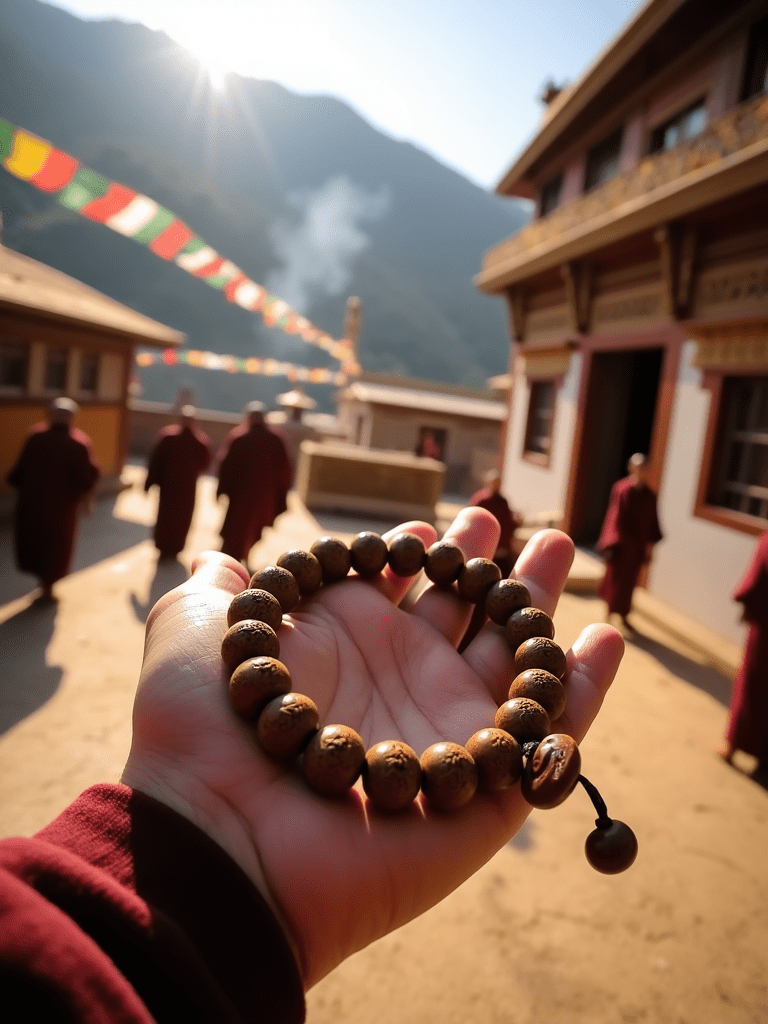
You’ve likely felt it. You're sitting across from someone, perhaps a friend or even a stranger in a quiet café, and you notice the beads around their wrist. It’s not flashy or ostentatious. It’s something else entirely.
The wood is dark and worn smooth with use, the stones have a depth that seems to pull in the light, and the entire piece carries an unmistakable weight—a gravity that has nothing to do with its physical mass.
You find yourself wondering about its story. Where did it come from? What have those beads counted? What secrets do they hold? This isn't just an accessory; it’s a presence. It’s a quiet statement in a loud world, a tangible piece of a tradition so ancient it feels rooted in the very earth.
You realize you’re not only looking at jewelry. You’re witnessing a piece of a life, a tool for a journey, and a connection to something profound and enduring.

What It Really Is: A Legacy on Your Wrist
To truly understand the object on your wrist, you must look beyond its form and trace its lineage back through centuries of Himalayan winds and resonant chants. A Tibetan bracelet is not a modern invention; it is a direct descendant of the traditional Japa Mala, or threngwa in Tibetan, the string of 108 beads used by Buddhist practitioners since at least the 8th century.
When the great master Padmasambhava (Guru Rinpoche) brought Buddhism to Tibet, he brought with him these essential tools for practice—tools for focusing the mind and accumulating merit through the repetition of mantras.
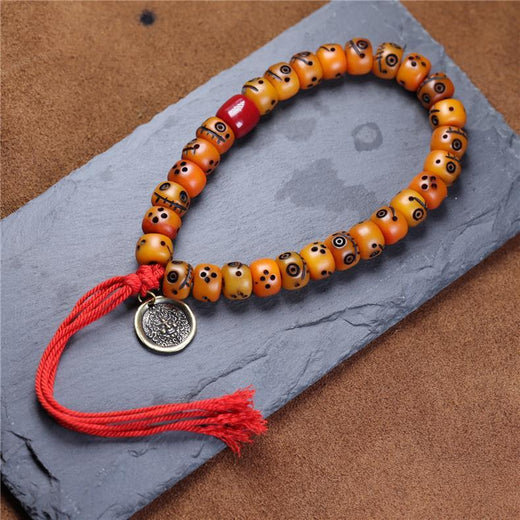
The full 108-bead mala was, and is, a practitioner's constant companion. But for daily life, a more compact, wearable version emerged. These wrist malas, often with 21 or 27 beads (fractions of 108 with their own significance), allowed laypeople and monastics alike to carry their practice with them everywhere.
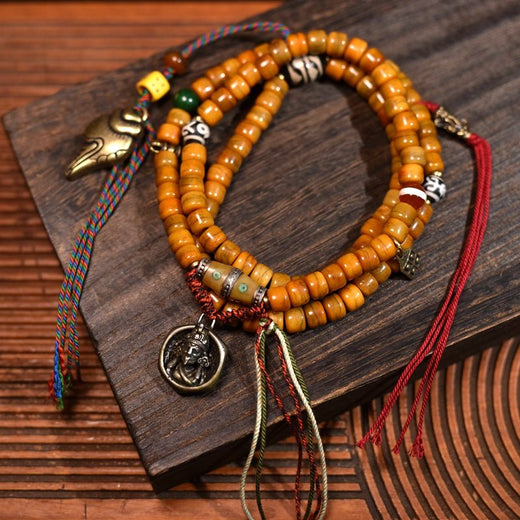
They weren't merely decorative; they were functional, portable altars. Each bead was a step, a breath, a recitation of "Om Mani Padme Hum." The materials were never chosen randomly. They were sourced from the sacred landscape: yak bone from the high plateaus, a stark and powerful reminder of impermanence; turquoise mined from the mountains, believed to be a sky-stone offering protection and health; and rudraksha or bodhi seeds, directly linking the wearer to the path of enlightenment.
This deep authenticity is why certain antique malas command staggering prices at auction houses like Christie's and Sotheby's. A rare 18th-century mala, perhaps once belonging to a high lama from the Drepung or Sera Monastery near Lhasa, is more than an artifact.
It is considered a vessel, imbued with the spiritual presence of countless mantras. Some pieces, crafted from human bone (kapala), were used in specific tantric practices and are among the most sought-after ritual items.
When a Qing Dynasty imperial court mala, made of pearls and precious stones, sells for millions, the world sees its material value. But what you, the discerning practitioner, should understand is its *provenance value*.
It has been held, used, and blessed. It has been a part of a living lineage. When you wear an authentic Tibetan bracelet, you are not only wearing beads; you are carrying a piece of that sacred history, a fragment of the devotion that has echoed through the valleys of Tibet for over a thousand years.
The Deeper Meaning: More Than Stone and String
Every element of a genuine Tibetan bracelet is a deliberate word in a sentence of spiritual intention. It is a microcosm of the Buddhist path, a tangible map of the journey toward awareness that you can hold in your hand.
The symbolism is not superficial; it is woven into the very fabric of the object, designed to constantly reorient your mind toward the Dharma.
The number of beads is paramount. A full mala has 108, a sacred number representing the 108 delusions or afflictions (kleshas) one must overcome to attain enlightenment. Each recitation of a mantra, counted by one bead, is a step in purifying one of these afflictions.
The wrist malas you wear are often made with a division of this number, such as 27 (108 divided by 4) or 21 (often used for short praises, like a homage to Tara). This numerical link ensures that even the smaller bracelet maintains its connection to the complete practice.
It's a promise, a commitment to the full journey, even when undertaken in smaller, manageable steps throughout your day.
At the center is the "guru bead" or sumeru, a larger, often decorative bead that marks the start and end point. This bead symbolizes the guru, the teacher, or the ultimate awareness that is the goal of the practice.
When you are using the mala for mantra, you never cross over the guru bead. Instead, you pause, reflect with gratitude on your teachers and the path, and then turn the mala around to continue in the opposite direction.
This simple act is a profound teaching in itself: the path is cyclical, but our awareness should always be guided by wisdom, not mindless repetition.
The materials themselves are teachers. Yak bone, as mentioned, is a direct confrontation with impermanence (anicca), the first mark of existence. To wear it is to accept the reality of death and the preciousness of this human birth.
Bodhi seeds, from the same species of tree under which the Buddha attained enlightenment, are a constant source of inspiration, connecting you directly to the potential for awakening that exists within you. Stones like turquoise are seen as protective, absorbing negativity and promoting healing, while red coral symbolizes life force and passion harnessed for the spiritual path.
Even the string that holds them together is symbolic, representing the unbroken continuity of the Dharma that connects all beings. When you choose to wear one of these powerful spiritual tools, you are choosing to surround yourself with these silent, potent teachings every moment of the day.
Real Benefits for Modern Life: An Anchor in the Storm
It’s easy to dismiss the benefits of a spiritual object as purely esoteric, but the impact of wearing and using a Tibetan bracelet is profoundly practical and grounded. In a life saturated with digital alerts and constant demands on your attention, it serves as a powerful, analog anchor for your mind and well-being.
Think about your immediate, physical experience. When anxiety rises or your thoughts begin to race during a stressful meeting or a crowded commute, your instinct might be to reach for your phone—a device designed to scatter your focus further.
Instead, imagine the simple, deliberate act of touching the beads on your wrist. The cool, smooth surface of a stone or the textured pattern of a seed under your thumb provides immediate tactile feedback.
This is a somatic grounding technique. By focusing on the physical sensation, you draw your awareness out of the chaotic narrative in your head and into the present moment. You can subtly roll a single bead back and forth, using it as a focal point for your breath.
This isn't about belief; it's about neurology. You are giving your brain a simple, calming, repetitive task that interrupts the cycle of stress and brings you back to your center.
The bracelet also functions as an "intention anchor." At the start of your day, you might set an intention—to be more patient, to listen more deeply, to act with compassion. But by mid-morning, that intention is often forgotten, buried under an avalanche of emails and responsibilities.
Your bracelet can be the physical cue that calls you back. A glance at your wrist during a frustrating conversation becomes a silent reminder: *patience*. The weight of it as you type an email can prompt you to reconsider your tone: *compassion*.
It transforms a fleeting morning thought into a continuous, day-long practice. It doesn't quietly strike your problems away, but it consistently returns you to the state of mind from which you are best equipped to handle them.
Furthermore, it offers a tangible alternative to digital dependency. The urge to fill every spare moment with scrolling is a modern affliction. A Tibetan bracelet provides a meaningful substitute. Waiting in line for five minutes?
Instead of checking social media, you can hold your wrist mala and silently recite a mantra 27 times. It's a micro-dose of meditation, a small act of reclaiming your time and attention. It's about consciously choosing to cultivate inner peace rather than consuming more information.
This simple swap, practiced consistently, can fundamentally change your relationship with technology and, more importantly, with your own mind. You begin to discover pockets of stillness you never knew existed. Explore our entire range of mindfully crafted items to find the one that can serve as your personal anchor.

How To Spot the Real Thing: A Guide for the Heart and Mind
working through the market for Tibetan jewelry can be daunting. Mass-produced imitations abound, and it's crucial to know how to distinguish a genuine piece of spiritual hardware from a mere fashion accessory. Choosing an authentic bracelet is an act of intention, one that involves engaging your senses and your intuition, not only your wallet.
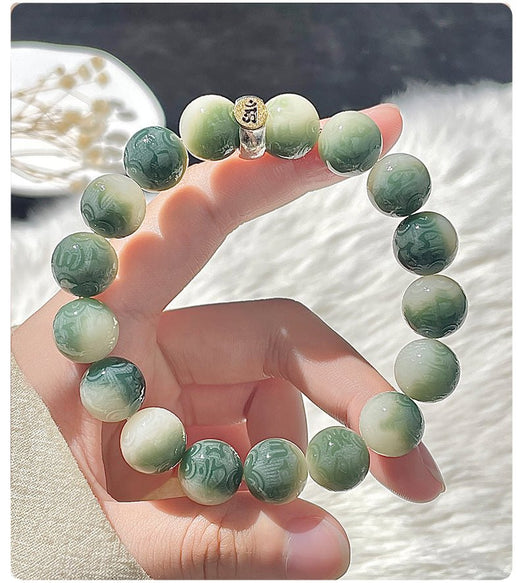
First and foremost, consider the materials. Authenticity has a feel, a weight, a temperature. Real stone beads, like turquoise or lapis, will feel cool to the touch and have a certain density. Plastic or resin imitations feel light, warm, and often have a tell-tale seam from the mold.
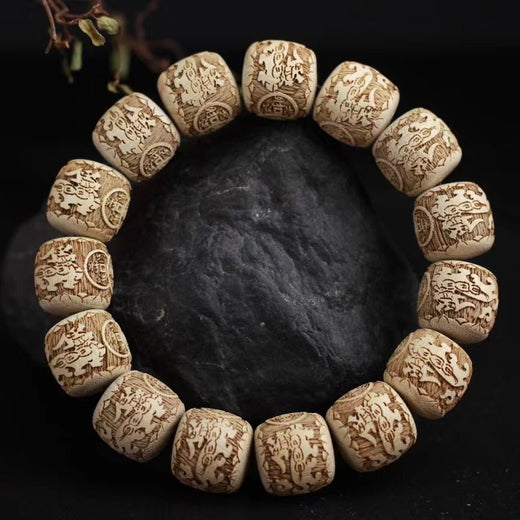
Run your fingers over Bodhi seeds; true seeds have unique, natural variations and imperfections in their patterns. Factory-made beads are perfectly uniform. Yak bone that has been hand-carved will show subtle irregularities, the marks of the artisan's tool.
These "flaws" are not defects; they are the signature of human hands and a hallmark of authenticity. Be wary of colors that look too bright or unnatural—dyed howlite is often passed off as turquoise, for example.
Genuine materials possess a natural, earthy beauty that synthetics can never replicate.
Next, examine the craftsmanship. Look closely at how the bracelet is constructed. Many authentic wrist malas are hand-knotted on a durable cord. While not all are knotted, the quality of the stringing is vital.
It should feel strong and secure. The guru bead should be well-seated and the connection point robust. The overall construction should feel like it was made for use, not only for show. The presence of the artisan is imparted to the object they create.
A bracelet made with care and mindful attention by someone who understands its purpose will feel different from one churned out by a machine in a factory. This is a quality of character that is difficult to describe but deeply felt when you hold the piece in your hand.
Finally, and most importantly, consider the source. Where you buy your bracelet matters immensely. Seek out sellers who are transparent about where their items come from, who the artisans are, and what the materials mean.
A reputable source like Buddhabelief doesn't just sell a product; they share a tradition. They can answer your questions about symbolism and practice because they are steeped in the culture. Ultimately, let your intuition guide you.
An authentic bracelet should speak to you on a closer level. It might be the color, the feel of the beads, or an inexplicable sense of connection. When you find a bracelet that speaks to your path, you are not only acquiring an object; you are welcoming a companion for your journey.
How to Use It: Activating Your Spiritual Tool
Once you have chosen your bracelet, the next step is to transform it from a beautiful object into a living part of your spiritual practice. Using a wrist mala is a simple, ancient, and deeply rewarding process.
It is about creating a relationship with the tool, infusing it with your intention and focus through mindful repetition.
Before you begin, you may wish to "activate" or consecrate your bracelet. This is a personal ritual to cleanse it of any influence from its creation and journey to you, and to dedicate it to your specific purpose.
You can do this by gently passing it through the smoke of cleansing incense like sandalwood or sage. You can also leave it in the light of a full moon overnight or place it in a singing bowl and let the resonance wash over it.
As you do this, hold a clear intention in your mind. You might dedicate its use to the cultivation of compassion, the development of wisdom, or the well-being of all sentient beings. This act of setting an intention is what truly makes the bracelet yours.
To use the bracelet for mantra recitation, the traditional method is to hold it in your left hand, the receiving hand in Buddhist practice, draped over your middle finger. The index finger, which represents the ego, is generally not used to touch the beads.
You begin with the first bead next to the guru bead. With your thumb, you gently pull that bead towards you as you recite your chosen mantra one time. For example, "Om Mani Padme Hum." Then you move to the next bead, pulling it towards you as you repeat the mantra.
You continue this process, bead by bead, moving around the circle.
This physical action is key. The movement of the thumb, the feeling of the bead, the sound of the mantra—all of these elements work together to occupy the senses and quiet the discursive mind.
It gives your "monkey mind" a job to do, allowing a closer state of calm and focus to arise. When you complete a full circuit and arrive back at the guru bead, you pause.
This is a moment to feel gratitude. You do not cross over the guru bead. Instead, you respectfully turn the bracelet around 180 degrees and begin the next round, moving back in the direction you came.
This honors the student-teacher relationship and acknowledges the wisdom that guides your practice. By integrating this simple ritual into your daily life, your bracelet becomes more than a symbol; it becomes an active gateway to inner peace.
Common Questions
Why are some Tibetan bracelets so expensive?
The value of a Tibetan bracelet is determined by a combination of material rarity, craftsmanship, age, and spiritual provenance. While a simple wooden or seed bracelet can be quite affordable, pieces that command high prices often feature materials that are exceptionally rare or culturally significant.
Chief among these are ancient Dzi beads. These etched agate beads, whose origins are shrouded in myth, are considered powerful protective talismans in Tibetan culture, with some antique beads fetching tens or even hundreds of thousands of dollars.
Similarly, high-quality, deep red coral and vibrant, untreated turquoise, especially from old mines, are increasingly scarce and highly prized. Beyond the materials, the level of craftsmanship—such as intricate silverwork or hand-carved bone beads—adds value.
Finally, age and provenance play a crucial role. An antique bracelet that has been used for decades in monastic practice is believed to be imbued with spiritual blessings, making it not only a piece of jewelry but a sacred artifact.
This combination of tangible and intangible value is what creates the wide price spectrum you see.
Can anyone wear a Tibetan bracelet, or is it only for Buddhists?
Absolutely anyone can wear a Tibetan bracelet. While these bracelets have their roots deeply embedded in Buddhist tradition, their core purpose is to serve as a tool for cultivating mindfulness, peace, and compassion—qualities that are universal, not exclusive to any single religion.
You do not need to be a Buddhist to benefit from the grounding effect of the beads or to use them as a reminder of your personal intentions. The most important element is respect.
It's vital to approach the bracelet not as a mere fashion trend, but as an object with a profound cultural and spiritual heritage. By wearing it with a sense of reverence for its origins and purpose, you honor the tradition from which it comes.
Whether your intention is secular (to reduce anxiety) or spiritual (to connect with a path of compassion), the bracelet can serve as a powerful and supportive companion for anyone who approaches it with a sincere and respectful heart.
What's the difference between a wrist mala and a full 108-bead mala?
The primary difference lies in form and function, though they share the same spiritual DNA. A full 108-bead mala, or threngwa, is the traditional tool for formal meditation practice. Its 108 beads are used for counting mantra repetitions during a dedicated sitting session, with the goal often being to complete one or more full rounds.
It is typically long enough to be worn as a necklace but can be cumbersome for constant wear. The wrist mala, by contrast, is a compact, portable adaptation designed for integrated, daily-life practice. Usually made with 21 or 27 beads, it allows you to carry the essence of the practice with you everywhere.
It's perfect for reciting a few mantras while waiting in line, on public transport, or during a work break. Think of the full mala as the tool for your formal time on the meditation cushion, and the wrist mala as the tool that helps you carry that meditative quality out into the world.
Both are sacred, but they are optimized for different contexts of practice.
How do I cleanse my bracelet energetically?
Cleansing your bracelet is a wonderful way to refresh its energy and reaffirm your connection to it, especially after you first receive it or if you've been through a particularly challenging period. There are several traditional methods.
Smudging is very effective: you can light sage, palo santo, or a good quality Tibetan incense stick and allow the smoke to waft over and through the beads, visualizing it carrying away any stagnant energy.
Sound cleansing is another powerful option. Placing your bracelet in or near a Tibetan singing bowl and striking the bowl will bathe the beads in purifying resonance. Moonlight, particularly the light of the full moon, is a gentle and potent way to cleanse and recharge your bracelet; simply leave it on a windowsill overnight.
What's most important in any of these methods is your intention. As you perform the cleansing, hold the clear thought that you are purifying the object for the highest good, rededicating it as a tool for your spiritual journey.
What does it mean if my bracelet breaks?
In the Tibetan tradition, a mala breaking is not seen as a negative event or a sign of bad luck. On the contrary, it is often viewed with a sense of positive significance. A breaking cord can symbolize the completion of a cycle.
It is believed that the mala has absorbed the negative karma or obstacles that it was meant to, and in breaking, it signifies a spiritual breakthrough or the resolution of a difficult situation. It has, in essence, fulfilled its purpose for that particular chapter of your life.
The proper response is not to be upset, but to be grateful. Carefully gather all the beads. You have a choice: you can retire them respectfully by placing them in a planter or releasing them into a natural body of water, or you can have the bracelet restrung.
Restringing it, perhaps with a new guru bead or a different cord, can symbolize a new beginning and a fresh commitment to your practice, carrying forward the blessings of the original beads into a new form.
Which hand should I wear my Tibetan bracelet on?
There are traditional guidelines regarding which hand to wear your mala on, though personal comfort and intention are ultimately the most important factors. Traditionally, the left hand is considered the "receiving" hand. It is associated with the feminine principle, intuition, and the internal self.
Therefore, for practices aimed at cultivating inner qualities like compassion, wisdom, or peace, or for receiving blessings, wearing and using the mala on the left wrist is often recommended. The right hand is considered the "giving" or "projecting" hand, associated with the masculine principle and action in the external world.
If your practice is focused on projecting calming presence outwards or engaging actively in the world with compassion, the right hand might feel more appropriate. Practitioners simply wear it on their non-dominant hand for practical reasons.
The best advice is to experiment and see what feels most natural and aligned with your intention. The bracelet is your personal tool; let your intuition guide you to the placement that feels right for you.
Your Next Step
You now understand that a Tibetan bracelet is far more than an object of adornment. It is a legacy you can wear, a tool for mindfulness, and a constant, silent companion on your personal journey.
It is a small piece of the vast and profound wisdom of the Himalayas, made tangible for your modern life. The connection you feel to it is real—it's a resonance with a tradition of peace, intention, and self-discovery.
The next step is not only to own one, but to begin a relationship with one. To find the combination of materials and presence that speaks directly to your spirit and supports the path you wish to walk.
We invite you to explore our curated selection of wrist malas, each handcrafted with reverence and authenticity, and find the one that is waiting to become a part of your story.
Keep reading