buddhist-jewelry
Thangka Necklace: Your Portable Sacred Talisman
You’re caught in traffic, the horns blaring a chaotic symphony. Your phone buzzes relentlessly, each notification a tiny demand on your attention. In a meeting, the conversation circles without resolution, and you feel your own inner calm begin to fray.
It’s a familiar friction, the feeling of being pulled in a dozen directions at once, your mind scattered like leaves in the wind. In these moments, you might reach for a distraction, another scroll through a feed.
But imagine, instead, reaching for an anchor. Imagine your fingers closing around a small, intricate object resting against your chest. It’s cool to the touch, its details a silent a sign of centuries of devotion.
This isn’t just a piece of jewelry. It is a miniature world, a sacred map, a direct line to the quiet monastery of your own mind. This is the profound, grounding experience of wearing a Thangka necklace—your personal, portable talisman in a world that never stops moving.

What a Thangka Necklace Really Is: A Recorded Message from the Himalayas
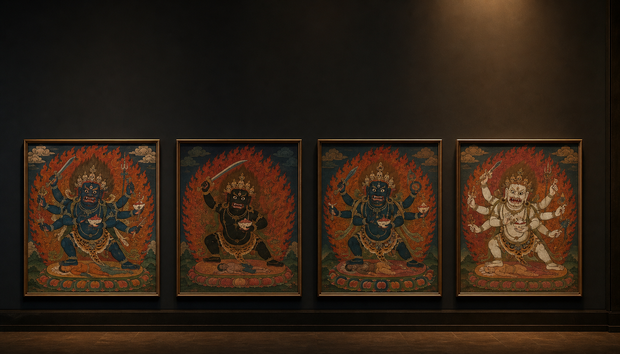
To understand the power held within your Thangka necklace, you must first understand its origin, which is far grander than its miniature form suggests. The term "Thangka" (ཐང་ཀ་) is Tibetan; it doesn't mean "painting" but translates more accurately to "recorded message." These are not mere decorations.
They are visual scriptures, teaching tools, and objects of profound spiritual technology, born from the need to transmit the complex teachings of the Dharma across the vast, often nomadic, landscapes of Tibet.
The tradition traces its roots back to the 7th and 8th centuries, intertwining with the arrival of Buddhism in Tibet. Early forms were heavily influenced by the masterful artistry of Nepalese Newar artists, like the famed Arniko who traveled to the court of Kublai Khan, and the sophisticated scroll-painting traditions of China.
But in the crucible of the Himalayas, this art form became uniquely Tibetan. Large-scale Thangkas, painted on cotton or silk canvas with ground mineral pigments, were created for monasteries like Ganden and Drepung. Unfurled during major religious festivals, such as the Saga Dawa Duchen celebrating the Buddha's birth, enlightenment, and parinirvana, these massive scrolls would cascade down hillsides, making the enlightened figures accessible to entire communities, many of whom were illiterate.
The Thangka was their textbook, their guide, their direct vision of the path.
The Thangka necklace is a direct descendant of this tradition, born from the practical necessity of personal devotion on the move. Traveling monks, pilgrims, and nomadic families couldn't carry a large, brocaded scroll. Instead, they required a portable form of refuge and protection.
This led to the creation of tsakli—small, painted initiation cards used in esoteric rituals. From this, the concept of a wearable Thangka evolved. These miniature masterpieces were often housed in a Gau, a portable shrine or amulet box, crafted from silver or copper.
This allowed a practitioner to carry their tutelary deity, their protector, or a visual representation of their vows with them at all times. The painting itself followed the same sacred principles as its larger counterparts.
Artists, often monks themselves, trained for years within specific stylistic schools, such as the spacious, landscape-focused Karma Gadri style originating in the eastern region of Kham, or the vibrant, deity-centric Menri style of Central Tibet.
When you wear a Thangka necklace, you are not simply wearing a pendant; you are carrying a direct lineage of this sacred art, a "recorded message" miniaturized for your personal journey. It is a piece of the monastery wall, a fragment of a sacred scroll, made intimate and constant.
The Deeper Meaning: Decoding the Sacred Map
A genuine Thangka necklace is a universe of meaning, a dense weave of symbolism where every color, posture, and object is a deliberate instruction for your mind. To look upon it as mere art is to see only the surface of a deep ocean.
Its true purpose is to serve as a visual sadhana—a spiritual practice—and a map to your own innate enlightened nature. Understanding its language transforms it from a beautiful object into a powerful catalyst for inner change.
The central figure, the deity, is the heart of the Thangka's message. This is not a god to be worshipped in the Western sense, but an archetype of an awakened quality that already exists within you.
When you wear an image of White Tara, you are carrying a constant reminder of boundless compassion and healing. Her iconic seven eyes—on her forehead, palms, and soles—symbolize her perfected ability to see and respond to the suffering of all beings, in all realms.
The necklace becomes a prompt: in a moment of judgment or impatience, her image encourages you to open the eyes of your own compassion. If your Thangka depicts Manjushri, the Bodhisattva of Transcendent Wisdom, you carry the tools to cut through confusion.
His right hand wields a flaming sword, not of violence, but of discernment, severing the roots of ignorance. In his left, he holds the stem of a lotus supporting a Prajñāpāramitā Sūtra, the "Perfection of Wisdom" text.
Wearing his image is an affirmation of your quest for clarity, a talisman against the mental fog of doubt and indecision.
Beyond the central figure, the entire composition is governed by sacred science. The proportions of each deity are dictated by a precise system of iconometric grids and measurements known as thig-tse. This is not a limitation on artistic freedom; it is a method to ensure the image is a perfect conduit for the specific presence and blessings of that enlightened being.
The colors are also symbolic: white for peace, red for power and magnetism, blue for healing and immovability, gold for the light of enlightenment itself. If your Thangka contains a mandala, you are carrying a celestial palace, a two-dimensional blueprint of an enlightened mind and a pure realm.
Each gate, wall, and central point corresponds to a stage on the path to awakening. Wearing it is like carrying the architectural plans for your own inner temple. This profound depth of symbolism is the essence of Tibetan sacred art, a philosophy that informs **our entire collection of meaningful Buddhist artifacts**.
Real Benefits for Modern Life: Your Tactile Anchor in a Digital World
In a life saturated with abstract information and digital noise, the Thangka necklace offers something profoundly real and tangible. Its benefits are not vague spiritual comforts; they are practical, psychological tools that can fundamentally alter how you navigate your daily experience.
It functions as a potent anchor for your awareness, a trigger for emotional regulation, and a constant, quiet reminder of your deepest intentions. — explore our protection jewelry collection for authentic pieces.
First, consider it a point of single-minded focus. Your attention is constantly being fractured by notifications, emails, and the endless stream of online content. The Thangka necklace is a counterpoint to this diffusion. When you feel your mind becoming scattered or overwhelmed by a chaotic environment, the simple, physical act of touching the necklace can serve as a micro-meditation.
It pulls your awareness out of the swirling vortex of anxious thoughts and grounds it in a single, tactile sensation. This physical anchor is linked to a sacred image, and by extension, to the quality that image represents—be it Green Tara's fearless action or Chenrezig's unwavering compassion.
This practice, repeated over time, trains your mind to return to a state of centeredness more quickly and easily.
Second, it acts as a powerful tool for emotional regulation through visual and physical association. Your brain is wired to create strong connections between objects and internal states. By consciously linking your Thangka necklace with moments of peace—during meditation, quiet reflection, or prayer—you infuse it with that intention.
When you later find yourself in a stressful situation, such as a difficult conversation or a moment of high pressure, seeing your reflection or feeling the weight of the necklace can trigger a conditioned response.
It becomes a subconscious cue that helps you access that reservoir of calm and clarity you've cultivated. It doesn't solve the external problem, but it helps you shift your internal state, allowing you to respond with greater wisdom and less reactivity.
Finally, the necklace is a constant, non-verbal reminder of your highest aspirations. It's easy to set intentions in the morning only to have them forgotten by lunchtime, lost in the shuffle of daily demands.
Your Thangka necklace is a persistent, gentle whisper. It hangs near your heart, a physical embodiment of your spiritual vows. When you are about to react in anger, a glimpse of Chenrezig, the Bodhisattva of Compassion, can be the crucial pause you need to choose a different response.
When you feel paralyzed by fear, the image of Green Tara, ever-ready to act, can inspire a step forward. This practice of infusing daily life with sacred meaning is at the heart of Tibetan Buddhism, a philosophy you can explore through **our curated selection of authentic pieces**.

How to Choose an Authentic Thangka Necklace: A Guide to Sacred Art
Choosing a Thangka necklace is an intimate process, an act of connecting with a sacred object that will become a part of your daily practice. To ensure this connection is genuine, it is vital to understand the difference between an authentic piece of sacred art and a mass-produced imitation.
An authentic Thangka, no matter how small, carries the lineage of its tradition, and knowing what to look for will help you choose a talisman with true spiritual integrity.
The most crucial element is the artist's intention and training. A true Thangka is not merely painted; it is created as a meditative practice. The artist, often a practitioner themselves, has typically undergone years of rigorous training to master the sacred iconography and techniques.
They perform rituals and recite mantras while they work, infusing the piece with spiritual presence. When you seek a Thangka necklace, inquire about its source. Was it made by an individual artist or a cooperative of artisans trained in a specific lineage?
An authentic seller will honor and share this information. The intention behind its creation is the invisible focus that you will carry with you.
Next, examine the iconographic accuracy. The details matter immensely. In a genuine Thangka, the proportions of the deity will be correct according to sacred geometry. The implements they hold (a vajra, a lotus, a sword) will be precise and clear.
The colors will be vibrant and traditionally symbolic. A mass-produced item, often a print glued into a pendant, will lack this precision. The lines may be blurry, the colors flat, and the details generic or even incorrect.
An authentic, hand-painted miniature will possess a stunning level of detail and life. You should be able to see the fine, confident brushstrokes, the subtle shading, and the living quality of the deity's expression, even on a tiny scale.
Pay attention to the materials. Traditionally, Thangkas are painted with mineral pigments and often feature accents of 24k gold. These materials have a unique luminosity that cannot be replicated by acrylic paints or printing inks.
Look for that subtle, earthy depth in the colors and the brilliant shimmer of real gold leaf on the deity's ornaments or halo. The casing that holds the Thangka is also important. Traditional Gau boxes and settings are often made of sterling silver or copper, designed to protect the sacred image within.
When you're ready to find your own sacred talisman, you can **explore our collection of Thangka necklaces**, each sourced with deep respect for these artistic and spiritual traditions.
How to Use Your Thangka Necklace: A Daily Practice of Remembrance
Acquiring a Thangka necklace is the first step. The next, and most important, is to breathe life into it through your intention and practice. It is not a passive object but an active partner in your spiritual development.
Integrating it into your life with respect and mindfulness will unlock its true potential as a source of refuge and inspiration. Here is a simple, step-by-step guide to using your sacred talisman.
Step 1: Consecration and Intention Setting. Traditionally, a Thangka is considered a mere beautiful object until it is consecrated, or blessed, by a qualified lama or Rinpoche. This ceremony is believed to invite the wisdom-being of the deity to reside within the image.
If you have access to a teacher, this is the most powerful way to activate your necklace. However, if you do not, you can perform a personal consecration. Find a clean, quiet space. You might light a candle or some incense.
Hold the necklace in your hands at your heart. Generate a sincere feeling of refuge and loving-kindness. Then, recite the mantra of the deity depicted 108 times (using a mala is helpful). For example, for Green Tara, you would chant `Om Tare Tuttare Ture Soha`.
As you chant, visualize brilliant, pure light emanating from all the Buddhas and Bodhisattvas, flowing into the Thangka, filling it completely with blessings and positivity. Conclude by setting a clear intention: "May this talisman be a constant reminder of my potential for compassion."
May it protect my mind from negativity and guide my actions for the benefit of all."
Step 2: The Daily Ritual. Weave the necklace into the rhythm of your day. In the morning, as you put it on, take one conscious breath. Recall your intention. This simple act transforms dressing into a moment of spiritual commitment.
Throughout the day, use it as a mindfulness anchor. When you feel stress rising, your mind wandering, or a negative emotion taking hold, gently touch the pendant. You don't need to stop what you are doing.
Just make contact. Let the physical sensation bring you back to the present moment. Take three deep breaths and silently repeat the deity's mantra once or twice. In the evening, as you take it off, take a moment to express gratitude.
Acknowledge one time during the day when the necklace reminded you of your path, or one instance where you successfully embodied its quality (e.g., a moment of patience or clarity).
Step 3: Respectful Handling. Because it is a sacred object, a representation of the enlightened mind, your Thangka necklace should be treated with respect. Avoid placing it directly on the floor or in an unclean place like a bathroom.
When you are not wearing it, it should be kept in a high, clean location, such as on your personal altar, on a shelf above head-level, or wrapped in a clean silk or cotton cloth.
By handling it with this level of care, you reinforce its significance in your mind and honor the tradition from which it comes. This conscious respect is a practice in itself. By engaging with your Thangka necklace in this way, you make it more than an adornment; you make it a living part of your path, a constant companion on your journey inward.
Many practitioners find that **these sacred objects** become cherished guides over a lifetime.
Common Questions About Your Sacred Talisman
As you begin your journey with a Thangka necklace, questions naturally arise. Here are answers to some of the most common inquiries, helping you wear your talisman with confidence and understanding.
- 1. Do I have to be a Buddhist to wear a Thangka necklace?
- No, you do not need to identify as a Buddhist. The qualities represented by the deities in Thangka art—compassion, wisdom, strength, healing—are universal human aspirations. However, it is essential to approach the necklace with respect rather than as a mere fashion accessory. Understanding its origin as a sacred object in the Tibetan Buddhist tradition is key. Wearing it is an acknowledgment of the wisdom it represents and an intention to cultivate those positive qualities in your own life, regardless of your spiritual affiliation.
- 2. Which deity is right for me?
- This is a deeply personal choice. The best way to choose is to reflect on your current life path. What quality do you most need or wish to develop right now? If you are facing many obstacles and fears, the swift, protective presence of Green Tara might resonate. If you are a student or feel clouded by confusion, the clear, discerning wisdom of Manjushri could be your guide. If your goal is to open your heart and develop universal love, Chenrezig (Avalokiteshvara) is the embodiment of compassion. Research the different Bodhisattvas and deities. Read their stories and contemplate their attributes. The right one will often be the one that you feel a natural, intuitive connection to.
- 3. How do I care for my Thangka necklace?
- Treat it as the precious, sacred art that it is. The miniature painting is delicate. Avoid exposing it to moisture, direct sunlight for prolonged periods, or harsh chemicals. The casing, which is often sterling silver, can be gently polished with a soft, dry silver-polishing cloth, but take great care to avoid touching the cloth to the painted surface or any protective glass. When you are not wearing it, store it respectfully in a clean, dry place, preferably wrapped in a soft cloth or in its own pouch.
- 4. Can I wear more than one sacred item at a time?
- Yes, many practitioners wear multiple items, such as a Thangka necklace along with a mala or a protection cord. There is no strict rule against it. However, the purpose of such items is to aid focus and intention. Be mindful that you are not simply accumulating objects. Each piece you wear should have a clear purpose and meaning for you. If wearing multiple items helps you feel more connected and reminded of your path, that is beneficial. If it becomes a distraction or feels cluttered, it may be better to focus on one primary talisman.
- 5. What is the difference between a Thangka necklace and a Gau box?
- The terms are often used interchangeably, but there is a subtle distinction. A Gau (or Ghau) is a specific type of Tibetan amulet box or portable shrine. It is a container, often ornate, designed to hold sacred objects. A Gau can contain a miniature Thangka, but it might also hold a relic from a great teacher, sacred herbs, or a printed mantra roll. A "Thangka necklace" is a broader term that specifically refers to a wearable pendant where the central feature is the painted Thangka itself. It may be set in a simple frame or housed within a more elaborate Gau box, but the focus is on the sacred painting.
- 6. Is it okay if my necklace was not
- A blessing from a realized master is the traditional ideal, as it is believed to infuse the object with a powerful lineage of spiritual presence. However, its absence does not render your talisman useless. Your own sincere intention is an incredibly powerful force. By performing a personal consecration ritual—visualizing light, reciting mantras, and dedicating the object to your spiritual path—you imbue it with your own purpose and connect it to your practice. The respect, mindfulness, and devotion you bring to the necklace are what truly activate its potential in your life.
Your Next Step on the Path
A Thangka necklace is far more than a beautiful piece of jewelry from a distant land. It is a practice you can wear. It is a portable sanctuary, a constant companion on your spiritual path, and a tangible commitment to your own highest potential.
To choose one is to choose a focus for your mind and an aspiration for your heart. It is a daily reminder, resting near your pulse, of the clear, wise, and compassionate nature that is your true essence, waiting to be uncovered.
This is not an object
Keep reading