buddhist-jewelry
The Art and Spirit of Thangka: A Comprehensive Guide
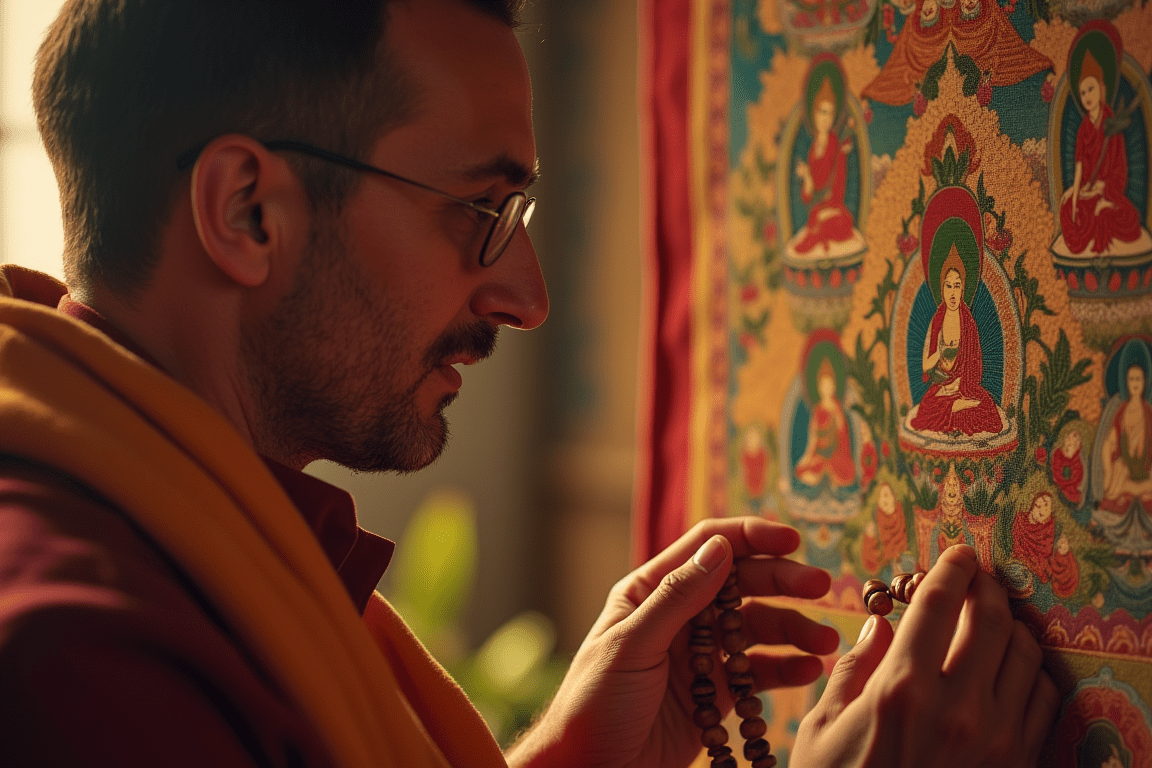
You sit in your quiet space. The cushion is comfortable, the incense is lit, and your intention is set. Yet, as you close your eyes, your mind still skitters and jumps. The focus you seek feels just out of reach, an abstract concept you’re trying to grasp in the dark.
You’ve read the texts and understand the principles of compassion, wisdom, and enlightened energy, but they remain words on a page. Something is missing—a bridge between the intellectual understanding and the felt, lived experience.
You need a focal point, a sacred anchor that doesn’t just occupy space on your wall but actively opens a doorway in your mind. This is the moment many seekers discover the Thangka, not as a piece of art, but as a key.
It is a vibrant, living presence that gazes back at you, offering a direct line to the very qualities you wish to cultivate.

What a Thangka Really Is
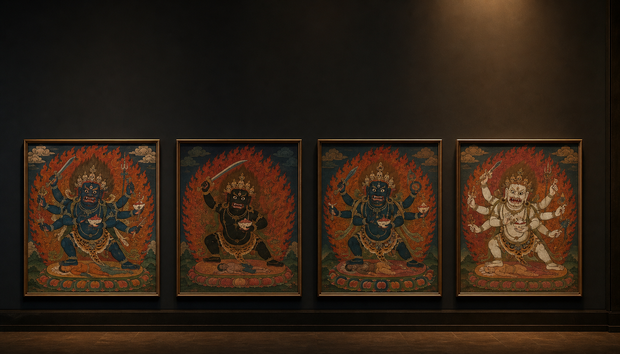
To call a Thangka a "painting" is like calling a temple a "building." It misses the essence entirely. A Thangka is a visual dharma, a painstakingly rendered sermon on cloth that transcends language. Its origins are not in galleries but in the practical needs of nomadic Tibetan culture and the deep wellspring of Indian Buddhist art.
Before the 7th century, when Buddhism took root in Tibet, teachings were primarily oral. Thangkas emerged as portable scrolls, allowing wandering monks and lamas to carry complex teachings across the vast, high-altitude plateau, unfurling them in tents and village squares to illustrate the life of the Buddha, the nature of reality, and the path to liberation.
The artistic lineage flows directly from the Pala Empire of India (8th-12th centuries), a bastion of Mahayana and Vajrayana Buddhism. As these traditions migrated north, their artistic conventions—seen in surviving murals and manuscripts—were adopted and transformed by Tibetan and Newari artisans in the Kathmandu Valley.
A pivotal figure was Arniko, a brilliant 13th-century Nepali artist from the court of Patan. His mastery was so profound that he was invited to the court of Kublai Khan, where he established a school of Himalayan art that shaped aesthetics across Asia.
He didn’t just paint; he transmitted a sacred system of creation.
The creation of a Thangka is itself a profound meditation. The canvas, or ras gzhi, is meticulously prepared cotton, stretched and treated with a mixture of chalk and animal hide glue, then polished with a smooth stone until it resembles ivory.
The pigments are not modern acrylics but the very substance of the earth: lapis lazuli for deep blues, malachite and azurite for greens, cinnabar for reds, and orpiment for yellows, all painstakingly ground by hand and mixed with hide glue as a binder.
The finest details, from the threads of a deity’s robes to the halo of light surrounding them, are often painted with pure, powdered gold. This is not decoration; it is an offering. Each brushstroke is laid down with intention, often accompanied by the recitation of mantras, embedding the spiritual presence directly into the fabric of the piece.
The Deeper Meaning: A Map of the Enlightened Mind
A Thangka is not a product of artistic whim. It is a precise iconographic map governed by sacred geometry. Every element, from the posture of the central figure to the color of their skin and the objects they hold, is dictated by canonical texts and centuries of spiritual insight.
The artist works within a strict system of grids and proportions known as thig tse. This ensures that the depiction of a deity is not a mere representation, but a true channel for their enlightened presence.
Your eye is guided through a landscape of profound symbolism, designed to awaken specific qualities within your own mind.
Consider the details you might see. A deity seated in the full lotus posture, or vajrasana, represents the unshakable, adamantine nature of enlightenment. Their hand gestures, or mudras, are a silent language: the right hand raised in the abhaya mudra grants fearlessness, while two hands resting in the lap in the dhyana mudra signify deep meditative concentration.
The colors speak volumes: the brilliant white of Avalokiteshvara embodies pure, untainted compassion; the wrathful, dark blue of Vajrapani symbolizes the power to transmute anger into mirror-like wisdom; the radiant red of Amitabha signifies the life force of discerning awareness.
When you gaze upon a mandala Thangka, you are looking at a blueprint of a celestial palace, the perfected world of a Buddha. You are seeing a two-dimensional representation of a multi-dimensional enlightened consciousness.
The outer rings are not mere decoration. A ring of fire burns away ignorance and worldly attachment. A ring of vajras symbolizes the indestructible diamond-like nature of reality. A ring of lotus petals represents the purity that arises from the mud of samsara.
As your gaze moves inward toward the central deity, you are symbolically journeying from the confused outer world to the pristine, peaceful center of your own enlightened nature. The Thangka is not an object to be passively observed; it is an environment for your mind to inhabit.
Real Benefits for Your Modern Life
In a world of constant digital distraction, your attention is your most precious resource. A Thangka offers a powerful way to reclaim it. It serves as a dedicated spiritual anchor, a tangible focal point that draws your mind away from the noise and back to your deepest intentions.
Hanging a Thangka in your space does more than beautify a wall; it fundamentally shifts the character of the room, creating a constant, silent reminder of the path you have chosen to walk.
The most profound benefit emerges when you use a Thangka as a support for meditation, specifically for visualization practices (known in Tibetan as kye-rim, or the generation stage). Instead of struggling to conjure a complex image of a deity from memory, you have a perfect, vibrant reference right before you.
Your practice becomes one of active engagement. You gaze upon the image of, for example, Green Tara, absorbing every detail: her compassionate smile, her hand extended to offer aid, the vibrant green of her form symbolizing enlightened activity.
Then, you close your eyes and recreate that image in your mind's eye. You visualize her light pouring into you, clearing away obstacles and fear. You dissolve your ordinary self into her form, embodying her fearless compassion.
The Thangka makes this advanced practice accessible, transforming abstract concepts into a felt reality.
Furthermore, a Thangka is a profound learning tool. It is a visual encyclopedia of Buddhist teachings. By studying a Wheel of Life Thangka, you gain a visceral understanding of the cycle of rebirth (samsara) and the causes of suffering.
A Thangka depicting the life of the Buddha tells his story more vividly than any book. One showing the lineage of spiritual masters connects you to a golden chain of wisdom passed down through generations.
It allows you to learn the dharma not only with your intellect, but with your eyes and your heart. As you deepen your understanding, you may find yourself drawn to different deities or symbols, each reflecting a new stage of your inner development.
Finding the right piece is a deeply personal process, and when you explore **our curated collection of sacred art**, you are taking a meaningful step on that journey. — explore our Tibetan jewelry collection for authentic pieces.

How to Choose an Authentic Thangka
When you decide to bring a Thangka into your home, you are not only buying art; you are becoming a custodian of a sacred object. Distinguishing an authentic, spiritually potent piece from a mass-produced souvenir is crucial.
An authentic Thangka carries the intention and meditative presence of the artist, while a cheap print is merely a decorative image. Your first guide is the material. True Thangkas are painted on a specially prepared cotton or silk canvas, and the colors are derived from ground minerals.
This gives them a unique, earthy, and matte finish. If a piece looks glossy, shiny, or has perfectly uniform colors like an inkjet print, it is likely made with acrylics or is a digital reproduction.
Next, examine the details with a discerning eye. The linework on a genuine Thangka is astonishingly fine and confident. Pay close attention to the face of the central deity; the eyes, in particular, are painted with immense care and are "opened" in a final, ritual act.
The expression should be alive and serene, not flat or cartoonish. Look at the delicate lines of the fingers, the intricate patterns on the robes, and any gold elements. Real gold paint, made from ground gold, has a subtle, warm luster, whereas metallic paint or foil on a replica will have a cheap, cold glitter.
Remember, the proportions are governed by sacred geometry. An authentic piece will feel balanced and harmonious, while a poorly made one will often have awkward or distorted figures.
The silk brocade border is another indicator of quality. It is considered the "garment" of the Thangka and should be well-made, often with rich, symbolic colors. A flimsy, cheap-looking border can suggest the painting itself is of lower quality.
Ultimately, the most important factor is the source. To ensure you are acquiring a genuine piece and supporting the continuation of this sacred tradition, it is vital to purchase from reputable dealers who have direct relationships with master artists and monastic workshops in Nepal and Tibet.
When you explore **authentic Tibetan Buddhist artifacts**, you are not only making a purchase; you are participating in the preservation of a precious lineage.
How to Use and Honor Your Thangka
Once you have chosen your Thangka, its journey with you is just beginning. To fully activate its spiritual potential, it should be treated with reverence. The ideal first step, though not mandatory, is to have it consecrated.
This ritual, known as rab ne in Tibetan, is performed by a qualified lama or monk. Through chanting, mantras, and visualization, the deity is formally invited to reside within the painting, transforming it from a beautiful object into a living presence and a true field of merit.
Your placement of the Thangka is your first act of respect. It should always be hung in a high, clean, and honored place in your home—ideally in your meditation area or above an altar.
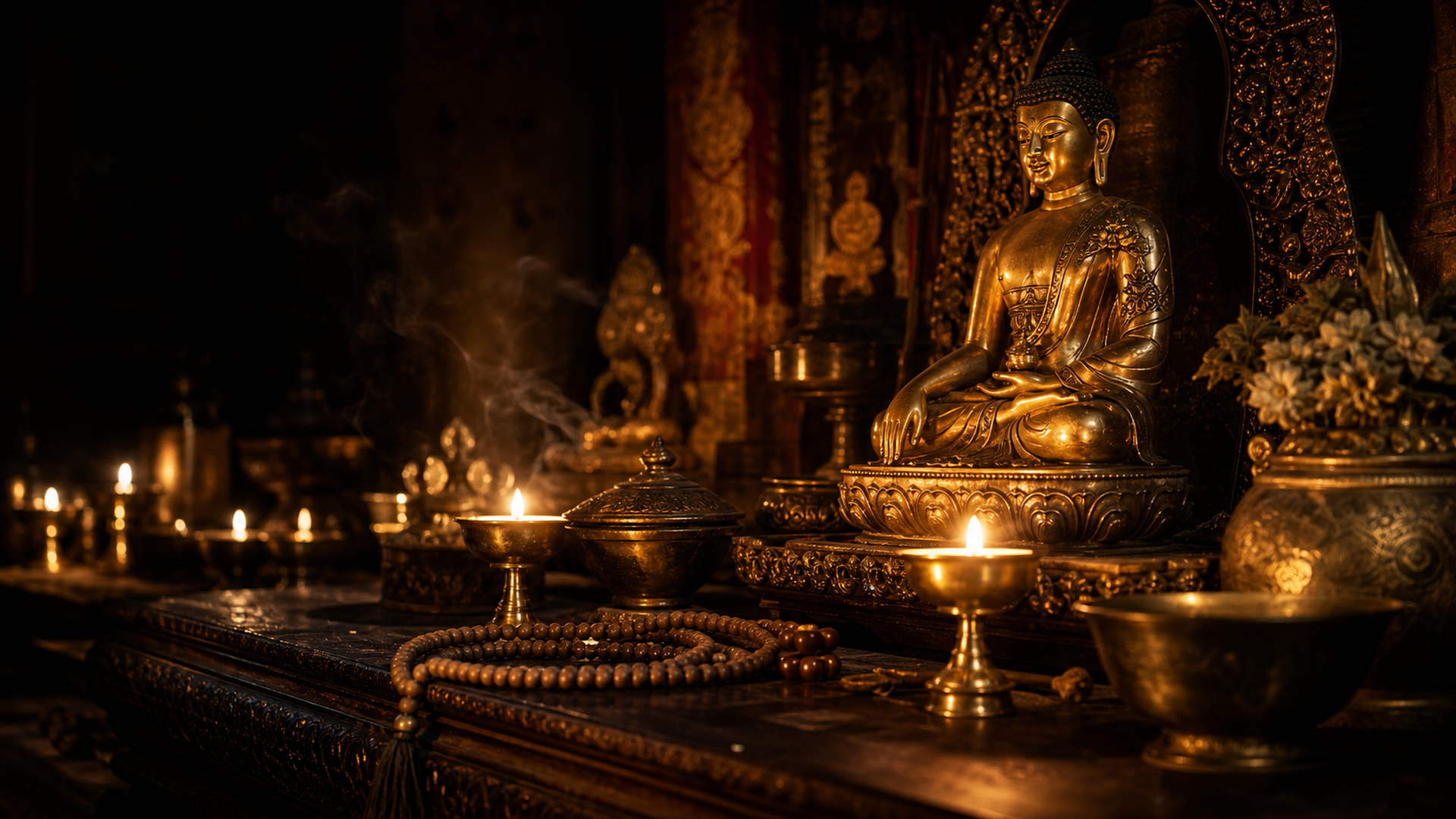
Never place it on the floor, in a bathroom, or in a location where people's feet would point toward it. When you approach the Thangka for practice, you can make traditional offerings of a candle (representing the light of wisdom), incense (representing pure ethical conduct), and a small bowl of water (representing clarity).
This creates a powerful connection and sets a sacred tone for your meditation.
The core practice involves your gaze. Begin by sitting comfortably before the Thangka. Let your eyes rest softly on the entire image, taking in the colors, composition, and presence. Then, slowly bring your focus to the central deity.
Study their face, posture, and the implements they hold. Let the image fill your awareness. As you gaze, you can recite the mantra associated with the deity. For example, if it is a Thangka of Avalokiteshvara, you would softly chant Om Mani Padme Hum.
This synergy of sight and sound deepens your connection exponentially. The final step is visualization. Imagine light of a corresponding color—white for compassion, for instance—radiating from the heart of the deity, entering your own heart, and filling your entire body.
Visualize this light purifying all negativity and bestowing the deity's enlightened qualities upon you. This is how a Thangka becomes a portal to your own inner transformation.
Common Questions About Thangka Art
Can a non-Buddhist own or use a Thangka?
Absolutely. You do not need to be a practicing Buddhist to appreciate the profound beauty and spiritual presence of a Thangka. Practitioners are drawn to them as masterpieces of sacred art. However, to unlock its deeper benefits, it is important to approach it with respect for its origins and purpose.
You can engage with it as a focus for mindfulness, a symbol of peace, or a source of inspiration. The key is to treat it not as mere decoration but as a window into a sacred tradition.
How do I properly care for my Thangka?
Thangkas are delicate and require careful handling. The mineral-based pigments are sensitive to moisture and direct sunlight, which can cause fading and cracking over time. Hang your Thangka in a dry area away from windows.
To clean it, never use water or cleaning solutions. A very gentle dusting with a soft, clean feather duster is all that is needed. If you need to store or transport it, always roll it from the bottom up with the painted surface facing inward, preferably with a thin piece of silk or acid-free paper covering the image to protect it.
The brocade border is designed to help it roll correctly.
What is the real difference between a printed and a hand-painted Thangka?
The difference is immense, both materially and spiritually. A hand-painted Thangka is the result of weeks or even months of intensive meditative practice by a trained artist using precious, traditional materials. Every brushstroke is imbued with intention and mantra.
A print is a mechanical reproduction with no spiritual investment; its value is purely decorative. The texture, depth of color, and energetic presence of a genuine painted Thangka are unmistakable once you have seen one in person.
There are so many deities. Which Thangka should I choose?
This is a wonderful question that invites self-reflection. The choice of a Thangka is deeply personal. Consider what qualities you wish to cultivate in your life right now. If you are working on developing boundless compassion, you might be drawn to Avalokiteshvara (Chenrezig).
If you seek to overcome obstacles and fear, Green Tara or the wrathful Vajrapani might call to you. To cut through confusion and increase wisdom, you might choose Manjushri. There is no wrong choice.
Trust your intuition; often, a particular deity will resonate with you for reasons you may not even consciously understand. Exploring **our extensive selection** can be a meditative process in itself, helping you discover which sacred presence aligns with your path.
What is the meaning of the silk brocade border?
The silk border, or goya, is an integral part of the Thangka. It serves several purposes. Symbolically, it is the "clothing" of the deity. Functionally, it frames the sacred image, separating the enlightened world of the painting from the ordinary, mundane world around it.
It also protects the painted surface and allows the Thangka to be rolled for storage without damaging the art. Often, a thin silk veil, the zhal khebs or "face cover," is attached at the top.
This is draped over the image when it is not being used for active practice, as a sign of respect.
Why are authentic Thangkas so expensive?
The price of an authentic Thangka reflects the incredible investment of time, skill, and precious materials that go into its creation. A master artist may spend hundreds of hours on a single piece, requiring a level of concentration and precision that is itself a form of advanced meditation.
The materials—hand-ground minerals, pure gold, and high-quality canvas and silk—are also costly. You are not simply buying a painting; you are commissioning a sacred object, supporting a master artist, and helping to preserve a vital and ancient spiritual tradition.
Your Next Step on the Path
You have now journeyed from the nomadic plains of ancient Tibet to the intricate symbolism of the enlightened mind. You understand that a Thangka is more than art—it is a tool for transformation, a companion for your spiritual practice, and a sacred presence in your home.
It is a map, and you are the traveler. The intellectual understanding is the first step, but the true journey begins when you connect with an image that speaks directly to your heart.
This is your invitation to move from learning to experiencing. The path to finding the right Thangka is a practice of mindfulness in itself. It requires you to look not only with your eyes, but with your intuition.
It asks you to consider not what would look best on a wall, but what your spirit needs to see. Your journey into the heart of Tibetan art begins with a single, mindful glance.
We invite you to explore **the sacred imagery in our collection** and find the visual dharma that will illuminate your path forward.
Keep reading