buddhist-jewelry
Tibetan Buddhist Items: An Expert Guide (2025)
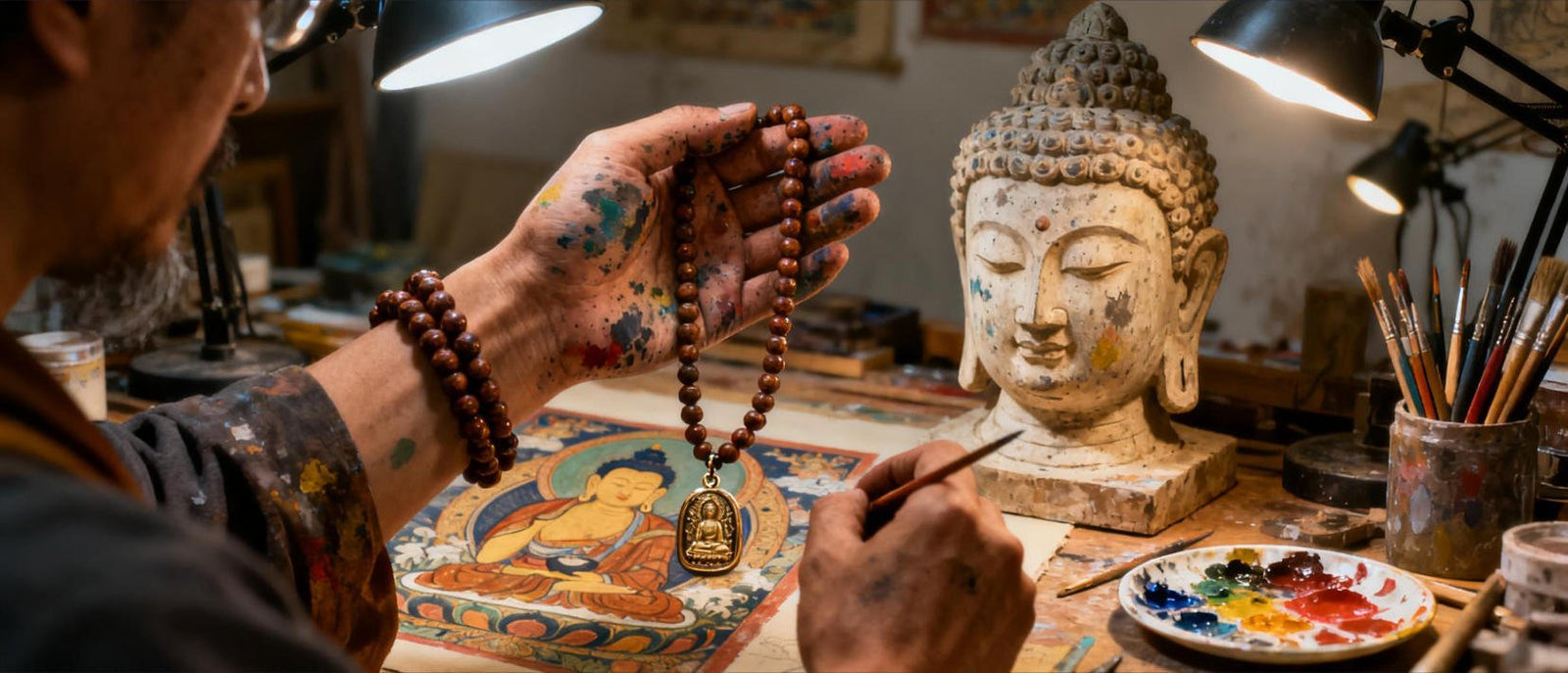
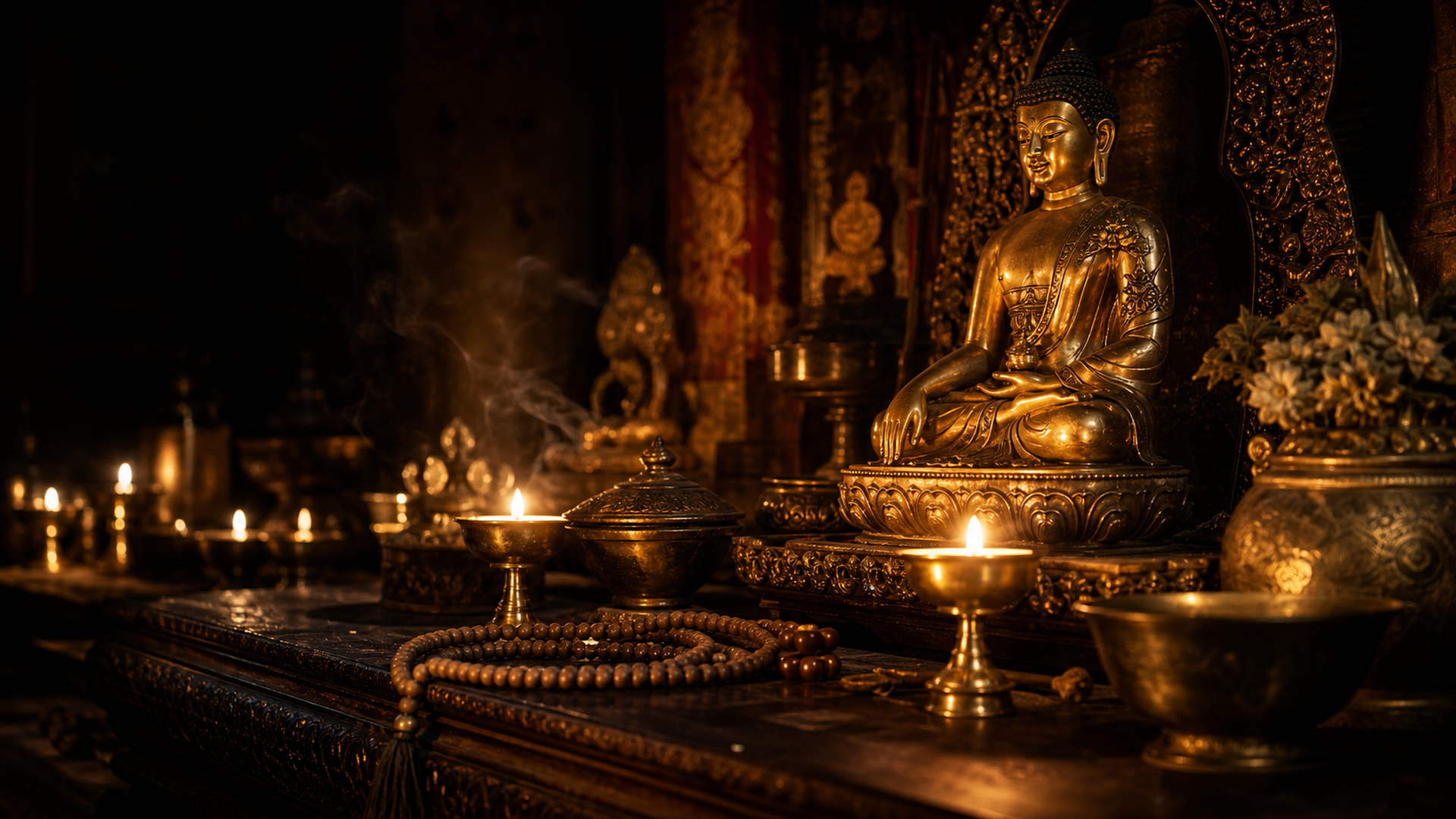
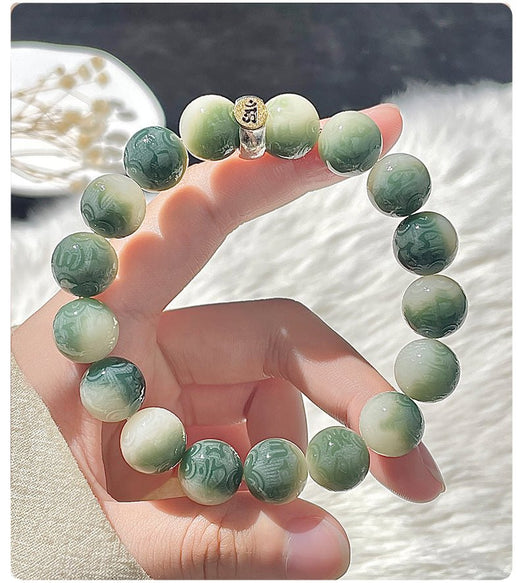
You hold the string of beads in your hand, the cool, smooth surface of bodhi seeds a grounding weight against your skin. You’ve felt a pull toward these objects for a long time—the deep, resonant hum of a singing bowl, the intricate, silent story of a thangka painting, the cyclical promise of a prayer wheel.
But a question lingers beneath the surface, a quiet whisper in your mind: “What am I really holding?” You sense a history that stretches back centuries, a meaning deeper than the surface beauty. You feel the gap between simple appreciation and true understanding.
This guide is for you. It is not only a list of items, but a bridge to their heart. It is an invitation to move beyond seeing these tools as mere artifacts and to begin experiencing them as living extensions of a profound spiritual tradition, keys to unlocking a closer part of your own practice and your own mind.

During our recent research trip, we spent an illuminating afternoon
What It Really Is: The Authentic Origins
To truly understand a Tibetan Buddhist item, you must journey back in time, over the formidable peaks of the Himalayas, to a land where spirituality was woven into the very fabric of existence. These are not objects born in a factory; they are artifacts of a rich, complex history, shaped by devotion, necessity, and the rugged landscape of Tibet.
Their story begins in earnest during the 7th century with King Songtsen Gampo, who, through his two Buddhist wives, formally introduced the Dharma to the Tibetan plateau. Yet, it was the arrival of the great master Padmasambhava (Guru Rinpoche) from the Swat Valley in the 8th century that truly ignited the flame of Vajrayana Buddhism.
He didn't just bring texts; he brought practices, rituals, and the need for sacred tools to make the esoteric teachings tangible.
The mala, or prayer beads, finds its roots in the ancient Indian japa beads, but it was in Tibet that it became an indispensable tool for accumulating mantras. Monks and lay practitioners in monasteries like Samye—the very first Buddhist monastery in Tibet, founded by Padmasambhava himself—would use malas crafted from local materials like yak bone or apricot seeds to track their recitations of powerful mantras, embedding their devotion into each bead.
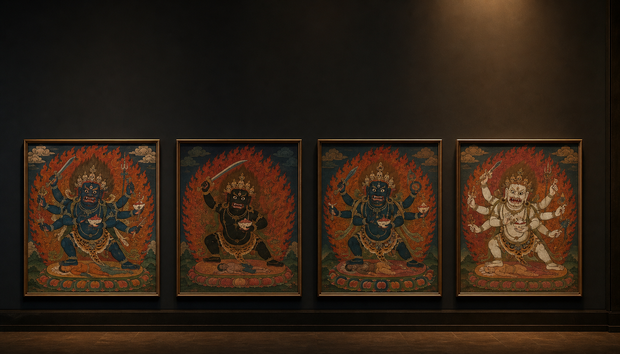
The thangka painting, a portable scroll depicting deities and mandalas, was born from the nomadic lifestyle of the Tibetan people. Monasteries were centers of learning, but teachings had to travel. Monks journeying between remote communities like those in the Kham and Amdo regions would carry these rolled-up thangkas, unrolling them to provide a visual focus for complex teachings on compassion or wisdom.
They were, and are, sacred roadmaps to enlightenment.
Other items have even older, pre-Buddhist origins. The resonant metal bowls, now known as singing bowls, are believed by many historians to have roots in the shamanistic Bön religion that predated Buddhism in Tibet.
These early bowls were likely used in healing rituals and ceremonial practices. When Buddhism flourished, this ancient sound technology was absorbed and repurposed, the resonance seen as a powerful way to clear obstacles and deepen meditative states.
Similarly, the prayer wheel, or Mani Khorlo, transformed a simple concept into a profound engine of compassion. The idea of inscribing prayers on rotating cylinders can be traced back to ancient China, but Tibetan masters saw its immense potential.
They filled the wheels with countless paper scrolls inscribed with the mantra Om Mani Padme Hum, believing that a single turn releases the same merit and blessings as reciting the mantra for every inscription inside—a powerful practice accessible to all, from the learned scholar at Ganden Monastery to the elderly pilgrim circumambulating the Jokhang Temple in Lhasa.
These items are not mere decorations; they are the accumulated wisdom of a civilization dedicated to the inner journey, each one a sign of the enduring power of the Dharma.
The Deeper Meaning: Symbolism and Spiritual Significance
Every element of a Tibetan Buddhist item is intentional, saturated with layers of meaning that speak directly to the core principles of the path. These are not only beautiful objects; they are a sophisticated symbolic language designed to awaken your mind.
When you engage with them, you are not merely holding an item, but participating in a dialogue with centuries of wisdom. The most profound of these symbols are often found in the ritual implements of Vajrayana practice: the dorje (or vajra) and drilbu (bell).
The dorje, held in the right hand, represents the indestructible, diamond-like nature of reality itself. It symbolizes upaya—skillful means, compassion, and the masculine principle. Its five upper prongs represent the five Dhyani Buddhas, while the five lower prongs represent their consorts, all emerging from a central sphere of emptiness (shunyata).
The drilbu, or bell, held in the left hand, represents prajna—wisdom, the direct realization of emptiness, and the feminine principle. Its hollow form is the void from which all phenomena arise, and its clapper is the sound of wisdom articulating that void.
When used together in ritual, the crossing of the hands holding the dorje and bell signifies the ultimate goal of the path: the indivisible union of wisdom and compassion, the non-dual state of enlightenment.
A practitioner's mala is a microcosm of the universe and the path. The traditional 108 beads are not an arbitrary number. They represent the 108 worldly afflictions (kleshas) that you must overcome.
With each repetition of a mantra, you are transforming one of these poisons into wisdom. The larger bead at the end, the guru bead or stupa, symbolizes the teacher or the state of enlightenment itself.
You do not cross over this bead; instead, you pause, reflect, and turn the mala around to continue your practice, a gesture acknowledging that the path is cyclical and continuous. The material of the mala also carries significance.
Bodhi seeds connect you to the Buddha's enlightenment under the Bodhi tree, while sandalwood calms the mind, and rudraksha seeds are associated with the powerful, transformative character of Shiva, who is revered in Tibetan Buddhism as a great yogi and protector.
Even the sound of a singing bowl is rich with symbolism. The fundamental tone is the ground of being, while the shimmering overtones that emerge are the countless manifestations of reality arising from that ground.
The sound itself is considered a representation of the primordial sound of creation, the "unstruck sound" that is the source of all existence. When you listen to a singing bowl, you are attuning your own consciousness to this fundamental harmony.
Likewise, the Endless Knot (shrivatsa), a common motif found on jewelry and ritual objects, is a visual representation of the interconnectedness of all things. It has no beginning and no end, perfectly illustrating the Buddhist doctrine of Dependent Origination (pratītyasamutpāda)—the truth that nothing exists independently.
It is a constant reminder that your actions, thoughts, and words are interwoven with the fabric of the entire universe. By understanding this language, you begin to see how our curated selection of authentic ritual items can serve as constant, potent reminders of the path.
Real Benefits for Modern Life: Beyond the Mystical
While these items are steeped in traditional teachings, their benefits are profoundly relevant to the challenges of your modern life. Their power lies in their ability to bridge the gap between abstract spiritual concepts and your lived, moment-to-moment experience.
They are not magic talismans but sophisticated tools for training your mind and nervous system, offering tangible support for your well-being.
Consider the practice of mantra recitation with a mala. In a world of constant digital distraction, your attention is fragmented. The simple, tactile act of rolling a bead between your thumb and finger with each repetition of a mantra creates a powerful kinesthetic anchor.
It engages your sense of touch, grounding you in the present moment. When your mind inevitably wanders—to a work deadline, a family concern, or a past regret—the physical sensation of the next bead in your fingers acts as a gentle, non-judgmental reminder to return to your practice.
This is not only "mindfulness"; it is a practical, neurological exercise in focus. It trains your brain to release obsessive thought loops and return to a chosen point of concentration, a skill that translates directly into greater clarity and calm throughout your day.
The singing bowl offers a different, yet equally potent, benefit. You are constantly bombarded by chaotic noise—traffic, notifications, discordant conversations. The pure, harmonic resonance of a well-crafted bowl provides an antidote. The specific frequencies produced can help entrain your brainwaves, shifting them from the busy, anxious Beta state to the relaxed, reflective Alpha state, or even the deeply meditative Theta state.
This is not only about "relaxation." It's about creating an internal environment where insight can arise. The physical resonance, when the bowl is placed on or near your body, can help release stored tension in your muscles and fascia, offering a form of somatic release that a purely mental practice might not reach.
It’s a way to literally harmonize your body and mind.
Even engaging with a visual item like a thangka or a piece of jewelry with the Endless Knot has practical effects. Contemplating the image of Chenrezig, the Buddha of Compassion, is an exercise in cultivating empathy.
By focusing on his serene expression and many arms reaching out to help all beings, you are actively priming your own mind for compassionate responses. This visual focus can be more effective than simply telling yourself to "be more compassionate." Similarly, tracing the lines of the Endless Knot with your eyes can be a powerful practice for reframing problems.
It helps you to see the interconnectedness of your challenges and resources, moving you away from a feeling of isolated struggle and toward a perspective of holistic problem-solving. These are not only passive objects of beauty; they are active partners in your personal development, helping you to embody the qualities you wish to cultivate.
When you explore our collection of handcrafted pieces, you're not only looking at jewelry; you're discovering tools for transformation. — explore our Tibetan jewelry collection for authentic pieces.

How To Spot the Real Thing: A Guide for the Conscious Seeker
In a global marketplace flooded with imitations, distinguishing an authentic, spiritually potent item from a mass-produced trinket is a crucial skill. The difference is not merely aesthetic; it is energetic. An authentic piece is created with intention, often by artisans who are themselves practitioners, and carries a palpable sense of presence and history.
A factory-made replica is spiritually inert. Your ability to discern between them is key to finding a tool that will truly support your practice.
First, pay close attention to the materials. A genuine bodhi seed mala will have beads that are slightly irregular in shape and size, bearing the unique markings of a natural product. A plastic or composite imitation will be perfectly uniform.
Run your fingers over the beads; real seeds have a distinct texture and warmth. For singing bowls, the difference is in the alloy and the sound. Traditional bowls are made from a seven-metal alloy (gold, silver, mercury, copper, iron, tin, and lead), corresponding to the seven visible planets and chakras.
A cheap brass imitation will produce a flat, short-lived "clang." A true seven-metal bowl, when struck, will sing with a deep fundamental tone and a chorus of shimmering, long-lasting harmonic overtones. The sound should feel complex and alive.
Next, examine the craftsmanship. Authenticity lies in the touch of the human hand. A hand-knotted mala will have a small, tight knot between each bead, providing the perfect spacing for mantra counting and ensuring the mala’s durability.
A mass-produced version will often be strung on a cheap, stretchy cord with no knots. Look at the details of a dorje or a small statue. Hand-cast and hand-finished pieces will have minute imperfections and a level of detail—the crispness of a deity's facial features, the precision of a pattern—that machines cannot replicate.
For thangkas, look for the subtle texture of the cotton canvas and the rich, opaque quality of mineral-based paints, which differ greatly from the flat, uniform sheen of a printed replica.
Finally, consider the source. Where and by whom was the item made? Authentic pieces often come from artisan communities in Nepal (particularly in the city of Patan, renowned for its metalworkers), Bhutan, or Tibetan settlements in India and are made by people for whom this craft is a sacred tradition passed down through generations.
When you choose an item from a source that honors these artisans, you are not only acquiring an object; you are supporting the preservation of a precious cultural lineage. Be wary of sellers with vague descriptions and impossibly low prices.
True craftsmanship takes time, skill, and high-quality materials. Investing in an authentic piece means investing in quality that will last a lifetime and an energetic integrity that will deepen, not hinder, your spiritual journey.
Viewing the full range of our artisan-made items can help you develop an eye for this level of quality and intention.
How to Use It: Integrating Sacred Tools into Your Practice
Acquiring an authentic Tibetan Buddhist item is the first step; learning to use it with respect and correct intention is what unlocks its true potential. These tools are designed to be used, not only displayed.
Integrating them into your daily life and spiritual practice transforms them from static objects into dynamic partners on your path.
Using Your Mala for Mantra: Your mala is a tool for focus and devotion. Before you begin, take a moment to set a clear intention. This could be for your own well-being, for the benefit of a loved one, or for all sentient beings.
- Hold the mala in your left hand, the hand associated with receiving wisdom. Drape the beads over your middle finger. The index finger, representing the ego, should not touch the beads; keep it extended.
- Begin with the first bead next to the large "guru" bead. Use your thumb to pull the bead towards you as you recite your chosen mantra, such as Om Mani Padme Hum.
- With each recitation, move to the next bead, pulling it towards you with your thumb. Allow the physical motion and the sound of the mantra to synchronize, creating a unified focus for your mind.
- When you complete a full circle and reach the guru bead, pause. Take a moment for gratitude and reflection. Do not cross over the guru bead. Instead, flip the mala around and continue in the opposite direction. This honors the student-teacher relationship and the continuity of practice.
Activating Your Singing Bowl: A singing bowl creates a sacred space with its sound. Find a quiet place where you won't be disturbed.
- Place the bowl in the flat palm of your open hand. Do not grip the sides with your fingers, as this will dampen the resonance.
- There are two ways to make it sing. The first is to gently strike the outside rim with the mallet (pua), creating a pure, gong-like tone. Let the sound fade completely before striking again.
- The second method is "rimming." Hold the mallet like a pen and, with firm, even pressure, rub the suede-covered side of the mallet around the outside rim of the bowl in a clockwise motion. It may take a few tries to find the right speed and pressure. Be patient. As the bowl begins to vibrate, a beautiful, complex overtone will emerge and grow in volume.
Common Questions
Can non-Buddhists use these items?
Absolutely. The universal principles of compassion, mindfulness, and wisdom are not exclusive to any single tradition. However, it is essential to approach these items with respect and a sincere intention.
Using a mala to practice mindfulness or a singing bowl to create a peaceful environment is a beautiful way to connect with these principles. The key is to use them with an appreciation for their cultural and spiritual origins, rather than treating them as mere fashion accessories or exotic decorations.
It's about appreciation, not appropriation. The intention behind the use is what matters most.
What is the deep significance of the 108 beads on a mala?
The number 108 is profoundly significant in many Eastern traditions. In Buddhism, it is most commonly said to represent the 108 types of defilements or afflictions (kleshas) that keep us trapped in the cycle of suffering.
Each recitation of a mantra on a bead is a step in purifying one of these afflictions. Other interpretations include the 108 names of the Buddha, the 108 feelings (36 related to the past, 36 to the present, and 36 to the future), or connections to sacred Vedic astronomical calculations.
Ultimately, it serves as a complete and sacred number, representing the entirety of the path you traverse in your practice.
How should I care for my sacred items?
Proper care is a form of respect. For a mala, avoid getting it wet, especially if it's made of wood or seeds. Store it in a clean, special place, like a small pouch or on an altar, not only tossed in a drawer.
If a mala breaks, it is traditionally seen not as a bad omen, but as a sign of a cycle completed or a karmic obstacle overcome. It can be respectfully restrung. Singing bowls should be wiped with a soft, dry cloth.
Avoid harsh chemical cleaners. For a thangka, never expose it to direct sunlight, which will fade the natural pigments. Store it rolled up (with the painted side facing out) and wrapped in silk when not on display.
What does the mantra "Om Mani Padme Hum" mean?
This is the mantra of Chenrezig (Avalokiteshvara), the Buddha of Compassion. It is untranslatable in a simple, literal sense, as each syllable is rich with meaning. Om is the primordial sound of the universe. Mani means "jewel" and represents the altruistic intention to become enlightened for all beings. Padme means "lotus" and symbolizes wisdom, just as a lotus grows from mud but is unstained by it. Hum represents the indivisible unity of method (jewel) and wisdom (lotus).
Reciting it is a way to invoke and cultivate boundless compassion within yourself and for the world.
Is it disrespectful to wear a mala as a necklace or bracelet?
Traditionally, in Tibet, malas are used for practice and are typically carried in the hand or in a pouch. Wearing them as jewelry is more of a modern, Western adaptation.
There isn't a strict rule against it, but the guiding principle should always be respect. If you choose to wear your mala, treat it as a sacred object, not only a fashion accessory. Take it off during activities where it might get damaged or soiled.
The key is your internal attitude: are you wearing it as a constant, mindful reminder of your spiritual path, or simply for its aesthetic appeal? The former is a beautiful extension of practice; the latter misses the point.
There are so many items. How do I know which one is right for me?
Trust your intuition. Often, you will feel a natural resonance or pull toward a particular item, symbol, or material.
This is a good starting point. Also, consider your personal intention. If you are struggling with focus and a "monkey mind," a mala for mantra practice might be most beneficial. If you are seeking to create a more peaceful home environment, a singing bowl could be the right tool.
If you wish to cultivate a specific quality like compassion or wisdom, a small statue or thangka of the corresponding deity (like Chenrezig or Manjushri) can serve as a powerful daily reminder. Your path is unique, and the right tools are the ones that genuinely support you on that journey.
Let your heart guide you as you find a piece that resonates with your path.
Your Next Step on the Path
You now hold more than an object; you hold a key. You understand that the weight of the beads, the hum of the bowl, and the gaze of the deity are not external to you.
They are reflections of the qualities already present within your own mind—your innate capacity for focus, peace, and boundless compassion. These items are not endpoints but starting points. They are invitations to begin, to deepen, and to continue your journey inward.
They are trusted companions, imbued with the blessings of a lineage that has explored the vast landscape of the human spirit for centuries.
The next step is to choose a companion for your journey—a piece that speaks to you not only aesthetically, but spiritually. An object that feels like a homecoming. Allow your intuition to guide you as you browse the entire collection.
Let this be more than a purchase; let it be a commitment to your own awakening, a tangible connection to the timeless wisdom of the Himalayas, and a beautiful reminder of the path that unfolds with every single step you take.
For deeper context on the tradition behind this practice, see Tibetan Buddhist tradition on Wikipedia.
Keep reading