buddhist-jewelry
The Healing Power of Tibetan Energy Jewelry: A Modern G
You feel the subtle hum of the city through the soles of your feet, a constant, low-grade resonance that never quite leaves your system. Your phone buzzes again with another notification, another demand on your attention.
In the quiet moments, perhaps late at night or early in the morning, you sense a disconnect—a longing for a closer anchor in a world that seems to prize the fleeting and the superficial.
It’s not a dramatic crisis, but a persistent, quiet erosion of your inner peace. You’ve tried meditation apps and mindfulness exercises, and while they help, you find the stillness slips away the moment you step back into the rush.
What you’re truly seeking is not an escape, but a bridge. A tangible connection to your inner world that you can carry with you, a quiet reminder of your intention that persists even when your focus is pulled in a thousand different directions.
This is the space where Tibetan energy jewelry finds its true purpose.

What It Really Is: An Unbroken Lineage of Sacred Art
To understand Tibetan energy jewelry, you must first release the modern, Western notion of jewelry as mere decoration. In the high plateaus of the Himalayas, adornment has always been a language of the spirit, a form of protection, and a physical intention-setting of one's connection to the Dharma.
This is not a new-age trend; it is an ancient, unbroken craft rooted in the very geography and spirituality of Tibet. Its origins are not in a single workshop but woven into the history of trade, pilgrimage, and monastic life that has defined the region for over a thousand years.
The story begins with the materials themselves, which were considered precious not only for their rarity, but for their inherent energetic properties. Turquoise, or gyu, was mined in the mountains of the Derge region in Kham and was believed to be a piece of the sky fallen to earth, a symbol of the boundless mind.
Coral, brought laboriously over treacherous trade routes from the distant sea, represented lifeblood and vitality. Amber, fossilized resin from ancient forests, was carried along the Silk Road, valued for its light and warmth. These were not simply stones; they were elements of the earth imbued with sacred potential.
The craftsmanship was developed and perfected by master artisans, most notably the Newar craftsmen of the Kathmandu Valley in Nepal. Since as early as the 7th century, these artisans were commissioned by Tibetan nobility and high lamas to create ritual objects and jewelry.
Their unparalleled skill in repoussé metalwork, filigree, and stone-setting traveled to Lhasa, Shigatse, and the great monastic centers like Sera and Ganden. There, the Newar techniques blended with Tibetan symbolism to create a unique artistic vocabulary.
You can see this fusion in the intricate silverwork of a Gau box—a portable shrine—or the precise inlay of a Dorje pendant. These were not mass-produced items but painstakingly crafted objects, each hammer strike a prayer, each polished stone a dedication.
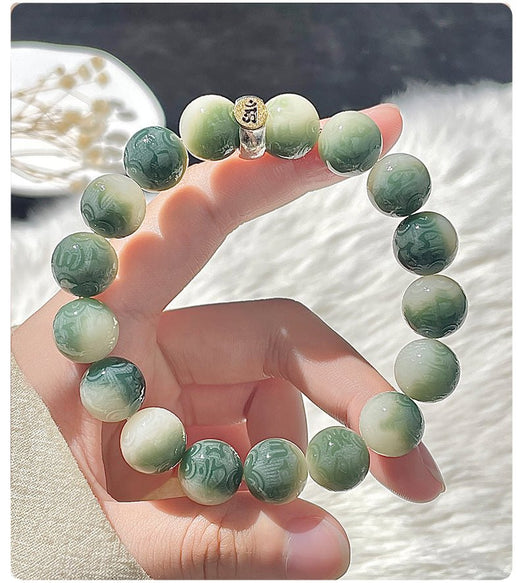
The energy of a piece comes not only from its materials, but from the focused, meditative intention poured into its creation—a tradition you can feel in every one of our sacred amulets and bracelets.
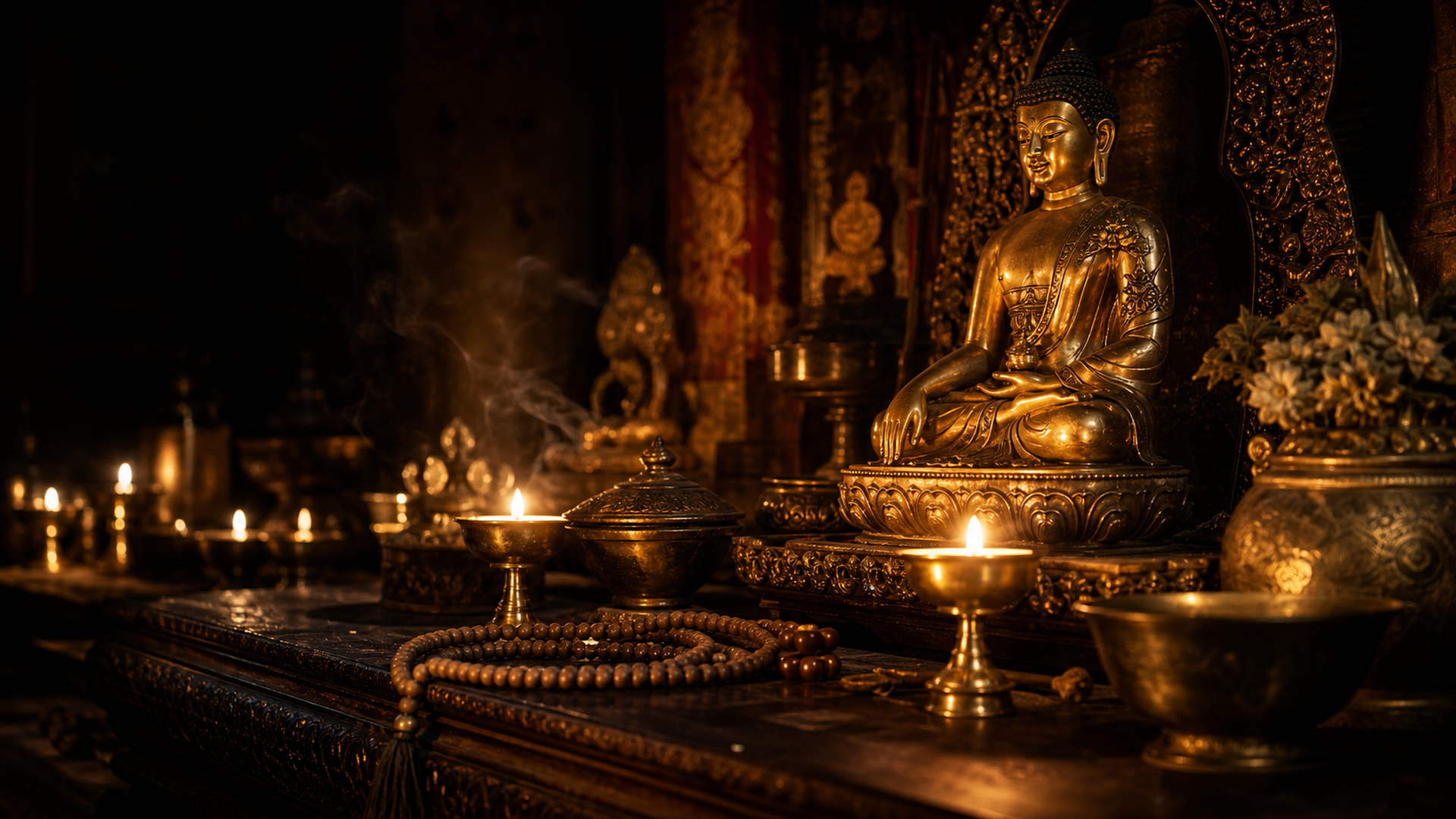
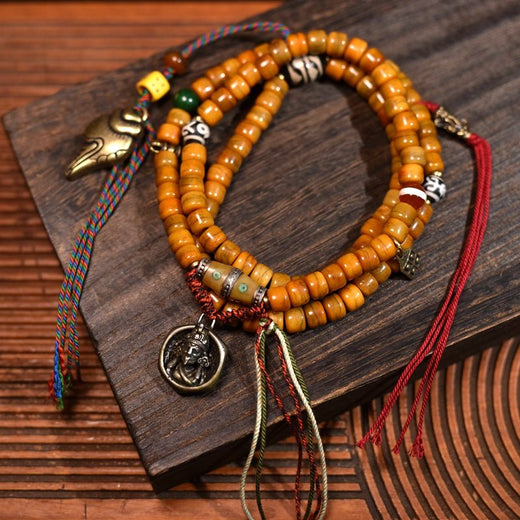
This jewelry was, and is, inextricably linked to spiritual practice. Malas (threngwa) were constructed with 108 beads for counting mantras, each bead absorbing the energy of the recitation over years of use.
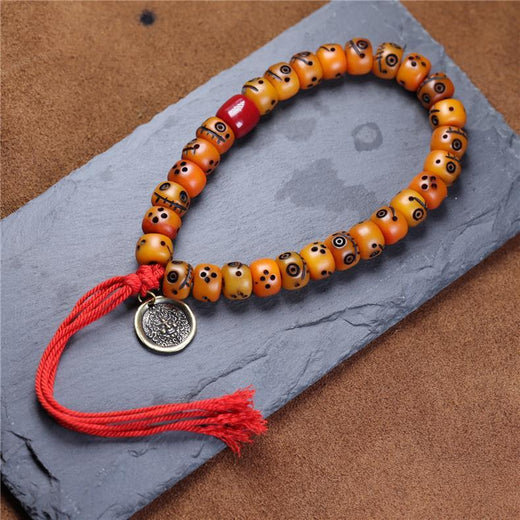
Dzi beads, etched agate stones of mysterious origin, were considered the most powerful talismans, believed to be gifts from the gods to protect the wearer from misfortune. Wearing these pieces was a public declaration of one's faith and a private source of strength, a constant, physical connection to the teachings that guided one's life.
The Deeper Meaning: Wearing Your Intention
Every element of authentic Tibetan jewelry is steeped in symbolism, designed to serve as a constant reminder of the path to enlightenment. It functions as a form of wearable Dharma, transforming a simple object into a powerful tool for mindfulness and spiritual cultivation.
When you wear a piece of this jewelry, you are not only accessorizing; you are aligning yourself with centuries of wisdom and setting a clear intention for your own journey.
Consider the core materials. Turquoise is more than a beautiful blue-green stone; it represents the calming presence of Medicine Buddha (Bhaisajyaguru) and the purification of negative karma. It’s worn to promote health, protect the wearer on journeys, and to balance the throat chakra, encouraging clear and compassionate communication.
Coral, with its deep red hue, is connected to the life force energy, or lung. It is associated with deities of power and passion, like Hayagriva or Vajrayogini, and is believed to combat depression and invigorate one's spirit.
These are not arbitrary associations but are deeply embedded in Tibetan medicine and Vajrayana cosmology.
The symbols carved, etched, or molded into the jewelry carry even more profound weight. The Vajra (or Dorje in Tibetan) is one of the most important symbols. It represents the indestructible nature of mind, the unshakeable clarity and brilliance of enlightenment itself.
To wear a Vajra is to remind yourself of your own innate Buddha-nature, the diamond-like essence that cannot be tarnished by the struggles of worldly existence. Similarly, the Endless Knot, or Shrivatsa, with its flowing, interconnected lines, symbolizes the interdependent nature of all phenomena.
It teaches the union of wisdom and compassion, and the ultimate truth that our actions and their consequences are inextricably linked. It reminds you that you are not an island, but part of a vast, interconnected web of existence.
Mantras, particularly the six-syllable mantra of Chenrezig (the Buddha of Compassion), Om Mani Padme Hum, are frequently incorporated into rings, bracelets, and pendants. Each syllable corresponds to the purification of a specific negative emotion: pride, jealousy, desire, ignorance, greed, and anger.
To wear this mantra is to carry a continuous prayer for the liberation of all beings from suffering. It becomes a focal point for your own compassion, a silent recitation that continues even when your mind is occupied.
The jewelry, therefore, ceases to be a passive object. It becomes an active participant in your spiritual practice, a touchstone that brings you back, again and again, to your deepest values and aspirations.
Real Benefits for Modern Life: Grounding in a World of Distraction
While the spiritual origins of Tibetan jewelry are profound, its benefits are incredibly practical and relevant to the challenges you face every day. Think of these pieces not as remarkable charms, but as sophisticated tools for training your mind and grounding your energy in a hyper-stimulated world.
Their power lies in their ability to act as a bridge between your inner intention and your outer actions.
One of the most immediate benefits is its role as a mindfulness trigger. How many times have you set an intention in the morning—to be more patient, to be more present—only to have it completely forgotten by lunchtime amidst a flurry of emails and obligations?
A Tibetan bracelet on your wrist or a pendant against your skin serves as a physical, sensory reminder. When you feel its weight or catch its reflection, it’s a gentle nudge, a non-judgmental prompt to return to your breath, check in with your emotional state, and reconnect with your purpose.
It breaks the cycle of unconscious reactivity, creating a small but powerful space for conscious choice.
These pieces also serve as powerful anchors for emotional regulation. When you feel a wave of anxiety, stress, or anger rising, the conditioned response is often to get swept away by it. By consciously associating your jewelry with a state of calm, you can create a new neural pathway.
In a quiet moment, hold your mala or pendant, take a few deep breaths, and recite a calming mantra or affirmation. Practice this regularly. Then, when you find yourself in a stressful meeting or a difficult conversation, simply touching the object can activate that learned response of calm.
It becomes a portable sanctuary, a way to access your inner peace without having to retreat from the world. — explore our Tibetan jewelry collection for authentic pieces.
Furthermore, Tibetan energy jewelry helps in clarifying and holding intention. The act of choosing a specific piece—perhaps one with the symbol of the Endless Knot to cultivate a sense of connection, or one with turquoise to support your journey of self-expression—is a powerful act of intention-setting.
Wearing it daily reinforces that commitment. It’s a silent declaration to yourself about what you are cultivating in your life. In a world that constantly tells you what you should want, your jewelry becomes a quiet, personal statement about what you truly value.
It helps you filter out the noise and stay aligned with your authentic path, transforming a beautiful object into a steadfast ally for your personal growth.

How to Choose Your Authentic Piece: A Guide to Conscious Selection
working through the world of Tibetan jewelry can be overwhelming, with a vast difference between authentic, spiritually resonant pieces and mass-produced imitations. Choosing the right piece for you is an intuitive process, but it should be guided by an understanding of authenticity, craftsmanship, and personal connection.
Your goal is to find a piece that not only looks beautiful but feels right and supports your spiritual journey.
First, consider the materials and craftsmanship. Authentic Tibetan jewelry often has a certain weight and feel to it. Look for high-quality, natural materials like sterling silver (often designated as 925), turquoise, coral, lapis lazuli, and amber.
Be aware that much of the "turquoise" on the market is dyed howlite or composite material. Real turquoise has natural variations in color and matrix (the dark veining). Reputable sellers will be transparent about the origin and nature of their stones.
The metalwork should show signs of human touch—slight imperfections that speak to its handcrafted nature, as opposed to the sterile uniformity of a machine-stamped item. Look for intricate details in filigree or repoussé work that indicate a high level of skill and time invested in its creation.
Next, focus on your personal resonance with the symbolism. Don't just choose a symbol because it's popular; take the time to understand its meaning. Are you working on cultivating compassion? A piece with the Om Mani Padme Hum mantra or an image of Chenrezig might be deeply supportive.
Are you seeking clarity and the strength to cut through delusion? A Dorje or a Phurba (ritual dagger) symbol could serve as a powerful reminder of that intention. Let your intuition guide you. Often, you will feel an unexplainable pull toward a particular symbol or stone.
Trust that feeling. It's an indication that the energy of the piece aligns with a quality you are seeking to cultivate within yourself. When you are exploring handcrafted Tibetan adornments, allow yourself the time to connect with the story and meaning behind each design.
Finally, inquire about the source and intention behind the jewelry. Where was it made? Who are the artisans? While not all authentic pieces are made in Tibet or Nepal anymore, it's important to choose a source that honors the tradition.
Look for brands that work directly with artisans or small cooperatives, ensuring fair compensation and a respectful continuation of the craft. Some pieces may even be blessed in monasteries, infusing them with an additional layer of sacred presence.
By choosing consciously, you not only acquire a powerful spiritual tool for yourself but also support the preservation of this ancient and sacred art form. When you feel ready, you can begin your search for a meaningful piece in our curated collection.
How to Use It: Activating Your Spiritual Tool
Once you have chosen your piece of Tibetan jewelry, the next step is to consciously integrate it into your life and practice. This is not about following rigid rules, but about building a personal relationship with the object, transforming it from something you wear into something you use.
This process of activation and regular use is what unlocks its full potential as a spiritual ally.
Your first action should be to cleanse and consecrate your new piece. This ritual clears any residual energy from its journey to you and attunes it to your specific intention. You can perform a simple cleansing by leaving the jewelry in moonlight overnight (especially during a full moon), or by gently smudging it with the smoke of sage, cedar, or a traditional Tibetan incense like juniper.
As you perform the cleansing, hold a clear intention in your mind. You might say a simple prayer or affirmation, such as, "May this object be cleansed of all previous energies and be a source of healing, clarity, and compassion for myself and all beings."
Next, you must set your intention. Sit quietly for a few moments, holding the jewelry in your hands. Close your eyes and connect with your breath. Ask yourself: What quality do I wish to cultivate with the help of this piece?
Is it patience? Is it courage? Is it a closer sense of connection? Visualize this quality filling you and infusing the jewelry in your hands. You are essentially "programming" the object with your purpose.
From this moment on, every time you touch or see it, it will remind you of this sacred intention.
Finally, engage in active daily use. If you have a mala, use it for its intended purpose: mantra recitation. Hold it in your left hand, and with your thumb, pull each of the 108 beads towards you as you recite your chosen mantra.
This practice builds a powerful energetic charge in the mala over time. For other pieces like rings or pendants, use them as mindfulness anchors. Throughout your day, make a conscious habit of touching the piece.
When you do, use it as a cue to take one deep, conscious breath. This simple, repeated action can profoundly shift your state of being, pulling you out of autopilot and back into the present moment.
By engaging with your jewelry in these ways, you embrace it not only as an adornment, but as one of the vast array of spiritual tools available to you on your path.
Common Questions About Tibetan Energy Jewelry
As you dig in deeper into the world of Tibetan spiritual adornments, questions naturally arise. Here are answers to some of the most common inquiries, helping you approach this tradition with clarity and respect.
1. Is it cultural appropriation for a non-Buddhist to wear Tibetan jewelry?
This is a thoughtful and important question. The key lies in your intention and approach. If you wear these symbols merely as an exotic fashion trend with no understanding or respect for their profound meaning, it can be seen as appropriation.
However, if you approach the jewelry with genuine respect, a desire to understand its symbolism, and an intention to use it as a tool for personal growth (such as cultivating compassion or mindfulness), it becomes an act of appreciation and cultural exchange.
The teachings of the Buddha are meant for everyone, and using these symbols to remind yourself of those universal values is a beautiful way to honor the tradition.
2. Does my jewelry need to be blessed by a monk to be effective?
While having a piece of jewelry blessed by a high lama or a monk in a monastery is a beautiful and powerful practice that adds a layer of sacred presence, it is not an absolute requirement for the piece to be "effective." The primary energy of the jewelry comes from three sources: the inherent quality of the materials, the intention of the artisan who made it, and, most importantly, your own intention and how you use it.
Your personal act of cleansing, consecrating, and regularly using the piece with a clear, positive intention is what truly activates its power in your life.
3. How should I care for my Tibetan jewelry?
You should care for it both physically and energetically. Physically, most Tibetan jewelry, especially pieces with silver, can be cleaned with a soft polishing cloth.
Avoid harsh chemical cleaners, especially on porous stones like turquoise and coral, which can be damaged by them. Store your pieces separately in a soft pouch to prevent scratching. Energetically, it's good practice to cleanse your jewelry periodically, especially if you have been through a particularly stressful time or if it feels "heavy." You can use the methods of smudging or placing it in moonlight as you did when you first received it.
4. Can I wear multiple pieces of Tibetan jewelry at once?
Yes, you absolutely can. In Tibetan culture, it is very common to see people wearing multiple rings, bracelets, and necklaces. There is no rule against combining different symbols or materials.
The key is to choose pieces that resonate with you. You might choose to wear a combination that feels balanced—for example, a turquoise piece for calm communication and a carnelian piece for courage. Trust your intuition.
If wearing multiple pieces feels empowering and harmonious to you, then it is the right choice for your practice.
5. What is the real difference between a mala and a regular beaded necklace?
The primary difference is structure and purpose. A traditional Buddhist mala has 108 beads, a "guru" bead (the larger bead at the end), and a tassel or counter beads.
The number 108 is sacred in many Eastern traditions. The mala is specifically designed as a tool for counting mantras during meditation, helping the practitioner to remain focused. While a regular beaded necklace can be beautiful, a mala is a functional spiritual tool.
Using a mala for its intended purpose builds a deep energetic connection and infuses the beads with the power of your practice over time.
6. Why are turquoise, coral, and amber so prevalent in Tibetan jewelry?
These three materials are often called the "three stones of Tibet" and hold immense cultural and spiritual significance. Turquoise (Gyu) is cherished as a sky stone, representing spiritual attainment and protection.
Coral (Churu) represents the life force and is believed to have healing properties. Amber (Pö), though not a stone, is valued for its connection to the sun, its warmth, and its purifying qualities.
Their prevalence is due to a combination of their perceived energetic properties, their historical availability through trade routes, and their deep integration into the symbolic language of Tibetan Buddhism and folk traditions.
Your Next Step on the Path
You have now journeyed through the history, symbolism, and practical application of Tibetan energy jewelry. You understand that these are not mere objects, but keys—keys that can unlock a closer connection to yourself and to a lineage of profound wisdom.
This knowledge is the first step, but the true transformation begins when you bring this practice into your own life. It starts with choosing a piece that speaks to your soul, an ally that resonates with the journey you are on right now.
This is a personal and intuitive decision, a quiet conversation between you and the sacred art.
Let this be an invitation to move from learning to experiencing. Allow yourself to feel the weight of handcrafted silver, to trace the lines of an ancient symbol, and to connect with the silent strength of a stone that has traveled from the earth to your hand.
We encourage you to begin your journey by exploring our full collection of Tibetan energy jewelry. Find the piece that is waiting to become a part of your story, a steadfast companion on your path to greater peace, clarity, and presence.
Keep reading