
buddhist-jewelry
Discover The Power Of Tibetan Empowering Bracelets
The email notification flashes again, the third in five minutes. Your shoulders feel tight, a familiar tension creeping up your neck as you stare into the blue light of the screen. The day's to-do list scrolls endlessly in your mind, a chaotic stream of demands and deadlines.
You take a breath, but it feels shallow, unable to reach the knot of anxiety in your chest. In this moment of overwhelming digital noise and internal static, your hand instinctively goes to your wrist.
Your fingers find the cool, smooth surface of the beads, their texture a grounding, physical reality.
As you roll a single bead between your thumb and forefinger, the frantic pace of your thoughts begins to slow. This simple, repetitive motion is an anchor. It doesn't erase the emails or shorten the list, but it creates a tiny pocket of space.
A pause. In that pause, you remember the intention you set this morning: patience. The bracelet is not magic, but a potent, tangible reminder of your own inner capacity for stillness. It’s a connection to a closer, quieter current that runs beneath the choppy surface of your day.
This is the true function of an empowering bracelet—not to change the world around you, but to reconnect you with the strength within you.
On our recent sourcing trip to a small, family-run workshop

What A Tibetan Bracelet Really Is
To truly understand the power of a Tibetan bracelet, you must look beyond its form as jewelry and see it as a continuation of a profound spiritual lineage. These are not mere accessories; they are tools for practice, born from the windswept plateau of Tibet and the deep meditative traditions of Himalayan Buddhism.
Their origin is not in a design studio but in the daily life of monasteries and the devotional paths of pilgrims. For centuries, monks at institutions like the Ganden Monastery, founded by the great Lama Tsongkhapa in 1409, have used 108-bead malas for counting mantra recitations.
The bracelets you see today are a direct evolution of these sacred malas, condensed into a wearable form for constant mindfulness.
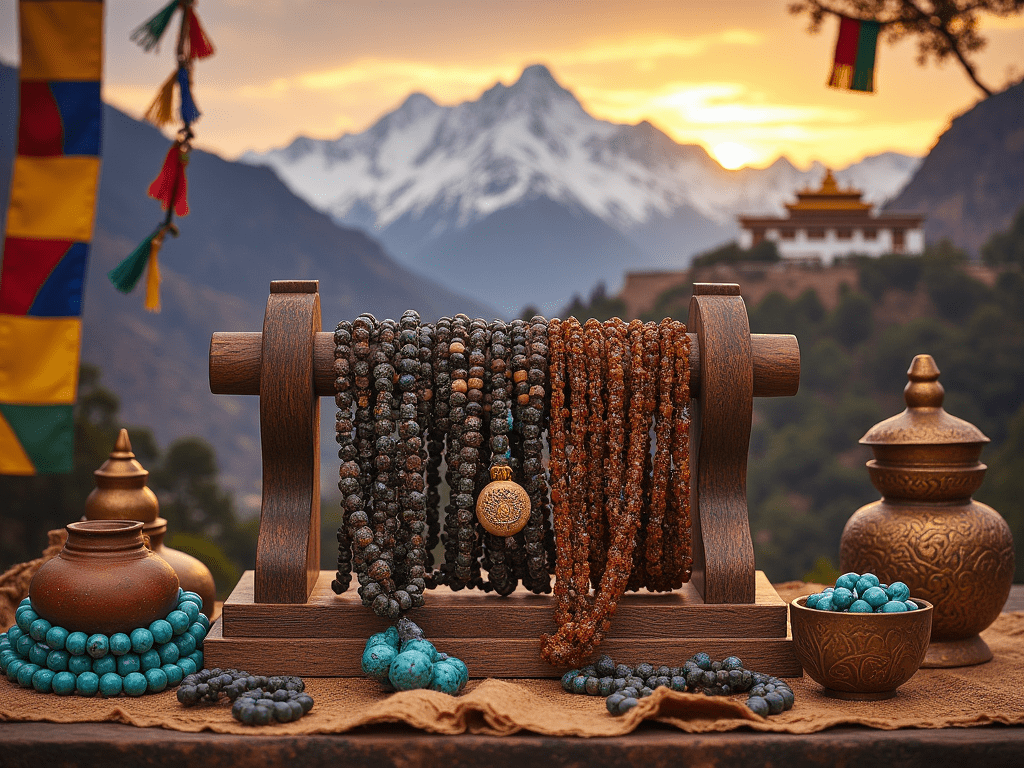
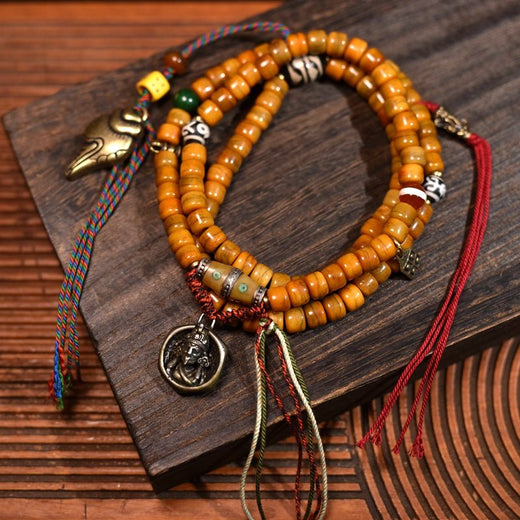
The materials themselves are steeped in history and purpose. The earliest forms were often crafted from what the rugged landscape provided. Bodhi seeds, from the same species of tree under which Siddhartha Gautama attained enlightenment, were naturally imbued with significance.
Yak bone, a common material in a region where the yak is essential for survival, became a powerful memento mori—a constant, tactile reminder of impermanence (anicca) and the preciousness of this human life.
Artisans, often practitioners themselves, would work in small workshops in places like the Barkhor circuit surrounding the Jokhang Temple in Lhasa, creating these objects not only for commerce, but as an act of devotion.
Each knot tied in the cord was often accompanied by the recitation of a mantra, infusing the object with spiritual presence from its very creation.
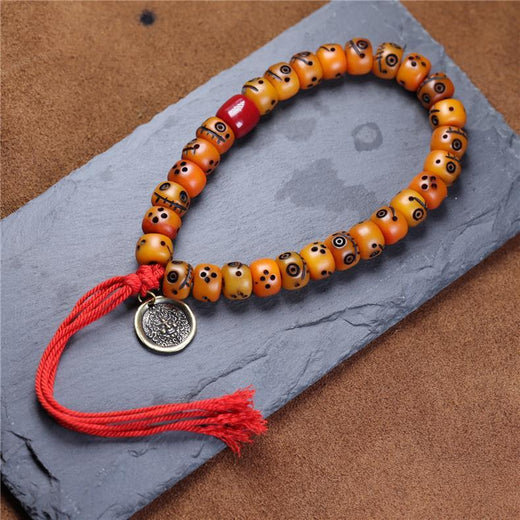
This tradition of creating sacred objects extends to the use of metals like copper, valued in traditional Tibetan medicine (Sowa-Rigpa) for its balancing properties. The famous Dzi beads, ancient agate stones with etched patterns, have a history shrouded in myth.
Tibetans believe they are not man-made but of celestial origin, offering immense protection to the wearer. The creation of these items was never separate from spiritual practice. It was a holistic process where material, intention, and craftsmanship merged.
Therefore, when you wear one, you are not only wearing beads on a string; you are carrying a piece of this sacred history, a link to the continuous stream of dharma practice that flows from the heart of the Himalayas.
The very essence of these sacred Tibetan bracelets is this unbroken connection to their monastic and devotional roots.
The Deeper Meaning Woven Into Every Bead
Every element of a genuine Tibetan bracelet is a vessel of meaning, a symbolic language that speaks directly to the core principles of the Buddhist path. It's a microcosm of the dharma that you can carry with you, a constant source of reflection and inspiration.
The circular shape itself is the most fundamental symbol: it represents the wheel of dharma, the endless cycle of existence (samsara), and the profound truth of interconnectedness. There is no beginning and no end, just as your own consciousness is part of a continuous, unbroken flow.
Holding the bracelet reminds you of this universal law.
The materials chosen are never arbitrary. As mentioned, yak bone is a direct confrontation with the truth of impermanence. In a culture that meditates on death to appreciate life, wearing it is not morbid; it is a celebration of the present moment.
It whispers, "This life is temporary and precious; use it wisely." Bodhi seeds carry the presence of enlightenment, a tangible link to the Buddha's own moment of supreme awakening. To touch a Bodhi seed is to touch a symbol of your own potential for wisdom and liberation.
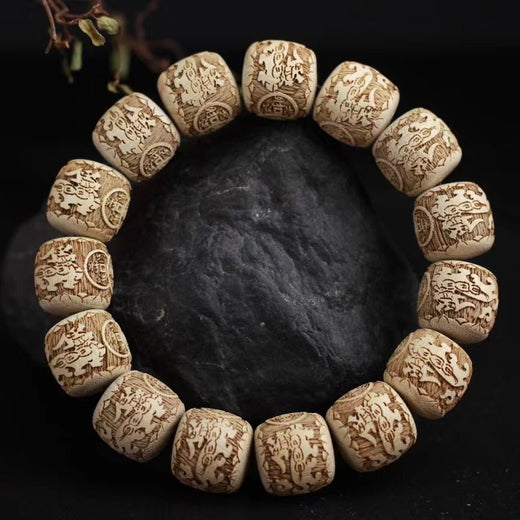
Woods like sandalwood or rosewood are chosen for their calming scents, which aid in meditation and help to pacify the mind. Their fragrance serves as a subtle, ever-present reminder to return to a state of peace.
Often, you will find specific symbols or mantras incorporated. The Endless Knot, one of the Eight Auspicious Symbols (Ashtamangala), is frequently used in the clasp or as a central bead. This intricate knot with no beginning or end represents the intertwining of wisdom and compassion, the two wings of enlightenment.
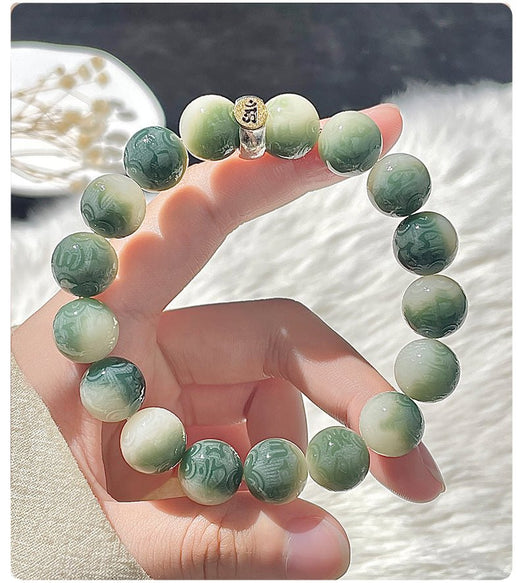
It also symbolizes the interdependent nature of all phenomena. The mantra Om Mani Padme Hum, the six-syllable invocation of Avalokiteshvara, the bodhisattva of compassion, is the soul of Tibet. When carved onto a bead or the entire bracelet, it transforms the object into a source of continuous blessing.
Each syllable has a deep meaning, purifying negative emotions and cultivating boundless compassion for all beings. This philosophy of interconnectedness and compassion is woven into every item we offer, reflecting a commitment to authentic spiritual purpose.
Real Benefits for Your Modern Life
While rooted in ancient tradition, the benefits of wearing and using a Tibetan bracelet are profoundly relevant to the challenges you face today. This is not about superstition; it is about practical, psychological, and spiritual support.
Its most immediate function is as a mindfulness anchor. In a life saturated with distractions, the simple, physical sensation of the bracelet against your skin can act as a powerful circuit breaker. When you feel your mind being pulled into a spiral of worry or distraction, the tactile sensation is a cue to return to the present.
You can consciously use it as a reminder to take one deep breath, to feel your feet on the floor, to come back to your body and out of the chaos of your thoughts.
The bracelet also becomes a potent tool for setting and holding intentions. When you first put it on in the morning, you can take a moment to hold it and dedicate your day to a specific quality—patience, compassion, focus, or strength.
Throughout the day, whenever you see or feel it, that intention is brought back to the forefront of your awareness. It's a way of actively programming your consciousness. If your intention is patience, and you find yourself in a frustrating meeting, a glance at your wrist can be the reminder you need to pause before reacting, creating a crucial space for a more skillful response.
It helps you move from a reactive state to a conscious, intentional one.
On a physiological level, the repetitive motion of rolling the beads between your fingers can have a direct calming effect on your nervous system. This is a form of self-soothing, a grounding technique that can mitigate feelings of anxiety.
It channels nervous focus into a simple, rhythmic action, helping to regulate your breathing and heart rate. Beyond these immediate benefits, wearing a Tibetan bracelet fosters a sense of connection to something larger than yourself.
It links you to a lineage of wisdom seekers who have walked the path of inner peace for millennia. This can provide a profound sense of stability and belonging, a quiet confidence that you are part of a timeless human quest for meaning, far removed from the fleeting trends and pressures of modern society.

How to Choose An Authentic Bracelet
In a market flooded with mass-produced imitations, choosing an authentic Tibetan bracelet is an act of intention in itself. Authenticity is not only about appearance; it's about the materials, the craftsmanship, and the spirit in which the object was created.
Your first guide should be the materials. Learn to recognize the difference between genuine and synthetic. Real Bodhi seeds, for example, have unique, subtle variations in color and texture; plastic imitations are often unnaturally uniform.
Yak bone has a certain porous quality and a satisfying weight that plastic cannot replicate. Natural stones like turquoise or coral will have imperfections and variations, which are marks of authenticity, not flaws.
Pay close attention to the craftsmanship. A genuinely handcrafted bracelet will show signs of human touch. The knots between beads might be slightly irregular, a sign of being tied by hand. Mass-produced items often use cheap, stretchy elastic cord that breaks easily, whereas traditionally made bracelets are strung on durable, multi-ply thread, knotted for strength and longevity.
This careful, patient construction is part of the bracelet's embedded character. When you explore an authentic collection of handcrafted pieces, you'll notice this quality immediately. The object feels substantial and alive in your hand, not flimsy or inert.
Consider the source. True Tibetan bracelets are made by artisans who understand their spiritual significance. They are often created in communities in Tibet, Nepal, or India where these traditions are preserved. By choosing a bracelet from a reputable source that honors these artisans, you are not only acquiring a meaningful spiritual tool but also supporting the continuation of a sacred craft.
Finally, trust your own resonance. When you look at different bracelets, one will often call to you. It might be the color, the feel of a particular bead, or an inexplicable sense of connection.
This intuition is a valid guide. The right bracelet for you is the one that feels like an ally on your personal journey, an object that resonates with the intention you wish to cultivate in your life.
How to Use Your Bracelet for Inner Strength
Once you have chosen your bracelet, its true power is unlocked through your interaction with it. This begins with a small ritual of consecration. When you first receive your bracelet, don't just put it on.
Find a quiet moment. Hold it in both hands and take a few deep breaths. Close your eyes and connect with your intention. What quality do you wish this bracelet to help you cultivate?
Is it compassion? Clarity? Courage? Silently or aloud, state this intention, infusing the bracelet with your personal purpose. You can visualize light filling the beads as you do this. This simple act transforms it from a beautiful object into your personal spiritual tool.
On a daily basis, use your bracelet as a mindfulness bell. Let it be a physical, tactile cue that pulls you out of autopilot. When you wash your hands and take it off, use that moment to check in with your breath.
When you put it back on, reaffirm your intention for the rest of the day. If you feel stress rising, instead of fidgeting aimlessly, purposefully bring your attention to your bracelet. Roll one of the beads between your thumb and forefinger, focusing entirely on the sensation—its texture, its temperature.
Follow your breath in and out for five cycles while doing this. This micro-meditation can completely shift your mental and emotional state in under a minute.
You can also use your bracelet for a simple mantra practice, even though it is not a full 108-bead mala. Hold the bracelet in your left hand (the receiving hand in many traditions). Starting with the bead next to the central "guru" bead or charm, use your thumb to gently pull each bead towards you as you recite a mantra, such as Om Mani Padme Hum.
Move from one bead to the next until you have completed the circle. This practice focuses the mind, builds positivity, and deepens your connection to the bracelet's compassionate essence. Finally, treat your bracelet with respect.
It is a sacred object. When you are not wearing it, place it on a clean surface or a small cloth, never on the floor. This mindful care reinforces its significance in your life.
Common Questions About Tibetan Bracelets
Can anyone wear a Tibetan bracelet, or is it only for Buddhists?
Absolutely anyone can wear one. While these bracelets originate from Tibetan Buddhist culture, their function as tools for mindfulness, intention, and grounding is universal.
The key is not religious affiliation but respect. If you wear the bracelet with an appreciation for its cultural origins and a sincere intention to cultivate positive qualities like peace and compassion, you are using it in the right spirit.
It is a gift from a wisdom tradition, offered to anyone seeking a more conscious and centered life.
Which wrist is the correct one to wear my bracelet on?
In many Eastern traditions, the left wrist is considered the "receiving" side of the body, the side closest to the heart. Wearing the bracelet on your left wrist is thought to help you receive the positive qualities and intentions you wish to cultivate internally.
The right wrist is seen as the "projecting" side, associated with giving out intention to the world. However, there is no rigid rule. The most important factor is your own comfort and intention. Some people simply wear it on their non-dominant wrist for practical reasons.
Choose the wrist that feels right and natural for you.
What does it mean if my bracelet breaks?
A breaking bracelet is not a bad omen. In the context of Buddhist thought, it can be seen as a positive sign. It can symbolize the breaking of a cycle of negative karma or the fulfillment of the bracelet's purpose in your life.
It has absorbed the presence it was meant to and has now served its function. You can see it as a milestone. You can choose to have it re-strung, perhaps with a new intention, or you can respectfully thank it for its service and return it to the earth by burying it in a garden or a pot.
How should I cleanse my bracelet?
Because these bracelets can absorb presence from their environment and from you, it's beneficial to cleanse them periodically. There are several gentle methods. You can smudge it by passing it through the smoke of burning sage or palo santo.
You can also place it in the light of a full moon overnight or in the gentle morning sun for a short period (prolonged direct sunlight can damage some materials). Sound cleansing is also effective; place it near a singing bowl and let the resonance wash over it.
Avoid soaking it in water, especially if it contains wood, seeds, or bone.
What is the main difference between a bracelet and a full 108-bead mala?
The primary difference is function and form. A full mala is specifically designed for Japa, the practice of reciting mantras. The 108 beads are used to count the repetitions, allowing the practitioner to focus on the mantra itself rather than on counting.
A bracelet is a condensed, wearable version. While you can use it for short mantra recitations, its main purpose is to be a constant, portable reminder of your practice and intention throughout the day.
For daily life in the modern world, many find that the constant presence of a Tibetan Buddhist bracelet is a more practical and accessible tool for continuous mindfulness.
Are Dzi beads real gemstones?
Dzi beads are a unique category. They are not natural gemstones in the way a diamond or sapphire is. They are ancient agate beads that have been treated or etched with symbolic patterns.
Their origins are mysterious, with Tibetan folklore often describing them as gifts from the gods. Their immense value lies not in their geological composition but in their profound spiritual and cultural significance. They are considered to be highly protective talismans, and their worth is determined by their age, quality, and the power of the patterns they carry.
They are a profound piece of Himalayan heritage.
Your Next Step on the Path
You have now journeyed from the surface of a beautiful object to the deep, quietly striking heart of its purpose. A Tibetan bracelet is far more than an adornment; it is a companion for your inner work, a tactile piece of a timeless wisdom tradition.
It is an anchor in the storm of modern life, a quiet reminder of the strength, peace, and compassion that already reside within you. It does not offer remarkable solutions, but something far more valuable: a way to continuously reconnect with your own deepest intentions.
The journey of mindfulness is a personal one, and the tools you choose should resonate with your unique path. If you feel a connection to this lineage of practice and purpose, if you seek a tangible anchor for your daily life, then you are ready to find the bracelet that is meant for you.
This is your invitation to move from understanding to experience. Begin your journey by exploring our curated collection of empowering bracelets, each one crafted with intention and respect for its sacred origins.
Keep reading