Hot
Garbhadhatu Mandala: Meaning & Symbolism
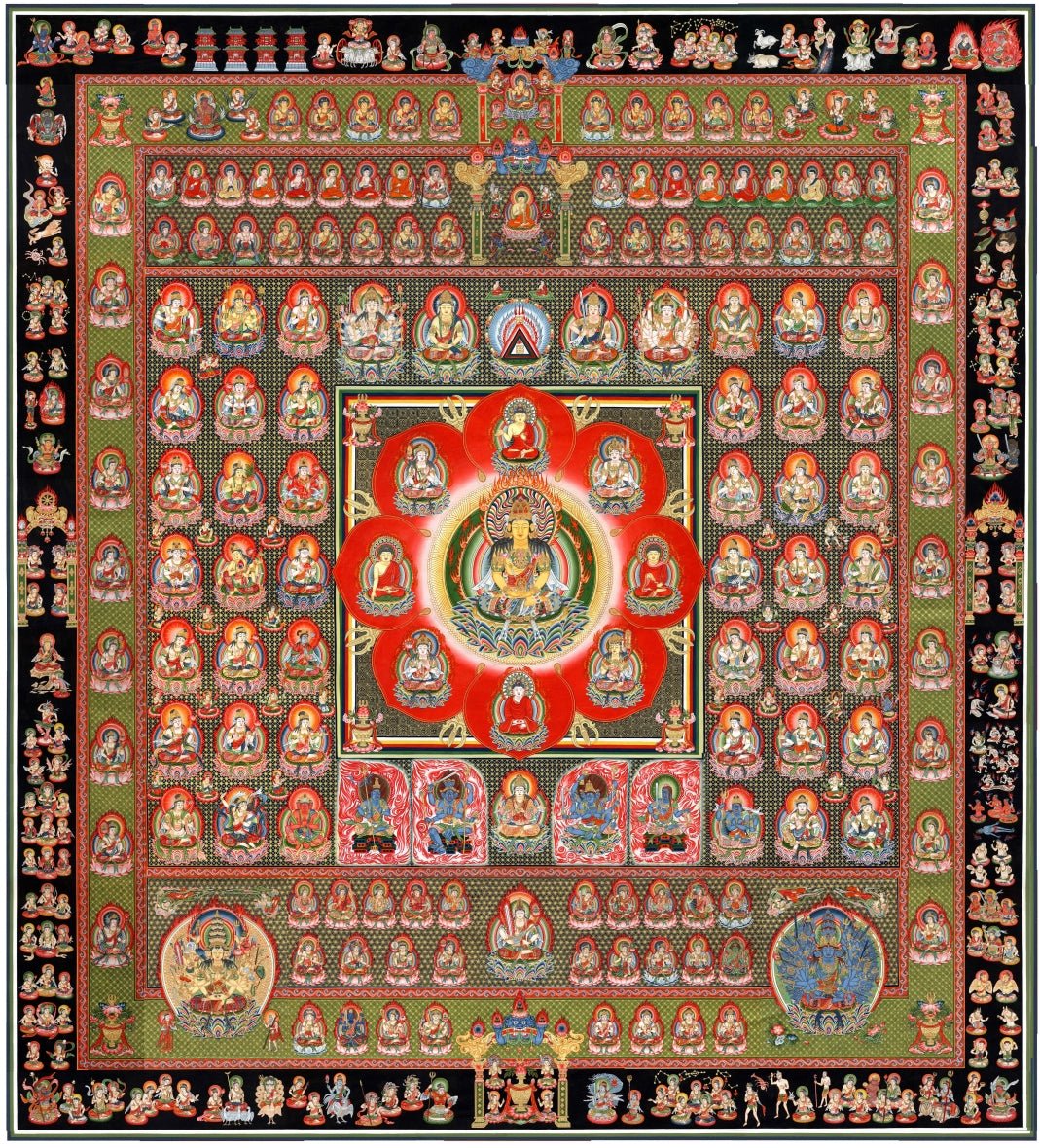
Updated July 2026. Garbhadhatu, also written Garbhadhātu, names the Womb Realm or Womb World mandala in Esoteric Buddhism. It presents Mahavairocana at the center of an eight-petaled lotus, surrounded by buddhas, bodhisattvas, guardians and symbolic forms.
What is the Garbhadhatu Mandala?
The Garbhadhatu Mandala is a visual map of the compassionate and generative dimension of awakening. It is based on the Mahavairocana Sutra and is especially prominent in Chinese and Japanese Esoteric Buddhist traditions. It is commonly paired with the Vajradhatu, or Diamond World, Mandala.
To truly understand the Garbhadhātu Mandala, you must trace its origins not to a painter’s studio, but to the heart of esoteric Buddhist revelation. Its source code lies within the pages of the Mahāvairocana Tantra, a foundational text composed in India around the 7th century. This tantra presented a revolutionary view: enlightenment is not a distant goal to be attained after countless lifetimes, but an inherent reality to be realized in this very body, in this very life. The mandala is the practical guide for that realization.
Its journey through history is a story of profound dedication. The teachings were carried from the great Indian monastic universities like Nalanda along the Silk Road. The Indian master Śubhakarasiṃha (637–735) traveled to China and, with his disciple Yixing, completed the first full translation of the tantra into Chinese in the Tang dynasty capital of Chang'an. It was here that the visual representation of the mandala began to be codified. However, its most famous transmission was carried by the Japanese monk Kūkai, who traveled to China in 804 to study these esoteric secrets. He received the full transmission and brought the teachings, along with paintings of the Garbhadhātu Mandala and its counterpart, the Vajradhātu (Diamond Realm) Mandala, back to Japan, founding the Shingon school of Buddhism.
The Womb World mandala developed from Indian Esoteric Buddhist sources and became especially important in East Asian traditions. Tibetan Vajrayana also uses mandalas centered on Vairocana and related tantric systems, but the traditions should not be treated as visually or ritually identical.
When you look at this mandala, you are not looking at a uniquely Japanese or Tibetan artifact, but at a visual dharma teaching that flowed from the heart of India and nourished the great esoteric traditions across Asia. It is a living piece of history that points directly to the timeless nature of your own mind. The intricate symbols and deities you see are not just art; they are the language of your own deepest consciousness, waiting to be understood. Contemplating them connects you to a lineage of masters who have walked this path before, each one using this map to find their way home. Discovering **sacred implements that honor this tradition** can deepen that connection in your daily life.
The Deeper Meaning: Entering the Womb of Compassion
The Garbhadhātu Mandala is not a static picture to be admired from a distance. It is an invitation. It asks you to enter, to explore, and to recognize that this entire cosmic palace is a reflection of your own mind. Its name, Garbhadhātu (胎蔵界), literally translates to "Womb Realm" or "Matrix Realm." This is the key to its profound meaning. It symbolizes the world of phenomena, the universe of causes and effects, all arising from a single, compassionate source. It is the womb where the potential for Buddhahood—your own Buddha-nature—is nurtured and brought to fruition.
At the very heart of the mandala, you find an eight-petaled lotus. This represents your own heart-mind, the seat of consciousness. Enthroned at its center is Mahavairocana Buddha (Dainichi Nyorai), the Cosmic Sun Buddha. He is not a god in a distant heaven but the ultimate principle of reality itself, the luminous ground of all being. His golden color signifies the radiant, all-pervading nature of consciousness. His gesture, the mudra of concentration, shows that this ultimate reality is found in profound stillness. The surrounding four Buddhas on the lotus petals represent the different facets of his enlightened wisdom.
From this central court, the mandala unfolds outwards through successive enclosures or "halls." Each hall is populated by a vast pantheon of deities, but these are not external beings to be worshipped. They are archetypes, personifications of the infinite qualities of your own enlightened mind.
- The Hall of Universal Knowledge: Surrounding the central lotus, you find Bodhisattvas like Avalokiteshvara (representing compassion) and Mañjuśrī (representing wisdom). They symbolize the active, engaged aspects of enlightenment that work for the benefit of all beings. Meditating on them helps you cultivate these very qualities within yourself.
- The Hall of the Wisdom Kings (Vidyārājas): In this court, you encounter fierce, wrathful-looking figures surrounded by flames. These are not demons. They are the Wisdom Kings, such as Acala (Fudō Myōō). Their fierce appearance represents the powerful, dynamic energy needed to cut through your deepest delusions, attachments, and inner obstacles. They are the embodiment of compassionate wrath, the tough love of the dharma that destroys whatever keeps you from freedom.
- The Outer Halls: The outermost courts include a host of other beings, including Hindu devas and other worldly gods who have been incorporated into the Buddhist pantheon. Their inclusion is a radical statement: enlightenment does not reject the world. It embraces and transforms every aspect of existence, recognizing all phenomena as expressions of the central, luminous consciousness of Mahavairocana.
The entire structure moves from the one to the many, from the central source to its infinite manifestations. Engaging with the mandala is a journey in reverse. You start at the periphery, with your ordinary, complex experience of the world, and you move inward. You learn to recognize the Bodhisattva of compassion in an act of kindness, the Wisdom King’s power in your resolve to break a bad habit, and ultimately, you trace all these experiences back to the single, silent, radiant source at the center of your own heart. It is a profound tool for realizing the unity of all things and recognizing your own place within this sacred matrix. The **symbols and deities found throughout our collections** are drawn from this rich iconographic tradition, serving as reminders of these inner qualities.
How to Use It: A Simple Contemplative Practice
You don't need to be an advanced practitioner in a monastery to connect with the power of the Garbhadhātu Mandala. You can begin a meaningful relationship with it through a simple, accessible contemplative practice. This practice is designed to help you internalize its structure and awaken the qualities it represents within your own consciousness. All you need is an image of the mandala—this could be a print, a digital image on a screen, or even a piece of jewelry that depicts its core elements.
Step 1: Settle Your Body and Mind
Find a quiet space where you won't be disturbed for 10-15 minutes. Sit in a comfortable but upright posture, either on a cushion or a chair. Close your eyes for a moment and take three slow, deep breaths. With each exhale, release any tension you are holding in your body. Let your mind settle. Set a simple intention for your practice: "May I connect with the peace and wisdom within me."
Step 2: The Absorbing Gaze
Open your eyes and let them rest gently on the image of the mandala. Don't try to analyze or "figure it out." For the first few minutes, simply absorb it as a whole. Notice the colors, the overall feeling of order and harmony. Let your gaze be soft and receptive, as if you were looking at a beautiful landscape. You are allowing your subconscious mind to absorb the mandala's energetic blueprint without intellectual interference.
Step 3: Journey from the Edge to the Center
Now, begin to consciously guide your attention. Start at the outermost edges of the mandala. Visually trace the lines and notice the figures in the outer courts. As you slowly move your gaze inward, through each successive hall, imagine you are letting go of the outer layers of your own identity—your daily worries, your roles, your distractions. You are on a pilgrimage, moving from the complexity of the world toward the simplicity of your essential nature.
Step 4: Rest in the Heart-Lotus
Arrive at the central eight-petaled lotus. Let your full attention rest on the figure of Mahavairocana Buddha at the very center. See this figure not as something external, but as a symbol of your own innate, luminous awareness—the part of you that is always calm, clear, and wise. Rest your attention here. Feel the qualities of profound peace and unconditional compassion radiating from this center, filling the entire mandala and filling your own being.
Step 5: Integration and Dedication
To conclude, imagine the entire mandala dissolving into pure, golden light. See this light stream from the image and absorb completely into your heart center. Feel that you have integrated its wholeness and harmony within you. Take a final deep breath. You can dedicate the merit of your practice, wishing that the peace you've cultivated may benefit all those you interact with today. This simple practice, done regularly, can create a profound shift in your daily experience.
Common Questions About the Womb Realm Mandala
Is the Garbhadhātu Mandala the same as the Kalachakra Mandala?
This is a common and important question. No, they are distinct mandalas from different tantric systems and lineages. The Kalachakra Mandala, central to Tibetan Buddhism, originates from the Anuttarayoga (Highest Yoga) Tantra class and is associated with advanced practices for achieving enlightenment within a single lifetime to avert worldly and cosmic suffering. The Garbhadhātu Mandala, as we've explored, originates from the Carya (Performance) Tantra class, specifically the Mahāvairocana Tantra. While both are profound maps of consciousness, their specific deities, structures, and associated practices are different. The Garbhadhātu focuses on cultivating enlightenment from our inherent Buddha-nature (the "womb"), while the Kalachakra has a unique focus on cycles of time and cosmology.
Do I need an initiation to meditate on this mandala?
For formal, in-depth practice within a specific esoteric lineage like Japanese Shingon, a ritual empowerment or initiation (abhisheka) from a qualified teacher is traditionally required. This ceremony formally connects the student to the lineage and empowers them to engage in the specific visualizations and mantra recitations associated with the mandala. However, you can absolutely engage with the mandala on a contemplative and inspirational level without formal initiation. You can respectfully study its symbolism, use it as a focus for mindfulness, and contemplate its universal themes of compassion, wisdom, and inner potential as a way to enrich your spiritual life.
What is the difference between the Garbhadhātu and Vajradhātu Mandalas?
They are considered a pair, representing two fundamental aspects of a single reality. The Garbhadhātu (Womb Realm) represents the world of principle, cause, and potential. It is the matrix from which enlightenment arises, symbolizing the compassionate and phenomenal aspect of the universe. The Vajradhātu (Diamond Realm) Mandala, its counterpart, represents the world of wisdom, effect, and realization. It symbolizes the indestructible, unchanging, and absolute nature of the enlightened mind. You can think of it this way: the Garbhadhātu is the fertile ground (potential), and the Vajradhātu is the diamond that is revealed from that ground (realization). Together, they form a complete picture of the esoteric path.
Why are some deities peaceful and others wrathful?
The presence of both peaceful and wrathful deities is a key feature of Vajrayana Buddhism. They represent the full spectrum of an enlightened being's activity. The peaceful deities, like Bodhisattvas, represent the gentle methods of teaching and nurturing, like a loving parent. The wrathful deities, or Wisdom Kings (Vidyārājas), are not evil or demonic. They are manifestations of fierce compassion. Their function is to overcome the most stubborn inner obstacles—deep-seated ignorance, intense craving, and powerful hatred—that cannot be pacified by gentle means. Their fire is the fire of wisdom that burns away delusion, and their weapons cut the roots of suffering. They are the embodiment of skillful, powerful, and protective energy.
Can wearing a mandala symbol as jewelry be beneficial?
Yes, it can be profoundly beneficial when approached with the right intention. Wearing a symbol of the mandala, or one of its deities, acts as a form of "recollection mindfulness." Every time you see or touch the piece, you are reminded of the sacred principles it represents. It becomes a touchstone that can bring you back to your center during a stressful day, a reminder of your own capacity for compassion in a difficult conversation, and a symbol of your commitment to your spiritual path. Choosing a piece from **an authentic collection** ensures the symbolism is accurate and respectfully rendered, making it a powerful support for your practice in daily life.
How is this mandala relevant to Tibetan Buddhism?
This is a crucial point of clarification. While the specific artistic form of the Garbhadhātu Mandala is most famously preserved and utilized in Japanese Shingon, its foundational principles are absolutely central to every school of Tibetan Buddhism. The core concepts—the universe as a manifestation of the ultimate Buddha (Mahavairocana/Samantabhadra), the idea of an innate Buddha-nature (tathāgatagarbha) within all beings, and the use of mandalas as divine abodes and maps for visualization practice—are the very heart of the Tibetan Vajrayana path. Tibetan mandalas, like the Kalachakra or Chakrasamvara, are built on these same shared principles inherited from the
For a broader visual vocabulary, see our Buddhist symbols guide. To compare related sacred art, browse Thangka pendants.
Sources and terminology
Keep reading