News
Labradorite Crystal Meaning 2026: Transformation,
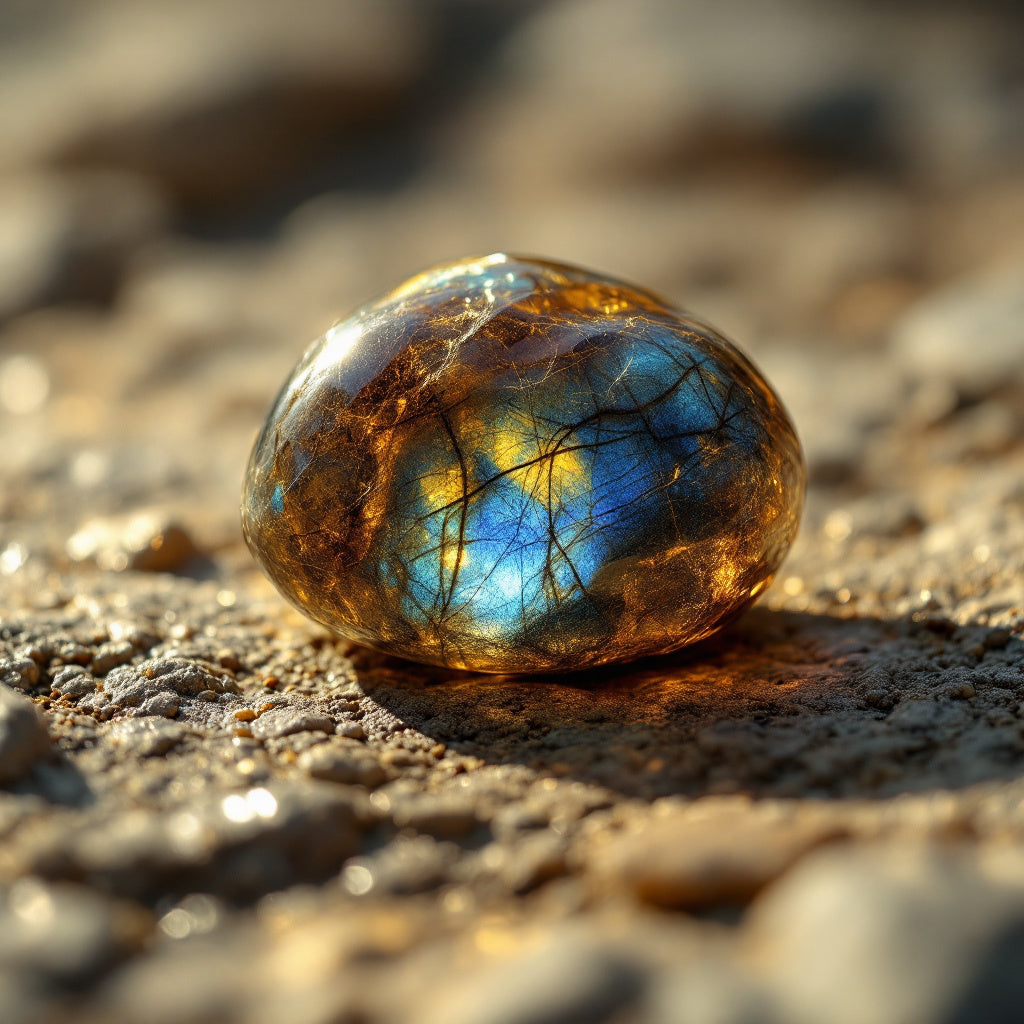
You pick it up in a shop — grey, almost dull — and then the light catches it at an angle and the whole stone ignites in blue-green fire. That moment of surprise is not a sales trick.
It is, in a very literal optical sense, the stone revealing something that was always there, invisible until conditions were right. If that sounds like a metaphor for something happening in your own life right now — a sense that something real is just beneath the surface, waiting for the right angle — you are not imagining the connection.
Labradorite has been used in contemplative traditions precisely because of that quality: the reminder that clarity is not absent, only obscured. This guide will walk you through what healing crystal collection practitioners and Tibetan Buddhist teachers actually say about this stone, how the optics work, and how you can use it practically in 2026.

What Labradorite Really Is (And What It Is Not)
Start with the rock itself, because understanding the physics actually deepens the meaning rather than flattening it.
Labradorite is a feldspar mineral, part of the plagioclase series, with the chemical formula (Ca,Na)(Al,Si)₂Si₂O₈. It was formally described by European mineralogists in 1770 after samples were collected from Paul's Island in Labrador, Canada — hence the name.
But the Inuit people of that region had their own account of the stone long before European contact. Their oral tradition held that the Northern Lights had once been trapped inside coastal rocks by an ancestral warrior who struck them with his spear, releasing most of the aurora into the sky but leaving some light permanently imprisoned in the stone.
That story, if you read it literally or symbolically, is doing the same interpretive work that Tibetan teachers do: pointing at the fact that this stone holds light inside structure.
The optical phenomenon responsible for that fire is called labradorescence, and it is worth understanding because it operates through a genuinely unusual mechanism. Inside labradorite, alternating microscopic layers of two slightly different feldspar compositions — called lamellae — are stacked at intervals of roughly 100 to 500 nanometres.
When light enters the stone, it hits these layers and undergoes a process called thin-film interference: wavelengths of light that are out of phase cancel each other out, while wavelengths that are in phase amplify.
The result is that only certain colours — most commonly blue, teal, gold, or violet — are reflected back to your eye, and the specific colour shifts as the angle of incidence changes. You are not seeing a surface coating.
You are seeing light that has penetrated into the stone's interior structure and been selectively amplified by it.
This matters for a direct reason: labradorite is not a flashy stone pretending to be deep. It is a structurally complex stone that reveals depth under the right conditions.
Now, the misconception worth breaking here. Those drawn to stone practice often treat labradorite as essentially interchangeable with moonstone — both described as "feminine," "intuitive," "lunar." This is lazy shorthand and it obscures real differences in how practitioners actually use them.
Moonstone (orthoclase feldspar) produces adularescence: a soft, billowy, milky glow that sits on or just beneath the surface. It is gentle, diffuse, internally reflective. Labradorite produces a hard, directional flash — it requires a specific angle, a specific light, a specific moment of alignment.
The experiential difference is significant. Moonstone is associated in practice with receptivity, softness, the yin quality of simply being open. Labradorite is associated with the moment of recognition — the flash of insight that arrives when conditions align.
These are related but distinct contemplative states, and conflating the stones does a disservice to both.
In Tibetan Buddhist iconography, the quality labradorite points toward is closer to what is called rigpa — the sudden, unobstructed recognition of the nature of mind — than to the softer, more sustained states moonstone tends to evoke. We will return to this when we discuss actual practice.
Geologically, the finest labradorite for contemplative use comes from three main sources: Labrador itself (producing strong blue-teal flash), Madagascar (often producing spectacular multi-colour spectral flash, sometimes called "spectrolite"), and Finland (where the term spectrolite is technically applied to the most vivid material, with flash ranging across the full visible spectrum).
Each origin produces a slightly different visual character, and experienced practitioners often develop preferences — though this reflects personal resonance rather than doctrine.
Why Labradorite Meaning Matters Specifically in 2026
There is a particular kind of exhaustion that has settled over those in their late twenties and early thirties right now. It is not the dramatic burnout of 2020-2021. It is quieter: a low-grade sense of being slightly out of sync with your own life.
You are doing the things you were supposed to do — the job, the apartment, the relationship milestones — and yet there is a persistent feeling that you are operating from a script that was handed to you rather than one you wrote.
Meditation apps help at the margins. Therapy helps. But there is something specifically disorienting about living through a period of rapid technological and social change while also trying to figure out who you actually are underneath all the noise.
This is the context in which labradorite meaning resonates so strongly right now, and it is not accidental. The stone's core symbolic territory — concealed depth, the flash of recognition, the necessity of the right angle — maps directly onto what those on a path of self-inquiry are trying to navigate.
Consider three specific scenarios that come up repeatedly:
The career crossroads. You have been in your current role for three or four years. You are competent at it. You are not miserable. But you have this recurring sense, usually at 2am or during a long commute, that you are not quite in the right place.
The difficulty is not that you lack options — it is that you cannot clearly see what you actually want underneath the layers of what you think you should want, what pays well, what your parents would approve of, what your LinkedIn profile looks like.
Labradorite, in practice, is used specifically for this kind of inquiry: not manifesting a specific outcome, but developing the clarity to see what is already true about yourself.
The relationship fog. You are in something — or recently out of something — and the question is not really about the other person. It is about your own patterns. Why do you keep choosing the same dynamic?
What are you actually afraid of? This is the territory of insight meditation, and it is the territory where labradorite has been used as a focus object in Tibetan practice since at least the 12th century: not to predict the future, but to develop the quality of seeing clearly without the distortion of habitual reactivity.
The spiritual starting point. You have done Headspace. You have done yoga. You have read one Thich Nhat Hanh book. You are genuinely curious about going deeper but the entry points feel either too commercial (crystals as aesthetic accessories) or too academic (dharma talks that assume you already know what skandhas are).
Labradorite sits at an interesting threshold here: it is visually compelling enough to hold attention, its optical properties — the flash of blue and grey light across the stone's surface — give you something concrete to contemplate, and its use in Tibetan Buddhist practice gives it a lineage that is real rather than invented.
The 2026 context adds one more layer. Artificial intelligence has made it genuinely harder to trust your own perception. When images, voices, and text can be generated at scale, the question of what is real and what is a surface effect becomes not only philosophical but practical.
The contemplative traditions that labradorite is associated with have been asking this question — what is appearance, what is reality, what is the relationship between the two — since the 8th century teachings of Padmasambhava.
That is not nothing.
We also want to be honest about what labradorite is not. It will not fix your job, your relationship, or your sense of identity. No stone will. What it can do, used with intention and in the context of an actual practice, is serve as a consistent anchor for the quality of attention you are trying to cultivate.
The stone is a tool. You are the practitioner.

How Labradorite Actually Works: Three Dimensions of Practice
1. The Optical Contemplation: Using Labradorescence as a Meditation Object
In Tibetan Buddhist practice, certain objects are used as dmigs pa — focus objects for stabilising attention. The most common are thangka paintings, butter lamps, and the tip of the nose in breath meditation.
Less formally, teachers in the Kagyu and Nyingma lineages have used naturally occurring phenomena — the movement of clouds, the surface of still water, the play of light — as objects for what is called shinay (shamatha, or calm abiding) practice.
Labradorite is particularly well-suited to a specific variation of this: the moment when the flash appears and then disappears as you shift the stone in your hand is an almost perfect physical demonstration of the teaching on impermanence and the nature of perception.
The flash is real — it is produced by actual physics — but it exists only in the relationship between the stone, the light source, and your eye. Change any one of those three variables and the flash vanishes.
This is not metaphor. This is optics. And it is also, Tibetan teachers would say, exactly how all experience works.
A simple practice: hold a piece of labradorite in natural light (morning light near a window works well). Move it slowly, very slowly, until you find the angle where the flash appears. Then hold that angle and simply look.
When the flash fades — because you moved, or the light shifted — notice the quality of that fading. Do not grasp for the flash. Do not force it back. Just observe what happened.
Do this for five minutes before your regular meditation session. Over time, this builds a felt sense of the teaching on dependent origination — that what we experience arises from conditions, not from fixed inherent qualities — in a way that is immediate and embodied rather than conceptual.
This is not a practice we invented. Rinpoche Tenzin Wangyal, a Bön teacher who has written extensively on working with natural phenomena in practice, describes using light-play as an entry point for recognising the mind's own luminous quality.
The stone is a pointer. The finger pointing at the moon is not the moon.
2. Labradorite and Intuition: The Tibetan Third-Eye Parallel
The association between labradorite and intuition is widespread in crystal healing literature, but it is usually stated without any explanation of why. Here is the actual lineage of that idea.
In Tibetan Buddhist anatomy of the subtle body, the ajna centre (the point between the eyebrows, corresponding to what Westerners call the third eye) is associated with the faculty of shes rab — often translated as "wisdom" or "discriminating awareness." This is not psychic ability in the popular sense.
It is the capacity to see through the surface of experience to its actual nature: to distinguish between what is real and what is a projection of habitual mind. The development of this faculty is central to Tibetan practice, and it is cultivated through specific forms of inquiry meditation, not through passive reception.
Labradorite's association with this centre comes from two sources: its optical quality (the flash appears suddenly, fully formed, without gradual buildup — analogous to the arising of insight rather than the gradual accumulation of information) and its colour range (blue and indigo, which in Tibetan colour symbolism are associated with the wisdom of Akshobhya Buddha — the mirror-like wisdom that reflects reality without distortion).
When you use labradorite in meditation specifically oriented toward developing clearer perception — of your own patterns, your own motivations, the gap between what you say you want and what you actually pursue — you are working in this territory.
The stone is not doing the work. Your attention is doing the work. The stone is a reminder of the quality you are trying to cultivate.
3. Transmutation: The Alchemical Quality
The third dimension of labradorite meaning is transmutation, and this one requires some care because it is the most easily romanticised.
In Tibetan Vajrayana practice, transmutation is a technical term. It refers specifically to the process of taking ordinary experience — including confusion, fear, desire, and anger — and recognising its underlying nature as wisdom.
This is not positive thinking. It is not pretending difficult emotions are actually fine. It is a rigorous practice of looking directly at experience without adding the layer of story and reaction that ordinarily obscures it.
Labradorite's role in this is as a physical analogy and anchor. The grey, unremarkable exterior of the stone that suddenly reveals extraordinary interior fire is a direct parallel to the Vajrayana teaching that ordinary mind and awakened mind are not two different things — one is the surface appearance, the other is what is revealed when you look with the right quality of attention.
This teaching appears in the Dzogchen texts as the distinction between sems (ordinary mind, with its habitual patterns) and rigpa (the recognition of mind's true nature).
Wearing or carrying labradorite as a reminder of this teaching is a legitimate use of the stone in the Tibetan context. It is not magic. It is a mnemonic device for a view you are trying to hold consistently throughout your day.
How To Spot the Real Thing Labradorite
The market for labradorite is large and not particularly regulated, which means quality varies enormously. Here is what actually matters when you are choosing a piece.
The flash test. Real labradorite produces labradorescence — that directional, internal flash — not a surface sheen. Hold the stone under a single light source (a lamp, not diffuse overhead lighting) and move it slowly.
If the colour is a consistent surface coating that looks the same from all angles, you are looking at dyed glass or a surface-treated stone. Authentic labradorite will show a flash that appears and disappears as you change angle, and the flash will seem to come from inside the stone rather than off its surface.
The grey matrix. Most genuine labradorite is primarily grey, dark green-grey, or black when not at the flash angle. If a stone is uniformly vivid blue or green at all angles, it has been treated.
Some sellers market "rainbow moonstone" which is actually white labradorite — this is a legitimate stone with its own properties, but it is not the same as classic labradorite and should be priced accordingly.
Origin transparency. Reputable sellers can tell you where their labradorite comes from. Madagascar material tends toward multi-colour flash. Finnish spectrolite, mined primarily since the 1940s, tends toward the most vivid and varied flash but is also the most expensive.
Labrador material tends toward strong blue. If a seller cannot tell you the origin, that is a flag.
Setting quality for jewelry. In labradorite jewelry, the setting matters as much as the stone because the stone needs to be oriented correctly to show its flash. A well-cut labradorite cabochon should be set so that its flash face — the angle at which the labradorescence is strongest — is visible when the piece is worn.
If you buy a pendant and the flash only appears when the pendant is held sideways, the lapidary did not orient the stone correctly. This is a craftsmanship issue, not a stone quality issue, but it affects your experience of the piece significantly.
Related: authentic crystal jewelry
Size and form for practice. For the optical contemplation practice described above, a palm stone or a loose cabochon of at least 3cm diameter works better than a small bead. For daily wear as a reminder, a pendant or ring works well.
Labradorite malas exist but are less common — the stone is relatively brittle (Mohs hardness 6-6.5) and small beads can chip with regular use. If you want a mala that incorporates labradorite's qualities, consider a mala with labradorite marker beads rather than all 108 beads in labradorite.
If you are new to working with crystals in a contemplative context, you might also find our guide to clear quartz as a foundational stone useful — clear quartz and labradorite are often used together, with quartz providing clarity of attention and labradorite providing the quality of penetrating sight.
One more note on price. A genuine, well-cut labradorite pendant from a source that can document origin and craftsmanship will typically run $45-$120 depending on size and flash quality. If you are seeing labradorite pieces at $8-$15 with vivid, consistent colour, something has been done to that stone.
An authentic labradorite piece is an investment in something you will wear for years and pass on — not a disposable accessory.

How to Actually Use Labradorite in Daily Practice
Most crystal guides either dissolve into vagueness ("set your intention and let the crystal work") or prescribe rituals that feel disconnected from real life. What follows is something you can actually use on a Tuesday morning.
Morning practice — the flash contemplation (5 minutes). Before you open your phone, hold your labradorite piece near a window. Move it slowly until you find the flash. Hold it there for three breaths.
Then ask yourself — not as a journaling prompt, just as a quiet internal question — "What am I not seeing clearly right now?" Do not force an answer. Just sit with the question for the remaining time.
This is a form of inquiry practice that Tibetan teachers call chö pa — investigation. The stone is not answering the question. Your own awareness is. The stone is just holding the space.
Wearing it with intention. If you wear labradorite jewelry, take five seconds when you put it on to remember why. Not a formal ritual — just a moment of conscious contact. "I am wearing this as a reminder to see clearly today." That is enough.
The Tibetan term for this kind of intentional object is ten — a support for practice. It works because it creates a consistent sensory cue that brings your attention back to the quality you are cultivating, the way a specific scent can bring back a memory.
The transition practice. Labradorite is particularly useful in moments of transition — the gap between finishing work and being home, the moment before a difficult conversation, the space between sleep and waking. In these liminal moments, holding the stone and taking three slow breaths while looking for the flash is a way of resetting your quality of attention before entering the next context.
You are not asking the stone to protect you. You are using it as a physical anchor for a deliberate shift in awareness.
Pairing with a mala practice. If you already have a mala practice — even a simple one of counting 108 breaths — holding a labradorite stone in your non-dominant hand while you work through the mala with your dominant hand is a traditional way of working with two objects simultaneously.
The mala counts the practice. The stone holds the quality of attention you are trying to bring to it.
Cleansing and care. Labradorite does not need elaborate cleansing rituals. Because it is relatively soft (6 to 6.5 on the Mohs hardness scale), avoid salt water as it can damage the surface over time.
Moonlight or morning sunlight for a few hours is sufficient if you feel the stone needs refreshing. More practically: wipe it with a soft cloth, store it away from harder stones that can scratch it, and re-engage with it consciously after periods of non-use.
The "cleansing" that matters most is your own renewed intention.
You might also explore how labradorite pairs with sacred geometric forms — the Flower of Life symbol in particular shares labradorite's quality of revealing hidden pattern and structure, and the two are often used together in altar arrangements.
Explore our Cat's Eye crystal mala.
Common Questions About Labradorite Meaning
Is labradorite the same as spectrolite?
Not exactly, though they are the same mineral. "Spectrolite" is a trade name originally applied specifically to the most vivid, full-spectrum labradorite found in Finland — material that shows the complete range of spectral colours (red, orange, yellow, green, blue, violet) rather than the more common blue-teal range.
Finnish spectrolite from the Ylämaa region is generally considered the finest quality labradorite in the world and commands significantly higher prices. Some sellers now use "spectrolite" loosely to mean any multi-colour labradorite regardless of origin, which creates confusion.
If you are buying something labelled spectrolite, ask specifically whether it is Finnish origin. For practice purposes, the difference is more aesthetic than functional — the flash quality matters more than the specific colour range.
Can labradorite go in water?
Short answer: occasionally, briefly, yes. Long answer: labradorite has a Mohs hardness of 6 to 6.5, which means prolonged exposure to water can eventually dull its polish, and the stone has perfect cleavage in two directions, meaning it can split along internal planes if subjected to thermal shock (sudden temperature changes between water and air).
For cleansing purposes, a brief rinse under cool running water is fine. Do not soak it, do not put it in salt water, and do not go from cold water to a warm room quickly.
For daily wear jewelry, remove labradorite pieces before swimming, showering, or washing dishes. The stone is durable enough for normal wear but it is not impervious.
What is the difference between labradorite and moonstone for meditation?
This comes up often enough that it deserves a careful answer. Both are feldspar minerals. Both produce optical phenomena through internal light interference. But the experiential quality is different and this difference matters in practice.
Moonstone produces adularescence — a soft, diffuse, floating glow that seems to move inside the stone like light through fog. It is associated in practice with receptivity, gentleness, the quality of open awareness without effort.
Labradorite produces a sharp, directional flash that requires a specific angle — associated with the sudden arising of insight, the moment of recognition, the quality of penetrating clarity. If you are working on developing softness and receptivity in your practice, moonstone may serve you better.
If you are working on clarity, discernment, and seeing through habitual patterns, labradorite is the more appropriate tool. Those on a path of self-inquiry use both, for different phases of practice.
Does labradorite need to be blessed to be effective in practice?
In Tibetan Buddhist practice, objects used as supports for practice are often blessed — this involves specific prayers, mantras, and sometimes extended ritual. The blessing is understood to orient the object toward its intended purpose and to connect it with the lineage of practitioners who have used similar objects.
A piece of labradorite blessed during a puja ceremony is, in the Tibetan view, different from an unblessed piece — not because the stone's mineral properties change, but because its function as a support for practice has been formally established.
Tibetan teachers are generally pragmatic about this: an unblessed stone used with genuine intention and consistent practice is more valuable than a blessed stone kept in a drawer. The practice is primary. The blessing supports the practice.
If you cannot access a formal blessing, your own sincere intention — stated clearly when you begin working with the stone — is a legitimate starting point.
Which chakra does labradorite correspond to?
The chakra system as commonly used in Western crystal healing is derived from Hindu tantric texts (primarily the Sat-Chakra-Nirupana, 1577 CE) filtered through Theosophical interpretation in the late 19th century. Tibetan Buddhist practice uses a related but distinct subtle body system with different energy centres.
Within the Western chakra framework, labradorite is most commonly associated with the third eye (ajna) centre and the throat (vishuddha) centre — corresponding to clarity of perception and authentic expression respectively. In the Tibetan system, the qualities labradorite supports — discriminating wisdom and the recognition of mind's nature — are associated with the channel at the crown and the heart centre, not a single point.
Both frameworks are pointing at something real. Neither is the complete picture. Use whatever framework helps you maintain a consistent practice.
Can you wear labradorite every day?
Yes, with some care. The stone is hard enough for daily wear in a protective setting — a bezel setting (where metal wraps around the stone's edge) is better than a prong setting for labradorite because it protects the edges, which are the most vulnerable to chipping.
Remove it for activities involving impact (sports, heavy manual work), for swimming, and for sleeping if you wear a ring (the stone can get caught in fabric and the setting can stress the stone over time).
A well-set labradorite pendant or bracelet worn daily for years is entirely reasonable. The more important question is if you are wearing it with intention or just as decoration — both are fine, but only one is practice.
Is labradorite associated with any specific Buddhist deity or practice?
There is no single canonical association between labradorite and a specific Tibetan Buddhist deity in the way that, say, turquoise is specifically associated with Medicine Buddha (Sangye Menla) in Tibetan iconography. However, the qualities labradorite embodies — mirror-like wisdom, the sudden arising of clarity, the recognition of what is hidden within the ordinary — align most closely with Akshobhya (Mitrugpa in Tibetan), the Buddha of the east, whose wisdom is described as mirror-like awareness that reflects reality without distortion.
His colour is blue, which corresponds to labradorite's most common flash colour. Practitioners working with Akshobhya practices sometimes use labradorite as an altar stone or a hand object during visualization. This is practitioner tradition rather than canonical instruction — but it is a coherent and legitimate association.
How long does it take to notice results from working with labradorite?
This is the most honest question and it deserves an honest answer. If you are asking whether holding a labradorite stone will produce noticeable changes in your clarity or intuition within a week, the answer is probably not — at least not in any way that you could reliably attribute to the stone rather than to the fact that you are paying more attention to your inner life because you have started a practice.
And that is actually the point. The stone is a tool for developing attention. Attention, developed consistently over weeks and months, does produce noticeable changes in how clearly you perceive your own patterns, motivations, and choices.
Practitioners who work with labradorite in the context of a regular meditation practice — even ten minutes a day — typically report noticing increased clarity in decision-making after four to eight weeks. That timeline aligns with what contemplative research (including studies at the Mind and Life Institute) suggests about the minimum duration for attention-training effects to become self-sustaining.
The stone accelerates nothing. Your practice does the work.
Your Journey With Labradorite in 2026
Here is what we have found, after years of working with these stones and those drawn to genuine practice: the moment you first see the flash is rarely the moment that matters most. The moment that matters is the third or fourth week of a morning practice, when you are holding the stone in ordinary grey morning light and the flash does not come — and you notice that you are not anxious about it.
You are just present with what is. That shift, from grasping for the flash to being easy with whatever arises, is the actual practice. The stone just held the space for it to happen.
At Buddhabelief, each piece in this collection is sourced directly from certified artisans in Nepal and Tibet, ensuring authentic craftsmanship and traditional blessing ceremonies.
2026 is a good year to start something real. Not a resolution, not a shift in identity, not a visible change. Just a practice. Something you do quietly, consistently, before the phone, before the notifications, before the day tells you who it needs you to be today.
Labradorite
Material, origin and ceremony details vary by product. Use the individual listing and request supporting records before relying on a particular workshop, artisan or temple claim.

Keep reading