
buddhist-jewelry
How to Use Meditation Beads for Mindfulness
Explore more in our Buddhist Spiritual Guide.
My meditation practice was inconsistent and frustrating until I discovered meditation beads.
I'd sit down to meditate, set a timer for 10 minutes, and within 30 seconds my mind would be planning dinner, replaying conversations, or making to-do lists. The timer felt like an eternity. I'd peek at it constantly.
Five minutes? Still eight minutes left? I was failing at something that was supposed to reduce stress.
Then a meditation teacher handed me a simple string of 27 wooden beads. She said: "Don't think about time. Just move one bead with each breath. When you reach the end, you're done."
Everything changed.
The beads gave my restless fingers something to do. They anchored my wandering mind. Each bead was a small, achievable goal. No more clock-watching. No more "am I doing this right?" Just: breathe, move bead, repeat.
That was seven years ago. I now have three sets of meditation beads—108-bead mala, 27-bead wrist mala, and a 33-bead Islamic tasbih. They're not remarkable. But they transform meditation from an abstract struggle into a concrete, tactile practice.
If you're curious about meditation beads or ready to deepen your practice, this guide will show you exactly how to use them.
Understanding Meditation Beads
Definition and Purpose
Meditation beads (also called prayer beads, counting beads, or worry beads) are a string of beads used to:
Count repetitions during meditation or prayer
Maintain focus by giving hands something to do
Track mantras or affirmations
Anchor the mind through tactile sensation
Mark spiritual practice across multiple traditions
Universal Across Traditions
Prayer beads appear in virtually every major spiritual tradition:
Buddhism: Mala beads (108, 27, or 21 beads)
Hinduism: Japa mala (108 beads)
Islam: Tasbih or Misbaha (99, 33, or 11 beads)
Christianity: Rosary (59 beads), Anglican prayer beads (33 beads)
Sikhism: Mala beads for Naam Simran
Greek Orthodox: Komboskini (100 knots)
Ancient practices: Worry beads in Greece, Turkey, Middle East
This universality suggests something fundamental: humans across cultures discovered that tactile counting aids spiritual focus.
Meditation Beads vs Mala Beads: What's the Difference?
Technical Distinction
Mala beads are a specific type of meditation beads:
| Aspect | Mala Beads | Meditation Beads (General) |
|---|---|---|
| Origin | Buddhism, Hinduism, Yoga | All spiritual traditions |
| Bead count | Typically 108 (or divisions: 54, 27, 21) | Varies: 11, 27, 33, 54, 99, 108 |
| Structure | Guru bead + tassel + 108 beads | Varies by tradition |
| Primary use | Mantra meditation (Japa) | Prayer, counting, focus |
| Religious association | Strongly Buddhist/Hindu/Yoga | Can be secular or any tradition |
Key insight: All malas are meditation beads, but not all meditation beads are malas. "Meditation beads" is the umbrella term; "mala" is specific to Buddhist/Hindu/Yoga traditions.
For detailed information on traditional mala beads specifically, see our complete mala beads guide.
When to Use Which Term
Use "mala beads" if:
- You practice Buddhism, Hinduism, or yoga
- You use 108-bead traditional format
- You're doing mantra meditation (Japa)
- You want to emphasize Eastern spiritual connection
Use "meditation beads" if:
- You want inclusive, non-denominational term
- You're using non-traditional bead count
- You practice secular mindfulness
- You want to avoid religious associations
Why 108 Beads? The Sacred Number Explained
Mathematical and Astronomical Significance
The number 108 appears throughout mathematics, astronomy, and spirituality:
Astronomical:
- Distance from Earth to Sun = 108 × Sun's diameter
- Distance from Earth to Moon = 108 × Moon's diameter
- Sun's diameter = 108 × Earth's diameter
Mathematical:
- 1⁰ × 2¹ × 3² = 108 (powers of 1, 2, 3)
- Harshad number (divisible by sum of its digits: 1+0+8=9, 108÷9=12)
- 108 = 27 × 4 = 9 × 12 (significant in many systems)
Spiritual and Cultural Meanings
Buddhism:
- 108 earthly desires (Bon-no) to overcome
- 108 defilements to be removed
- 108 Buddhist saints
- Temple bells rung 108 times on New Year's Eve (Japan)
Hinduism:
- 108 Upanishads (sacred texts)
- 108 gopis (devotees of Krishna)
- 108 names of deities (Ashtottara Shatanamavali)
- 108 sacred sites throughout India
Yoga:
- 108 energy lines (nadis) converging at the heart chakra
- 54 × 2 = 108 (54 letters in Sanskrit alphabet, masculine & feminine)
Practical reason: 108 is enough repetitions to quiet the mind but not so many that practice becomes tedious. A comfortable length for one meditation session (10-30 minutes at typical pace).
Other Sacred Numbers in Prayer Beads
27 beads: One quarter of 108, wrist mala size
33 beads: Christian/Islamic tradition, 99 names of Allah ÷ 3
54 beads: Half of 108
99 beads: Islamic tasbih (99 names of Allah)
59 beads: Catholic rosary
21 beads: Wrist mala, easier for beginners
Types of Meditation Beads by Tradition
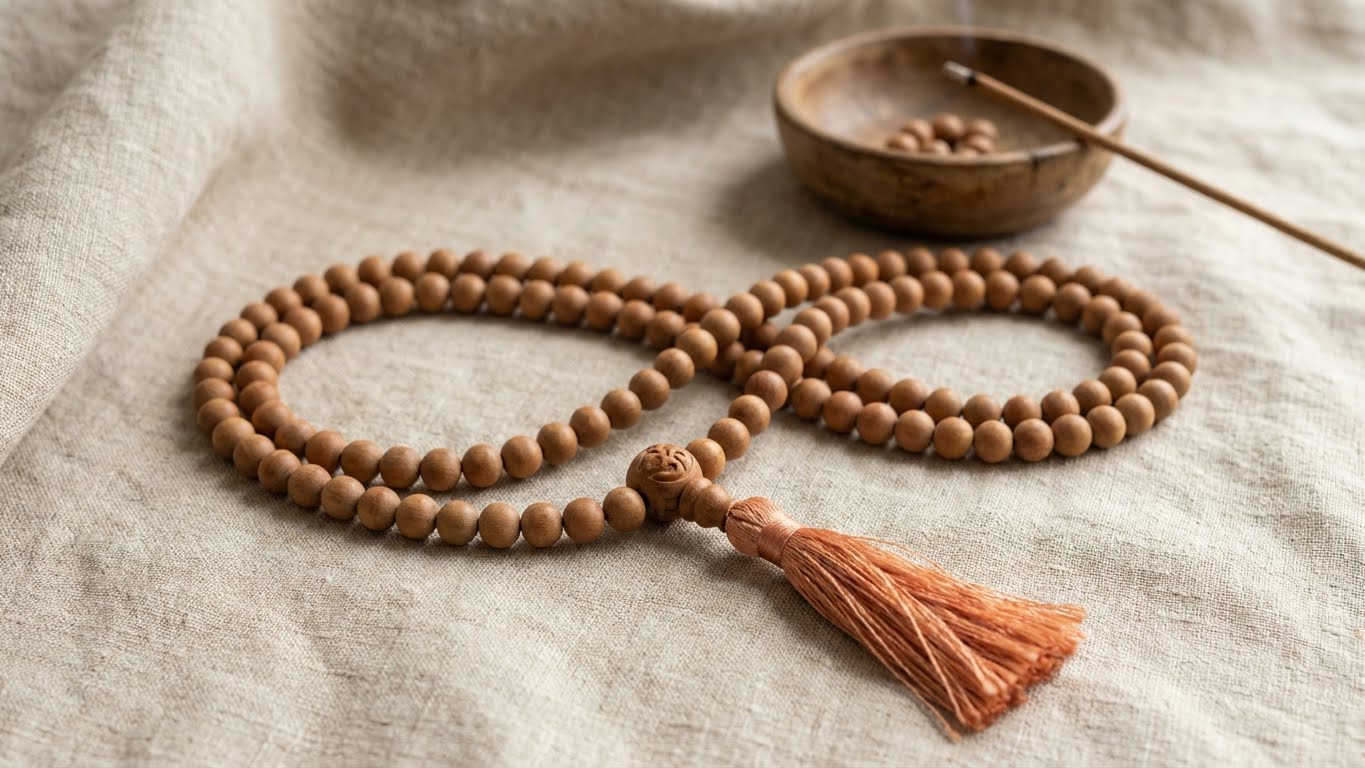
Buddhist Mala Beads (108 Beads)
Structure:
- 108 counting beads
- 1 guru bead (larger, not counted)
- Tassel or charm at the end
- Sometimes marker beads at 27 and 54
Materials: Bodhi seed, sandalwood, rosewood, rudraksha, gemstones
Used for: Mantra recitation, breath counting, mindfulness
Direction: Move away from body toward guru bead (clockwise)
Guru bead rule: Never cross over it; reverse direction when reached
Hindu Japa Mala (108 Beads)
Structure: Nearly identical to Buddhist mala
Materials: Rudraksha seeds (most traditional), tulsi wood, sandalwood, gemstones
Used for: Japa meditation (mantra repetition), especially Gayatri mantra, Om Namah Shivaya
Hand position: Held in right hand, draped over middle finger, moved with thumb
Sacred significance: Each bead represents a deity or aspect of creation
Islamic Tasbih/Misbaha (33 or 99 Beads)
Structure:
- 99 beads (99 names of Allah) or 33 beads (counted 3 times)
- Divided into three sections of 33
- May have marker beads or different colored beads
- Sometimes includes pendant charm
Materials: Olive wood, amber, pearl, coral, various gemstones
Used for: Dhikr (remembrance of Allah)
Common recitations:
- Subhan Allah (Glory to God) × 33
- Alhamdulillah (Praise to God) × 33
- Allahu Akbar (God is Greatest) × 34
Christian Rosary (59 Beads)
Structure:
- 5 decades of 10 beads each = 50 Hail Mary beads
- 5 Our Father beads (larger)
- 3 Hail Mary beads at start
- 1 Our Father bead at start
- Crucifix pendant
- Total: 59 beads + crucifix
Materials: Wood, glass, crystal, pearl, stone
Used for: Praying specific prayers in sequence
Structure: Five mysteries (Joyful, Sorrowful, Glorious, Luminous)
Anglican/Christian Prayer Beads (33 Beads)
Structure:
- 4 cruciform beads (cardinal directions)
- 4 weeks of 7 beads each = 28 beads
- 1 invitatory bead
- Total: 33 beads (Jesus's age at crucifixion)
- Cross pendant
Used for: Contemplative prayer, The Jesus Prayer, Psalms
Pattern: Structured but flexible, allows personal prayer choices
Secular/Mindfulness Meditation Beads
Modern adaptation: No religious association
Bead count: Varies (often 27, 54, or 108 for traditional feel)
Used for:
- Breath counting
- Affirmation repetition
- Anxiety management
- Mindfulness practice
- Gratitude meditation
Materials: Any natural materials, gemstones, wood
Benefit: Accessible to non-religious practitioners who want meditation structure
How to Use Meditation Beads: Step-by-Step Guide
Basic Technique for Beginners
Step 1: Choose your position
Sit comfortably with spine straight. Cross-legged on floor, chair, or meditation cushion. Relax shoulders and soften face. Close eyes or gaze downward.
Step 2: Hold the beads correctly
Drape beads over middle or ring finger of right hand. Use thumb to move beads toward you, one at a time. Index finger should not touch beads (considered disrespectful in some traditions, though not universally).
Alternative: Hold in left hand if that feels more natural. Modern practice is flexible.
Step 3: Choose your focus
Breath counting: One bead per breath cycle (inhale + exhale)
Mantra: One bead per mantra repetition
Affirmation: One bead per affirmation
Prayer: Follow your tradition's structure
Step 4: Begin at the guru bead
Start at the bead next to the guru bead (the large center bead with tassel). This is your starting point. The guru bead itself is not counted.
Step 5: Move through the beads
With each breath or mantra:
1. Say your mantra or take one breath
2. Use thumb to pull one bead toward you
3. Feel the bead pass through your fingers
4. Move to next bead
5. Repeat
Step 6: When you reach the guru bead again
Traditional rule: Do not cross over the guru bead. Instead:
- Pause and acknowledge completion of one round (108 repetitions)
- Either stop here (one round complete)
- Or reverse direction and go back the way you came
- Continue for as many rounds as desired
Modern approach: Some practitioners simply cross the guru bead and continue. Choose based on your tradition or preference.
Step 7: Close your practice
When finished:
- Hold beads to heart or third eye
- Take three deep breaths
- Offer gratitude for practice
- Slowly open eyes
Advanced Techniques
Multiple rounds: Complete 2, 3, or more full rounds (216, 324 repetitions)
Timed practice: Set timer and see how many rounds you complete
Walking meditation: Move one bead per step
Wrist mala technique: Wear 27-bead bracelet, move beads throughout day as mindfulness check-ins

Best Materials for Meditation Beads
Sacred Woods
Sandalwood:
Properties: Calming fragrance, cooling energy
Benefits: Natural aromatherapy during practice, traditionally purifying
Best for: Stress relief, emotional healing, meditation
Considerations: Fragrance fades over months (normal), avoid water
Price: $20-$80
Bodhi seed:
Significance: Buddha attained enlightenment under Bodhi tree
Properties: Rough texture, each seed unique
Benefits: Direct connection to Buddhist tradition, tactile
Best for: Buddhist practice, serious meditation
Price: $15-$60
Rosewood:
Properties: Beautiful grain, gentle fragrance, durable
Benefits: Smooth feel, natural beauty, accessible
Best for: Daily practice, beginners
Price: $15-$50
Seeds and Natural Materials
Rudraksha seeds:
Significance: "Tears of Shiva" in Hinduism
Properties: Rough, dimpled texture, organic look
Benefits: Highly sacred in Hindu tradition, said to lower blood pressure
Best for: Hindu practice, grounding
Price: $25-$100+
Lotus seed:
Significance: Lotus represents purity emerging from mud
Properties: Light brown, natural dimples
Benefits: Symbolism of spiritual growth
Best for: New beginnings, purification
Price: $20-$70
Gemstones and Crystals
Amethyst:
Meditation benefit: Third eye activation, intuition, spiritual connection
Best for: Spiritual practice, crown chakra work
Price: $30-$120
Clear quartz:
Meditation benefit: Clarity, amplification, pure energy
Best for: Any intention (programmable crystal)
Price: $25-$100
Black tourmaline:
Meditation benefit: Protection, grounding, clearing negativity
Best for: Protective meditation, energy clearing
Price: $30-$100
Rose quartz:
Meditation benefit: Heart opening, self-love, compassion
Best for: Heart chakra meditation, loving-kindness practice
Price: $25-$90
Traditional vs Modern Materials
| Traditional Materials | Modern Materials |
|---|---|
| Bodhi seed, Rudraksha, Sandalwood, Rosewood, Lotus seed | Lava stone, synthetic gemstones, glass, acrylic, silicone |
| Pros: Authentic, spiritual significance, natural energy | Pros: Durable, affordable, water-safe, variety |
| Cons: More expensive, fragile, requires care | Cons: Less authentic, may lack "soul" |
Recommendation: Start with traditional wood beads ($15-$40) for authentic experience. Upgrade to gemstones or sacred materials as practice deepens.
Choosing Your First Meditation Beads
By Experience Level
Complete beginners:
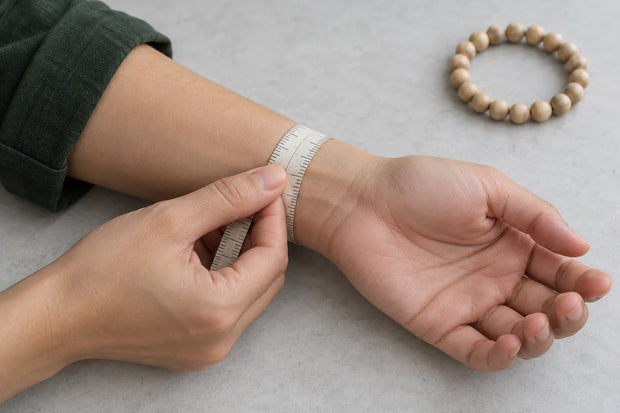
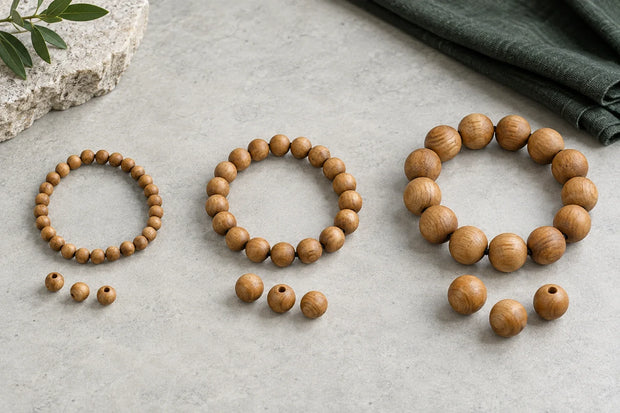
→ 27-bead wrist mala (shorter, less overwhelming)
→ Rosewood or simple sandalwood
→ $15-$30 price range
→ Focus on learning technique, not perfection
Some meditation experience:
→ 108-bead traditional mala
→ Bodhi seed or quality sandalwood
→ $30-$70 price range
→ Ready for full traditional practice
Experienced practitioners:
→ Specific gemstone for intention
→ Multiple malas for different practices
→ $70-$200+ investment pieces
→ Deep connection to practice
By Practice Type
For breath-focused meditation:
→ Simple wood beads (less distraction)
→ Smooth, uniform beads
→ 27 or 54 beads (manageable count)
For mantra meditation:
→ Traditional 108-bead mala
→ Sacred materials (bodhi, rudraksha)
→ Guru bead and tassel
For mindfulness throughout day:
→ Wrist mala (27 beads)
→ Durable materials
→ Comfortable for all-day wear
For anxiety relief:
→ Smooth beads (calming to touch)
→ Grounding stones (black tourmaline, hematite, obsidian)
→ Wrist size for accessibility
Quality Checklist
Before purchasing, verify:
✓ Bead uniformity: Consistent size unless intentionally graduated
✓ Smooth drilling: No rough edges inside holes
✓ Strong cord: Nylon or silk, knotted between beads (traditional)
✓ Secure guru bead: Larger than counting beads, firmly attached
✓ Tassel quality: If included, well-made and secure
✓ Natural materials: Real wood/stone, not plastic
✓ Appropriate weight: Substantial but comfortable
✓ Length: Full mala should fit comfortably over head when worn
Mantras and Affirmations for Meditation Beads
Traditional Sanskrit Mantras
Om Mani Padme Hum (Tibetan Buddhism):
Translation: "Behold the jewel in the lotus"
Meaning: Compassion mantra, purification, enlightenment
When to use: Cultivating compassion, general practice
Om Namah Shivaya (Hinduism):
Translation: "I bow to Shiva"
Meaning: Transformation, destruction of ego, inner truth
When to use: Personal transformation, connecting to divine
Gate Gate Paragate Parasamgate Bodhi Svaha (Buddhism):
Translation: "Gone, gone, gone beyond, gone altogether beyond, enlightenment, hail!"
Meaning: Heart Sutra mantra, letting go, transcendence
When to use: Letting go of attachments, spiritual progress
So Hum (Yoga):
Translation: "I am that"
Meaning: Unity with universe, breath awareness
When to use: Breath meditation, self-realization
Modern Affirmations
For peace:
- "I am peace"
- "Peace flows through me"
- "I choose calm"
- "Let go"
For self-love:
- "I am worthy"
- "I love and accept myself"
- "I am enough"
- "I deserve love"
For anxiety:
- "This too shall pass"
- "I am safe"
- "One breath at a time"
- "Breathe"
For gratitude:
- "I am grateful"
- "Thank you"
- "I am blessed"
- "Abundance flows"
How to Choose Your Mantra
Criteria for effective mantra:
1. Resonates emotionally: You feel something when you say it
2. Simple enough to remember: No struggling to recall words
3. Rhythmic: Flows naturally with your breath
4. Meaningful: Addresses what you need
5. Consistent: Stick with one mantra for extended period (weeks/months)
Trial period: Test a mantra for one week (7 days of practice). If it feels right, commit to it for at least 40 days to experience its full effect.
Caring for Your Meditation Beads
Daily Maintenance
After each practice:
- Store in dedicated pouch or box
- Keep in clean, elevated place (never on floor)
- Avoid bathroom or bedroom (keep sacred)
- Let sandalwood air out (don't seal immediately in bag)
Handling:
- Wash hands before practice
- Handle with reverence
- Don't let others touch your beads (absorbed your energy)
- Exception: Sharing with close family or passing down
Cleaning Physical Beads
Wood beads:
- Wipe with dry soft cloth
- No water (can damage wood)
- Natural oils from hands will polish beads
- If necessary, barely damp cloth then dry immediately
Gemstone beads:
- Wipe with soft damp cloth
- Mild soap if needed
- Dry thoroughly
- Check if specific stone is water-safe first
Cord/string:
- If fraying, have beads restrung
- Traditional: silk or nylon cord
- Knots between beads prevent all beads from falling if cord breaks
Energetic Cleansing
When to cleanse:
- New beads (clear manufacturing energy)
- Monthly for regular users
- After stressful meditation sessions
- When beads feel "heavy" or different
- After someone else touches them
Safe methods for all materials:
Smoke: Sage, palo santo, or incense
Sound: Singing bowl, bells, chanting
Moonlight: Full moon overnight (safest)
Intention: Hold and visualize white light clearing
Avoid for wood:
✗ Water cleansing
✗ Salt (can damage)
✗ Direct sunlight (can fade/dry wood)
Common Mistakes and How to Avoid Them
Beginner Mistakes
❌ Mistake: Counting the guru bead
✅ Correct: Guru bead is the marker, not counted. Stop when you reach it.
❌ Mistake: Rushing through beads to "finish"
✅ Correct: It's not a race. One bead, one breath/mantra, one moment. Quality over speed.
❌ Mistake: Getting frustrated when mind wanders
✅ Correct: Mind will wander. Each bead is a chance to return. That's the practice.
❌ Mistake: Choosing 108 beads as beginner and feeling overwhelmed
✅ Correct: Start with 27-bead mala. Work up to 108 when comfortable.
❌ Mistake: Buying expensive gemstone mala before establishing practice
✅ Correct: Start with simple wood beads ($15-$30). Upgrade as practice deepens.
❌ Mistake: Using different mantra every day
✅ Correct: Commit to one mantra for at least one week, ideally 40 days.
❌ Mistake: Treating beads carelessly (tossing on floor, letting anyone touch)
✅ Correct: Treat with reverence. They absorb your energy and deserve respect.
Explore our Rudraksha meditation mala.
Frequently Asked Questions (FAQ)
How long does it take to complete 108 beads?
Typical timeframe:
Breath counting: 10-15 minutes (one breath per bead, slow pace)
Short mantra (Om, So Hum): 12-18 minutes
Medium mantra (Om Mani Padme Hum): 15-25 minutes
Long mantra: 20-30 minutes
Factors affecting speed:
- Your natural breathing pace
- Mantra length
- How deeply you concentrate
- Level of relaxation
Important: Speed doesn't matter. Don't rush. The point is mindfulness, not completion.
Can I use meditation beads for different practices?
Yes, but with intentionality:
Best practice: Designate specific beads for specific practices:
- One mala for loving-kindness meditation
- Different mala for breath work
- Another for anxiety relief
Why separate: Beads absorb the energy of your practice. Keeping practices separate maintains clarity of intention.
If you only have one set: Cleanse energetically between different practice types, or simply accept that your beads hold all aspects of your practice.
Is there a wrong way to hold meditation beads?
Traditional rules:
In some traditions:
- Right hand only (left hand considered inauspicious)
- Middle or ring finger (never index finger)
- Move beads toward you (not away)
- Never let beads touch ground
Modern approach:
- Use whichever hand feels natural
- Hold however is comfortable
- Focus on practice, not rigid rules
Recommendation: Learn the traditional way first, then adapt as needed. Understanding tradition shows respect even if you ultimately modify it.
What if my meditation beads break?
Traditional interpretation:
Your beads absorbed negativity or spiritual obstacle meant for you. They "took the hit" and sacrificed themselves for your protection. This is actually positive—they fulfilled their purpose.
What to do:
1. Thank the beads for their service
2. Don't throw away disrespectfully
3. Options: Bury in nature, keep in special place, or repair if possible
4. Some say broken beads have completed their purpose and shouldn't be repaired
5.
Choose new beads when you feel ready
Practical view: Cords wear out, especially with daily use. A practical break doesn't invalidate the spiritual interpretation. Both can be true.
Can I wear meditation beads as jewelry?
Yes, with considerations:
Wearing as necklace:
✓ Common in yoga and Buddhist communities
✓ Keeps practice reminder close
✓ Honors sacred object
✗ Some traditions say beads are for practice only, not fashion
Wearing as wrist mala:
✓ 27-bead wrist malas designed for this
✓ Allows mini-practice throughout day
✓ Touch beads as mindfulness reminder
Guidelines if wearing:
- Treat with respect (not gym jewelry)
- Remove for inappropriate activities (same rules as pendant)
- Don't wear purely for fashion
- Understand you're wearing sacred tool
Do I need to be religious to use meditation beads?
No, but be respectful:
Secular use is valid:
- Meditation beads are tools for focus
- The technique works regardless of belief
- Modern mindfulness often uses them
- Breath counting needs no religion
Show respect by:
- Learning the history and tradition
- Not mocking or appropriating sacred symbols
- Treating beads with care
- Acknowledging cultural origins
- Using simple designs if uncomfortable with religious imagery
Consider: Many secular practitioners use simple wood beads without religious symbols. This honors the technique while respecting that you're not claiming a tradition you don't practice.
How often should I practice with meditation beads?
For beginners:
Frequency: 3-4 times per week
Duration: One round of 27 beads (5-8 minutes)
Goal: Build habit without overwhelm
For intermediate:
Frequency: Daily
Duration: One round of 108 beads (15-20 minutes)
Goal: Consistent daily practice
For advanced:
Frequency: Multiple times daily
Duration: Multiple rounds (216, 324, or more)
Goal: Deep spiritual practice
Most important: Consistency beats intensity. Better to do 5 minutes daily than 60 minutes once a week.
Can children use meditation beads?
Yes, with modifications:
Benefits for children:
- Concrete tool for abstract practice
- Calming for ADHD or anxiety
- Teaches patience and focus
- Introduces mindfulness early
Age-appropriate modifications:
Ages 5-7: 11-bead bracelet, short practice (2-3 minutes)
Ages 8-12: 27-bead bracelet, simple breath counting
Ages 13+: Full 108-bead mala if interested
Teaching tips:
- Make it fun, not forced
- Use simple language ("worry beads," "calming beads")
- Count breaths or say simple words ("peace," "calm")
- Keep sessions very short
- Celebrate small successes
What's the difference between worry beads and meditation beads?
Worry beads (Greek/Turkish komboloi):
Purpose: Stress relief, fidgeting, social tradition
Use: Casual manipulation, no specific count or prayer
Origin: Mediterranean cultures, secular
Practice: No set technique, just soothing repetitive motion
Number: Usually 17-23 beads
Meditation beads (mala, tasbih, rosary):
Purpose: Spiritual practice, meditation, prayer
Use: Specific counting, mantras, prayers
Origin: Religious/spiritual traditions
Practice: Structured technique with meaning
Number: Sacred numbers (108, 99, 33, etc.)
Overlap: Both provide tactile focus and stress relief. Worry beads are casual; meditation beads are intentional practice.
Should I buy natural or synthetic meditation beads?
Natural materials recommended:
Why natural is better:
✓ Holds energy more effectively
✓ Connects to earth and tradition
✓ Ages beautifully (develops patina)
✓ Authentic spiritual experience
✓ Supports artisan communities
Acceptable synthetic situations:
- Severe allergies to natural materials
- Budget constraints (though simple wood is affordable)
- Need for water-resistance (swimming, showering)
- Ethical concerns (avoiding endangered woods)
Compromise: Natural stone beads like quartz, amethyst, or agate are often similarly priced to high-quality synthetics and offer authentic natural energy.
Bottom line: If you can afford natural ($15-$50), choose natural. Your practice will benefit from the authentic material.

Scientific Benefits of Using Meditation Beads
Research-Backed Benefits
1. Enhances Focus and Attention
Study: Journal of Alternative and Complementary Medicine (2014)
Finding: Tactile meditation aids (like beads) improved attention span by 43% compared to meditation without aids
Mechanism: Sensory engagement keeps mind anchored in present moment
2. Reduces Anxiety
Study: BMC Complementary Medicine and Therapies (2019)
Finding: Prayer bead meditation reduced anxiety scores by 35% after 8 weeks
Mechanism: Repetitive motion activates parasympathetic nervous system (rest and digest)
3. Lowers Blood Pressure
Study: International Journal of Behavioral Medicine (2011)
Finding: Mantra meditation with beads lowered systolic blood pressure by average 11 mmHg
Mechanism: Rhythmic breathing plus tactile focus creates relaxation response
4. Improves Breath Awareness
Study: Consciousness and Cognition (2016)
Finding: Counting breaths with tactile aid increased breath awareness accuracy by 67%
Mechanism: Physical marker (bead) creates concrete feedback loop
Why Beads Work: Psychological Mechanisms
Anchoring effect: Physical object prevents mind wandering
Flow state: Repetitive motion can induce flow (optimal consciousness)
Neuroplasticity: Regular practice strengthens attention circuits in brain
Cognitive offloading: Beads handle counting, freeing mind for awareness
Pavlovian conditioning: Beads become conditioned stimulus for calm state
Your Next Steps with Meditation Beads
Ready to start your meditation bead practice?
Week 1 Action Plan:
- Get beads: Order 27-bead wrist mala or simple 108-bead rosewood mala ($15-$30)
- Choose mantra: Pick ONE simple mantra or use breath counting
- Set routine: Same time daily (morning best for consistency)
- Start small: 5 minutes (one round of 27 beads) for first week
- Track: Note practice in journal or app
- Be patient: Mind will wander—that's normal
- Celebrate: Completing one week is significant!
Month 1 Goal: Establish daily practice, even if just 5 minutes
Month 2 Goal: Increase to 10-15 minutes (full 108 beads if using traditional mala)
Month 3 Goal: Notice changes in stress, focus, emotional regulation
My meditation practice transformed when I picked up that first string of 27 beads. Not because the beads were remarkable, but because they gave my scattered mind something concrete to hold onto.
Seven years later, those beads are worn smooth from thousands of meditations. The wood has darkened from my oils. The cord has been replaced twice. They're not the same beads I started with—but neither am I the same person.
That's the real gift of meditation beads: not instant enlightenment, but a simple tool that helps you show up, day after day, breath after breath, until one day you realize you've changed.
Your practice starts with one bead. One breath. One moment.
Explore authentic meditation beads and complementary spiritual jewelry in our collection.
Begin today.
Keep reading