buddhist-jewelry
Taoist Symbols: An Authentic Meanings Guide
Taoist Symbols: Meanings, Origins & How to Work With Them Today
From intricate tattoos to minimalist pendants, Taoist symbols have woven themselves into the fabric of global spiritual and aesthetic culture. You’ve seen the Yin Yang, a perfect circle of black and white, a symbol so ubiquitous it feels universally understood.
But like the Tao itself, these symbols hold depths that popular understanding rarely touches. They are not mere decorations; they are living maps of the cosmos, keys to esoteric practices, and tools for aligning with the fundamental flow of the universe.
At Buddhabelief, we work directly with Taoist practitioners and temples in China, and we see a profound gap between the symbols' commercial use and their authentic, ceremonial meanings. This guide is our offering to bridge that gap, inviting you to explore the true power held within these ancient designs, including our curated collection of authentic Taoist jewelry.
Taoist Symbolss Origins is you’ve seen the Yin Yang, a perfect circle of black and white, a symbol so ubiquitous it feels universally understood.
The Yin Yang — Still the Most Misunderstood Symbol
The Yin Yang, or Taijitu (太極圖), is undoubtedly the most famous of all Taoist symbols. Its elegant simplicity is deceptive. The common interpretation sees it as a simple duality: good vs. evil, light vs. dark, male vs. female.
This is not only a vast oversimplification but also a fundamentally Western misunderstanding that imposes a moral binary onto a philosophy of harmony.
In authentic Taoist thought, Yin and Yang are not opposing forces in a battle for supremacy. They are complementary, interdependent, and perpetually transforming into one another. One cannot exist without the other, just as day cannot exist without night.
- Yin (陰): The black portion represents the principle of Yin. It is associated with qualities like darkness, passivity, femininity, receptivity, cold, stillness, and the Earth. It is the energy of rest, introspection, and nurturing. - Yang (陽): The white portion represents the principle of Yang. It is associated with light, activity, masculinity, creation, heat, movement, and Heaven. It is the energy of action, expansion, and outward expression.
- The S-Curve: The flowing line between them is not a straight, rigid division. It is a dynamic curve, signifying that the relationship between Yin and Yang is in constant motion. As Yang reaches its peak, Yin begins to arise, and vice versa. Think of the summer solstice, the peak of Yang, which marks the moment the days begin to shorten, giving way to Yin.
- The Dots: Perhaps the most crucial and overlooked element, the small dots of the opposite color within each section represent the seed of the other. Within the purest expression of Yang lies the potential for Yin, and within the deepest Yin is the spark of Yang. This teaches that nothing is absolute. In moments of great activity, there is a need for rest; in periods of quiet contemplation, the seeds of future action are sown.
To work with the Yin Yang is to accept the cyclical nature of life. It’s a reminder that periods of rest are as productive as periods of action, that challenges contain the seeds of growth, and that true strength lies not in choosing one side, but in harmonizing the whole.
For a closer exploration of this foundational concept, our complete guide to the Yin Yang symbol illuminates its rich history and philosophical underpinnings.
The Bagua — Eight Gates of Heaven and Earth
While the Yin Yang represents the fundamental duality, the Bagua (八卦), or "Eight Trigrams," illustrates how this duality manifests in the world. Often seen in the West as a Feng Shui tool—a map to arrange your home for optimal energy flow—its origins are far deeper.
The Bagua is a cosmological model, a divination system, and a symbolic representation of all the fundamental forces of nature.
Each of the eight trigrams consists of three lines, which can be either solid (a Yang line, ⚊) or broken (a Yin line, ⚋). These combinations create eight distinct symbols, each corresponding to a core element of reality:
- ☰ 乾 (Qián) - Heaven/The Creative: Three solid Yang lines. Represents pure creative power, the father, the sky, strength, and initiative.
- ☷ 坤 (Kūn) - Earth/The Receptive: Three broken Yin lines. Represents pure receptivity, the mother, the earth, nurturing, and yielding.
- ☳ 震 (Zhèn) - Thunder/The Arousing: A solid Yang line below two broken Yin lines. Represents sudden movement, shock, arousal, the eldest son, and growth.
- ☴ 巽 (Xùn) - Wind/The Gentle: A broken Yin line below two solid Yang lines. Represents gentle penetration, subtlety, the eldest daughter, and introspection.
- ☲ 離 (Lí) - Fire/The Clinging: A broken Yin line between two solid Yang lines. Represents light, consciousness, clarity, the middle daughter, and attachment.
- ☵ 坎 (Kǎn) - Water/The Abysmal: A solid Yang line between two broken Yin lines. Represents danger, the abyss, the deep, the middle son, and challenges.
- ☶ 艮 (Gèn) - Mountain/Keeping Still: A broken Yin line above two solid Yang lines. Represents stillness, stopping, contemplation, the youngest son, and stability.
- ☱ 兌 (Duì) - Lake/The Joyous: A solid Yang line above two broken Yin lines. Represents joy, pleasure, openness, the youngest daughter, and communication.
These trigrams are arranged in a circle in two primary ways:
- Early Heaven (先天八卦, Xiāntiān Bāguà): Attributed to the mythical sage Fuxi, this arrangement depicts the primordial, ideal state of the universe. It represents perfect balance and harmony, with opposite forces like Heaven and Earth, Fire and Water, directly facing each other. It is a map of cosmic potential.
- Later Heaven (後天八卦, Hòutiān Bāguà): Attributed to King Wen of Zhou, this arrangement depicts the call in world we live in—the world of constant change and cyclical processes. It is a map of time, seasons, and the flow of energy in our daily lives. This is the version most commonly used in Feng Shui.
To a Taoist practitioner, the Bagua is not only a diagram. It's a tool for understanding the patterns of change. By observing which trigrams are dominant in a situation, one can understand the underlying energies at play and anticipate future developments.
It is the foundational system behind the ancient divination text, the I Ching (Book of Changes). You can find a more detailed breakdown in our guide to the Bagua's meaning.

The Five Thunder Talisman — Divine Protection in Action
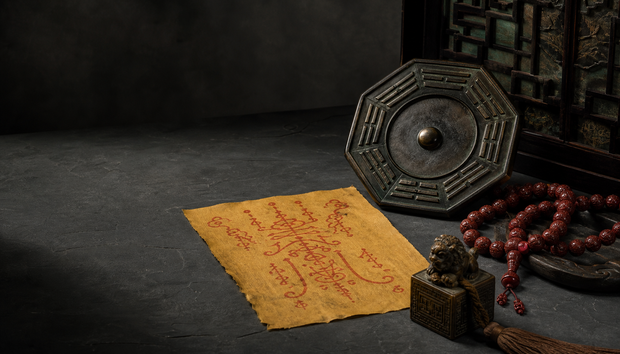
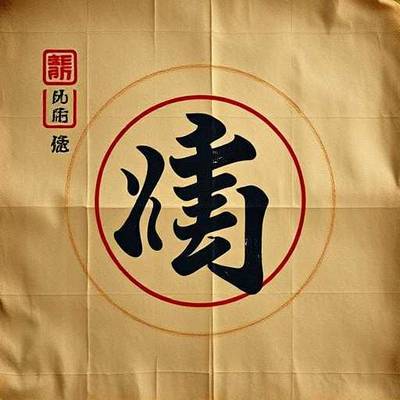
Of all the symbols in this guide, the Five Thunder Talisman (五雷符, Wǔ Léi Fú) is the one most deeply rooted in ceremonial Taoism and least understood by outsiders. It is not a passive symbol of good luck; it is an active instrument of spiritual power, a celestial command written in a script legible to gods and spirits.
In Taoist ritual, a talisman, or Fu (符), is a specific type of calligraphy that acts as a directive from the celestial hierarchy. It is a conduit for divine energy, drawn by a trained priest during a state of ritual purity and concentration.
The very act of writing it is a ceremony.
The "Five Thunders" refers to the thunder deities of the five directions (North, South, East, West, and Center). Thunder, in Taoist cosmology, represents the awesome, world-shaking power of Heaven—the ultimate expression of Yang energy that can shatter negativity, expel demons, and restore order.
The Five Thunder Talisman is therefore one of the most potent talismans for:
- Exorcism and Dispelling Negativity: It is used to cleanse spaces, objects, and people of harmful or stagnant energy (qi), including malevolent spirits or influences.
- Divine Protection: Worn as an amulet or placed in a home, it acts as a spiritual shield, warding off misfortune, psychic attacks, and unseen dangers.
- Commanding Spiritual Forces: In the hands of a priest, it is a tool to invoke the aid of the thunder deities for a specific purpose, such as healing or bringing justice.
The characters on a Five Thunder Talisman are not standard Chinese. They are a form of celestial script, often stylized and esoteric, understood to be the language of the heavens. The power of the talisman comes from the authority of the lineage that passed it down, the ritual purity of its creator, and the specific incantations and energies imbued into it during its creation.
This is why authentic talismans, sourced from practitioners, carry a completely different weight than mass-produced copies. A mass-produced symbol is an image; a ritually created talisman is a living tool. Discover the full extent of its power in our complete Five Thunder Talisman guide.

The Taiji — The Great Ultimate That Contains Everything
Here we arrive at a subtle but crucial distinction that separates casual observers from serious students. Practitioners use the terms "Yin Yang" and "Taiji" interchangeably. While they are inextricably linked, they are not the same thing.
- The Taijitu (太極圖) is the *diagram* we know as the Yin Yang symbol.
- The Taiji (太極) is the *philosophical concept* that the diagram represents. It translates as the "Great Ultimate," "Supreme Polarity," or "Great Ridgepole."
The Taiji is the state of primordial unity and potential that existed before the separation of Yin and Yang. It is the source from which all duality and, subsequently, all of creation emerges. Taoist cosmology often follows this progression:
- Wuji (無極): The "Limitless" or "Ultimate Non-being." This is the state of pure emptiness, the unmanifested Tao. It is a state beyond all concepts and forms, often represented by an empty circle.
- Taiji (太極): From the stillness of Wuji, the first movement or stirring of consciousness arises. This is the Taiji, the Great Ultimate. It is the One, the unified whole that contains the potential for everything. It is the cosmic seed from which the universe will sprout. - Yin and Yang (兩儀): The Taiji differentiates itself into the two fundamental principles of Yin and Yang. The One becomes the Two. This is the moment depicted by the Taijitu.
- The Myriad Things (萬物): From the interplay of Yin and Yang, the five elements, the eight trigrams, and all the phenomena of the call in world—the "ten thousand things"—are born.
Understanding the concept of Taiji is to understand the root of existence in Taoist thought. It teaches that beneath all the apparent chaos and diversity of the world, there is an underlying, unified source.
Meditation on the Taiji is a practice of returning to this source, of finding the stillness and wholeness that precedes all division. While you might wear a Yin Yang pendant to harmonize the dualities in your daily life, the deeper practice is to connect with the Taiji—the undivided unity from which those dualities spring.
The philosophy of the Taijitu is a gateway to this profound concept.
The Dragon and Phoenix — Cosmic Masculine and Feminine
The Dragon (龍, Lóng) and Phoenix (鳳凰, Fènghuáng) are powerful symbols with deep roots in Chinese culture, often associated with the Emperor and Empress, representing imperial power and authority. In Taoism, however, their meaning transcends the political and enters the world of the cosmic.
They are the ultimate celestial representations of Yang and Yin.
The Dragon (Lóng) - The Supreme Yang
The Dragon is the embodiment of pure Yang energy. It is not the fire-breathing monster of Western mythology but a divine, benevolent creature associated with Heaven, spiritual transformation, and elemental power.
- Power and Transformation: Dragons can fly through the heavens, swim in the deepest seas, and shapeshift at will. They represent the power of change and the ability to master all elements of the self.
- Heaven and Divinity: They are celestial messengers and guardians of divine wisdom. To "ride the dragon" is a metaphor for achieving spiritual enlightenment or immortality.
- Control of Water: As masters of rain, rivers, and oceans, they symbolize the life-giving and sometimes destructive power of nature, a force that must be respected and harmonized with.
The Phoenix (Fènghuáng) - The Supreme Yin
The Fènghuáng is the embodiment of supreme Yin energy. It is a composite of several birds and represents beauty, grace, peace, and good fortune.
- Grace and Beauty: Its appearance is said to be so beautiful it brings joy and harmony to all who see it. It represents the beauty that arises from virtue and right action. - Good Omen: The Phoenix is said to only appear during times of peace and prosperity under a virtuous ruler. Its presence is a sign of Heaven's favor. - Rebirth and Resilience: Like its Western counterpart, the Fènghuáng is associated with rebirth from ashes, symbolizing the indestructible nature of the spirit and the ability to overcome adversity.
When depicted together, the Dragon and Phoenix represent the perfect union of Yin and Yang. They are the ultimate symbol of cosmic harmony and balanced power. In a human context, they symbolize a blissful and successful marriage, but on a spiritual level, they represent the integration of the masculine and feminine energies within an individual practitioner on their path to enlightenment.
This is the alchemical marriage of opposites, the perfect harmony that gives birth to the highest spiritual potential.
How to Choose and Work With Taoist Symbols
Understanding these symbols is the first step. The next is learning how to integrate their wisdom into your life. This is not about superstition, but about using these potent images as focal points for intention, meditation, and self-reflection.
Choosing Your Symbol
The right symbol for you depends on your current intention and what energies you wish to cultivate in your life.
- For Balance and Harmony: If you feel pulled in too many directions or experience life in extremes, the Yin Yang is a powerful reminder to seek the middle path and honor both the active and passive cycles of your life. Our Yin Yang jewelry serves as a constant, wearable reminder of this principle.
- For Protection and Empowerment: If you are feeling energetically vulnerable, entering a challenging situation, or wish to cleanse your space of negativity, the Five Thunder Talisman is an unparalleled guardian. Its energy is active, strong, and purifying. For those seeking its power, our dedicated guide on the Five Thunder Talisman offers deeper insights.
- For Understanding and Adaptation: If you are seeking to understand the patterns of change in your life, make better decisions, or align yourself with the natural flow of events, the Bagua is your guide. It encourages you to see life not as a series of random events but as an ordered, cyclical process.
- For Integrated Power and Partnership: If you are working on harmonizing your inner masculine and feminine energies, or wish to cultivate a relationship built on balanced partnership and mutual respect, the Dragon and Phoenix are the perfect emblems.
Above all, trust your intuition. The symbol you are most drawn to is often the one whose energy you need most.
Working With Your Symbol
Once you've chosen a symbol, whether as a piece of jewelry, a printed image, or a statue, here are ways to activate its meaning in your life:
- Wear It with Intention: When you put on a pendant or ring, take a moment to connect with its meaning. If it's a Yin Yang, you might set the intention: "Today, I will honor both work and rest." This transforms it from an accessory into a spiritual tool.
- Create a Focal Point for Meditation: Place the symbol on a small altar or a quiet space in your home. Gaze at it before you meditate, allowing its form and meaning to fill your awareness. You can contemplate the questions it raises: Where in my life do I need more Yin? What does the energy of "Thunder" feel like?
- Energetic Cleansing: Like any spiritual tool, objects bearing these symbols benefit from regular energetic cleansing. You can leave them in moonlight overnight, pass them through the smoke of sage or incense, or simply hold them in your hands and visualize them being filled with clear, bright light.
- Respectful Placement: Treat these symbols with respect. Avoid placing them on the floor or in a bathroom. When you are not using or wearing them, keep them in a special box or on your altar. This practice of respect deepens your connection to their power.
Explore our Taoist Eight Trigram amulet.
Frequently Asked Questions
Can a non-Taoist wear or use Taoist symbols?
Absolutely. Taoist philosophy is universal and accessible to all. The key is to approach the symbols with respect and a genuine desire to understand their meaning. Using them as a mere fashion trend without acknowledging their cultural and spiritual significance can be seen as disrespectful.
When you wear them with intention and understanding, you are honoring their origin.
What is the difference between the Taiji and the Yin Yang symbol again?
Think of it this way: Taiji is the profound philosophical concept of the "Great Ultimate"—the unified source of all things before it split into two. The Yin Yang symbol, more accurately called the Taijitu, is the visual diagram that beautifully illustrates the *first intention-setting* of that split into the complementary forces of Yin and Yang.
The concept is the idea; the symbol is the map.
Is a Bagua mirror the same as the Bagua symbol?
No, they are related but distinct. The Bagua is the set of eight trigrams. A Bagua mirror is a specific Feng Shui tool that places the Bagua (usually the Later Heaven arrangement) around a round mirror.
These mirrors are used defensively to reflect or deflect negativity (sha qi) away from a home or business. They are a specific application of the Bagua's principles.
How should I cleanse my Taoist jewelry?
Energetic cleansing is recommended. Simple methods include leaving the jewelry in the light of a full moon for several hours, smudging it with the smoke of sacred herbs like sandalwood or sage, or placing it on a selenite crystal.
The most important element is your intention to purify the object of any stagnant energy it may have absorbed.
Are there any 'bad luck' or forbidden Taoist symbols?
Taoist symbols themselves are not "bad luck." However, some are extremely powerful and are intended for specific ritual use by trained priests only. For example, certain advanced exorcism or sorcery talismans should not be used casually as they invoke potent forces that require proper handling and understanding.
The symbols discussed in this guide—Yin Yang, Bagua, Dragon & Phoenix—are universally beneficial and safe for personal use.
Where do Buddhabelief's designs and knowledge come from?
Our commitment is to authenticity. We collaborate directly with Taoist masters, artisans, and temples in China, particularly in the Wudang and Longhu mountains, which are historic centers of Taoism. Our designs are not only inspired by Taoism; they are often co-created with or sourced from practitioners who live and breathe this tradition.
This ensures the symbols we offer are rendered correctly and with the proper respect for their lineage.
Is it okay to combine Taoist symbols with Buddhist ones?
In many parts of Asia, Taoism, Buddhism, and folk traditions have coexisted and blended for centuries. It is very common to see symbols from different paths used together in homes and temples. From a personal practice standpoint, it is perfectly acceptable, as long as you understand and respect the distinct meaning and origin of each symbol.
Both traditions ultimately point toward a path of wisdom, compassion, and understanding the nature of reality.
The journey into the world of Taoist symbols is a journey into the heart of reality itself. These are not only ancient drawings; they are vibrant, living philosophies that offer a guide to working through the world with balance, wisdom, and power.
By understanding their true meaning, you move beyond surface-level appreciation and begin to work with the very energies that shape the cosmos. We invite you to continue your exploration and discover how these symbols can enrich your path, perhaps by starting with our authentic Taoist jewelry collection.
Keep reading