buddhist-jewelry
Yin Yang Meaning: The Complete Symbol Guide
Yin Yang Meaning: The Complete Symbol Guide for Modern Spiritual Practice
It’s everywhere: on posters, tattoos, phone cases, and fashionable yin yang jewelry. The simple black and white circle is arguably one of the most recognizable icons on the planet. Yet, for all its fame, the yin yang is also one of the most profoundly misunderstood symbols in the world.
Many see it as a simple representation of opposites—good versus evil, light versus dark, male versus female. This interpretation, while common, barely scratches the surface of its true depth. It reduces a dynamic map of the cosmos into a static logo.
The yin yang symbol, properly known as the Taijitu, is not a statement about conflict. It is a visual scripture from the heart of Daoist philosophy, a guide to understanding the fundamental nature of reality itself.
It teaches that the universe is in a constant, flowing dance of complementary forces, and that harmony is found not in choosing a side, but in embracing the whole. This guide will move beyond the superficial to explore the authentic yin yang meaning, its roots in ancient Chinese wisdom, and its surprisingly practical relevance for working through the pressures of modern life.
Yin Yang Symbol is the simple black and white circle is arguably one of the most recognizable icons on the planet.
Yin and yang is the Taoist idea that opposite forces — dark and light, still and active — are partners rather than enemies, each holding a seed of the other and together forming one balanced whole.
What Yin Yang Actually Means — The Daoist Philosophy
To grasp the meaning of yin and yang, one must first approach the concept from which they arise: the Dao (or Tao). In the foundational text of Daoism, the Tao Te Ching, the Dao is described as the ultimate, unnamable source of all existence.
It is the formless, primordial unity from which everything originates. Chapter 42 states:
“The Dao gave birth to One. One gave birth to Two. Two gave birth to Three. And Three gave birth to the ten thousand things.”
Here, "One" is the unified cosmic energy, or Qi. "Two" represents the first great division of this unity into the two primary polarities: Yin and Yang. They are the fundamental duality, the cosmic breath of expansion and contraction that sets the universe in motion.
From their interplay, the "ten thousand things"—a poetic term for all of call in reality—are created.
It is crucial to understand that Yin and Yang are not a Western-style dualism of good versus evil. They are not opposing armies locked in eternal combat. Instead, they are complementary, interdependent forces that define and create each other.
Light has no meaning without darkness; sound cannot exist without silence; a peak is only a peak because there is a valley. One cannot exist without the other.
The core principles governing their relationship are:
- Opposition and Interdependence: Yin and Yang are relative opposites. Yin is characterized by qualities like darkness, passivity, cold, and receptivity. Yang is characterized by light, activity, heat, and assertion. They are defined by their relationship to one another.
- Mutual Consumption and Support: As one force grows, the other recedes. The Yang energy of midday slowly gives way to the Yin energy of twilight and the deep Yin of midnight, which in turn yields to the growing Yang of dawn. This is a continuous, cyclical process of ebb and flow.
- Inter-transformation: This is perhaps the most profound principle. At its absolute extreme, Yin can transform into Yang, and Yang can transform into Yin. Think of the winter solstice: the moment of maximum Yin (shortest day) is the very point where Yang begins its return. This principle ensures that nothing is static and that change is the only constant.
Yin and Yang are not things; they are qualities and tendencies. They are the dynamic process that drives the universe, from the spinning of galaxies to the beating of our own hearts. Understanding this philosophy is the key to unlocking the symbol’s true power.
The Symbol Decoded — Every Element Has Purpose
The Taijitu is a masterful diagram of the Daoist worldview. It is not an arbitrary design; every curve and dot is laden with meaning, visually representing the principles of cosmic harmony.

The Outer Circle: The Dao
The circle that contains the entire symbol represents the Dao itself—the undifferentiated wholeness and unity of all things. It is the container for existence, the ultimate reality that encompasses both Yin and Yang. Before the "One gave birth to Two," there was only this smooth totality.
The circle reminds us that despite the apparent dualities we experience, everything is ultimately part of a single, unified whole.
The Black Swirl: Yin (陰)
The black area represents Yin energy. Its qualities include:
- Feminine Principle: Nurturing, receptive, intuitive.
- Darkness & Night: The time for rest, introspection, and regeneration.
- Earth: Grounded, stable, material substance.
- Cold & Water: Cooling, flowing, descending energy.
- Passivity & Stillness: The state of being, of quiet contemplation.
- The Moon: Reflective, gentle, and cyclical.
Yin is the energy of being, of gathering inward, of rest and restoration. It is the fertile darkness from which new life emerges.
The White Swirl: Yang (陽)
The white area represents Yang energy. Its qualities are the complement to Yin:
- Masculine Principle: Active, creative, assertive.
- Light & Day: The time for action, expression, and outward movement.
- Heaven: Expansive, ethereal, spiritual inspiration.
- Heat & Fire: Warming, energizing, ascending energy.
- Activity & Movement: The state of doing, of creation and expansion.
- The Sun: Direct, radiant, and powerful.
Yang is the energy of doing, of expanding outward, of action and intention-setting in the world.
The S-Shaped Curve: The Dynamic Flow
Crucially, the line separating Yin and Yang is not a straight, rigid divider. It is a soft, S-shaped curve that speaks to the dynamic and fluid nature of their relationship. This line shows that the two forces are in a constant state of interplay, pushing and pulling, yielding and asserting.
There are no hard boundaries. This flowing line represents the perpetual motion of the universe, the dance of change that is life itself.
The Dots: The Seed of the Opposite
Within the heart of the black Yin swirl is a small white dot of Yang. Within the heart of the white Yang swirl is a small black dot of Yin. This is the most vital element of the symbol’s meaning.
It visually represents the principle of inter-transformation and teaches a profound truth: nothing is absolute.
Within the deepest darkness, there is always a seed of light. At the peak of activity, there is the seed of rest. In failure lies the seed of a new beginning. In success lies the seed of humility and potential decline.
This element reminds us that life is not a series of static states but a process of becoming. It offers hope in dark times and cautions against arrogance in bright ones. It is the key to resilience and adaptability.
Yin and Yang in the Human Body and Daily Life
Daoist philosophy is not merely an abstract intellectual exercise; it is a practical guide for living. The principles of Yin and Yang are directly applicable to our health, our work, and our mental well-being.
The Body as a Microcosm
Traditional Chinese Medicine (TCM) views the human body as a small universe, a microcosm governed by the same principles as the macrocosm. Health is understood as a state of dynamic balance between the Yin and Yang energies within the body.
- Yang in the Body: Yang relates to function, energy (Qi), heat, and activity. It governs the upper and outer parts of the body (head, back). The sympathetic nervous system ("fight or flight") is a very Yang process—active, fast, and energy-expending.
- Yin in the Body: Yin relates to structure, substance (Blood, body fluids), coolness, and rest. It governs the lower and inner parts of the body (feet, internal organs). The parasympathetic nervous system ("rest and digest") is a classic Yin process—calming, restorative, and energy-conserving.
Illness arises when there is an imbalance—an excess or deficiency of either Yin or Yang. For example:
- Excess Yang: Can call in as fever, inflammation, high blood pressure, headaches, anxiety, or insomnia. The body is "overheating" and over-active.
- Excess Yin: Can lead to feelings of cold, fluid retention, sluggishness, and lethargy. The body's functions are "dampened" and slow.
- Yang Deficiency: Results in fatigue, poor circulation, lack of motivation, and feeling cold. There isn't enough "fire" to power the body's functions.
- Yin Deficiency: Can cause night sweats, dryness (of skin, eyes, throat), and a feeling of "empty heat" or low-grade anxiety. There isn't enough "coolant" and substance to nourish the body.
TCM practices like acupuncture, herbal medicine, and Qigong are all designed to restore this vital balance by either tonifying a deficiency or clearing an excess.
Balancing Your Daily Life
Our modern culture is overwhelmingly Yang-dominant. We prize productivity, constant activity, growth, and outward achievement. This relentless pursuit of Yang leads to widespread burnout, anxiety, and stress—classic symptoms of Yin deficiency. Applying the wisdom of the Taijitu can help restore sanity and balance.
- Work (Yang) vs. Rest (Yin): "Hustle culture" is a recipe for imbalance. A period of intense work must be balanced by genuine, deep rest—not only scrolling on your phone, but true restorative activities like sleep, meditation, or quiet time in nature.
- Speaking (Yang) vs. Listening (Yin): In conversations and relationships, balance is key. Dominating a conversation is an excess of Yang. True connection requires the Yin quality of receptive, deep listening.
- Exercise (Yang) vs. Stillness (Yin): High-intensity workouts are Yang. They are beneficial, but must be balanced with Yin practices like stretching, yoga, or meditation to prevent injury and allow the body to recover and rebuild.
- Socializing (Yang) vs. Solitude (Yin): Spending time with others is an outward, Yang activity. It needs to be balanced with inward, Yin time for solitude, reflection, and recharging your own energy.
The goal is not a perfect 50/50 split at all times. The goal is a dynamic, responsive harmony. Life will demand periods of intense Yang. The wisdom lies in consciously cultivating Yin to replenish your reserves and maintain long-term well-being.

Yin Yang and the Five Elements — The Bigger System
While Yin and Yang represent the primary polarity, Daoist cosmology provides a more detailed system for understanding the processes of change: the Wu Xing, or the Five Elements (more accurately translated as the Five Phases or Five Movements).
The Five Elements are Wood (木), Fire (火), Earth (土), Metal (金), and Water (水). They are not literal substances but archetypal energies that represent different stages in a cyclical process. If Yin and Yang are the fundamental "why" of change (polarity), the Five Elements are the "how" (the specific phases of transformation).
Each element has both Yin and Yang characteristics and is part of two fundamental cycles:
- The Generating Cycle (Sheng Cycle): This is a creative, nurturing cycle. Water nourishes Wood, Wood fuels Fire, Fire creates Earth (ash), Earth produces Metal, and Metal collects Water (condensation).
- The Controlling Cycle (Ke Cycle): This is a balancing, restraining cycle that prevents any one element from becoming too dominant. Water controls Fire, Fire melts Metal, Metal cuts Wood, Wood penetrates Earth, and Earth dams Water.
This intricate system forms the foundation of advanced Daoist practices. Our comprehensive Wu Xing Five Elements guide explores this topic in greater detail. Furthermore, this cosmology expands into the I Ching (Book of Changes) and the Bagua, or Eight Trigrams.
Each trigram is a combination of three Yin (broken) and Yang (solid) lines, representing more complex archetypes of energy. You can dig in deeper into our exploration of the Bagua meaning and its eight trigrams.
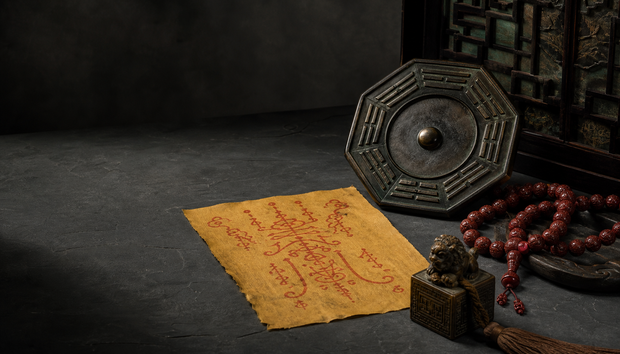
These systems are not only philosophical. They are the diagnostic and strategic frameworks for Feng Shui, TCM, martial arts, and Daoist remarkable practices, which often use powerful tools like an authentic Daoist talisman to consciously harmonize these elemental energies for protection and spiritual alignment.
Working With Yin Yang — Practical Daoist Principles
Understanding the yin yang meaning is the first step. The next is to actively apply its wisdom to live a more harmonious life. This involves cultivating a new way of seeing and being in the world.
1. Observe the Cycles (Guān 觀)
The first practice is simply to become a better observer. Pay attention to the cycles of Yin and Yang within and around you. Notice the daily cycle of light and dark. Notice the monthly cycle of the moon.
Notice the yearly cycle of the seasons. More personally, track the cycles of your own energy, mood, and motivation. When do you feel most active and expressive (Yang)? When do you feel the need to be quiet and introspective (Yin)?
By simply observing without judgment, you begin to align yourself with the natural rhythms of life instead of constantly fighting against them.
2. Embrace Wu Wei (無為) — Effortless Action
Wu Wei is often translated as "non-action," but this is misleading. It more accurately means "effortless action" or "action without struggle." It is the art of knowing when to act (Yang) and when to yield (Yin).
It's about swimming with the current, not exhausting yourself by fighting against it. When you face an obstacle, Wu Wei doesn't mean giving up. It means stepping back, observing the flow of energy, and applying your effort at the right time and in the right place for maximum effect with minimum resistance.
It is the opposite of the "brute force" approach that modern culture often celebrates.
3. Seek Dynamic Balance, Not Static Perfection
The goal is not to achieve a perfectly static 50/50 balance of Yin and Yang. Life is movement, and balance is a dance. There will be times that require immense Yang energy—launching a business, caring for a newborn, meeting a critical deadline.
The wisdom of the Taijitu teaches us to recognize these periods and consciously plan for the subsequent Yin phase. After a period of intense output, you must intentionally schedule time for input, rest, and recovery.
This conscious oscillation is the key to sustainable energy and avoiding burnout.
4. Cultivate Stillness (Jìng 靜)
In a world saturated with Yang energy—constant noise, information overload, and pressure to perform—the most radical spiritual practice is the cultivation of Yin. This means making time for stillness. This could be through formal practices like meditation or Qigong, or simply through unstructured time spent in nature, listening to calming music, or sitting in silence.
Stillness is not emptiness; it is a receptive state where you can quiet the noise of the ego and hear the subtle whispers of intuition and the Dao. It is in the Yin of stillness that the Yang of creativity and insight is born.
For many practitioners, tools like an explore five thunder talisman meaning can provide a focal point for meditation, helping to center the mind and harmonize one's personal energy field.
Yin Yang Across Traditions — Tibetan Buddhist Parallels
The profound truth of complementary duality is not exclusive to Daoism. We can find powerful parallels in other deep spiritual traditions, particularly in Tibetan Buddhism. This resonance highlights a universal understanding of the nature of reality.
In Vajrayana (Tibetan) Buddhism, the path to enlightenment is often described as the perfect union of Prajñā (Wisdom) and Upāya (Skillful Means or Method).
- Prajñā (Wisdom): This is understood as the direct, intuitive insight into the ultimate nature of reality—the emptiness (śūnyatā) of all phenomena. It is considered the feminine principle. It is receptive, vast, and all-encompassing, much like the Daoist concept of Yin. It is the "mother" of all Buddhas.
- Upāya (Skillful Means): This is the active, compassionate, and dynamic expression of that wisdom in the world. It is the practical application of insight to alleviate the suffering of all beings. It is considered the masculine principle, a clear parallel to the active, creative force of Yang.
Enlightenment is not achieved through wisdom alone or action alone. It requires their inseparable union. This sacred union is often depicted in Tibetan art through the imagery of Yab-Yum (literally "father-mother"), where a male deity is in sexual union with his female consort.
This is not a literal depiction of lust but a profound symbol for the ecstatic merging of compassion (Yang) and wisdom (Yin) that gives birth to an enlightened mind.
Just as the Taijitu shows that Yin and Yang are interdependent and arise from a single source, Tibetan Buddhism teaches that wisdom and compassion are two wings of the same bird, both essential for flight.
Yin Yang Jewelry — Wearing the Balance
In a world that constantly pulls us off-center, a physical reminder of our spiritual goals can be an invaluable tool. Wearing a symbol as profound as the Taijitu is more than a fashion choice; it is a conscious act of alignment, a daily commitment to the path of harmony.
A piece from an authentic explore yin yang jewelry serves as a personal talisman. Each time you see it in the mirror or feel its weight against your skin, it acts as a mindful prompt:
- A Reminder to Observe: It encourages you to notice where you are in your own cycles. Are you feeling overwhelmed and over-extended (excess Yang)? Or are you feeling stuck and lethargic (excess Yin)?
- A Call for Balance: It reminds you to seek the opposite. If your day is filled with hectic activity, the symbol prompts you to schedule an evening of quiet rest. If you've been isolated and introspective, it might encourage you to reach out and connect with others.
- An Embrace of Wholeness: The symbol is a a sign of the idea that all parts of you are valid. It honors both your strength and your vulnerability, your desire for action and your need for rest. It helps you accept the totality of your experience without judgment.
Our collection of handcrafted yin yang pendants and necklaces is designed with this deep understanding. Crafted from materials like pure silver, which has its own grounding and purifying properties, these pieces are more than ornaments.
They are tools for modern spiritual practice, intended to be worn with intention as you walk the path of the Dao. Exploring our yin yang necklaces can be a powerful way to integrate this traditional teachings into your daily life.
Related guide: Taoist jewelry symbols and their meanings
Explore our Tai Chi prayer bead bracelet.
Frequently Asked Questions about Yin Yang Meaning
What is the true meaning of yin and yang?
The true meaning of yin and yang is that of complementary, interdependent opposites that arise from a unified source, the Dao. They are not "good vs. evil" but rather two fundamental energies or qualities—like light/dark, active/passive, hot/cold—whose dynamic interplay creates all of call in reality.
Harmony is found in their dynamic balance, not the victory of one over the other.
Is yin female and yang male?
Yin is associated with feminine *energy* and Yang with masculine *energy*, but this is not about gender. These are archetypal principles. Every person, regardless of gender, contains both yin and yang energies. A healthy, integrated person knows how to access both their assertive, active (Yang) side and their receptive, nurturing (Yin) side.
What is the dot in the yin yang symbol?
The dot of the opposite color within each swirl is one of the most important aspects of the symbol. It signifies that nothing is absolute. Within the heart of Yin (darkness, passivity) there is always the seed of Yang (light, activity), and vice versa.
This guarantees that change and transformation are always possible; the darkest night contains the promise of dawn.
Can you have too much yin or yang?
Yes. In Daoist thought and Traditional Chinese Medicine, imbalance is the root of all problems, whether physical illness, mental distress, or societal dysfunction. Too much Yang can lead to burnout, aggression, and inflammation. Too much Yin can lead to depression, lethargy, and stagnation.
The goal of a healthy life is to constantly adjust and maintain a dynamic equilibrium between the two.
How can I apply yin yang to my life?
You can apply yin yang principles by first observing the natural cycles in your life and environment. Practice "Wu Wei" or effortless action by learning when to push (Yang) and when to yield (Yin).
Consciously balance active periods with restorative rest. And in our hyper-active modern world, make a specific effort to cultivate Yin through practices like meditation, stillness, and time in nature.
Is yin yang a religious symbol?
It is a philosophical symbol from Daoism, which is considered both a philosophy and a religion. However, its meaning is so universal that it has been adopted by people from many different spiritual paths and secular backgrounds.
It is a diagram of natural law, accessible to anyone who wishes to understand the flow of life.
What is the difference between Daoism and Taoism?
There is no difference in meaning. They refer to the same Chinese philosophy and religion. "Taoism" is the older spelling based on the Wade-Giles romanization system. "Daoism" is the more modern and phonetically accurate spelling based on the Pinyin system, which is now the international standard.
Both are correct, but "Daoism" is preferred in contemporary academic contexts.
Where can I find authentic yin yang jewelry?
Finding authentic pieces means looking for jewelers who understand and respect the deep philosophical meaning of the symbol. At Buddhabelief, our designs are not mass-produced trinkets but are crafted with intention. We focus on high-quality materials and designs that honor the sacred geometry and spiritual purpose of the Taijitu.
You can explore our collection of yin yang jewelry to find a piece that resonates with your practice.
The Dance of a Balanced Life
The yin yang symbol is far more than a decorative icon. It is a profound teaching, a map of the cosmos, and a practical guide for living. It teaches us that life is not a battle to be won but a dance to be joined.
It invites us to honor the necessity of both action and rest, speech and silence, light and shadow. By understanding its deep meaning, we can move from a state of resistance and struggle to one of grace, resilience, and harmony with the natural flow of the universe.
To carry this symbol is to carry a reminder of this sacred dance. It is a commitment to walking the middle path, embracing the whole of your being, and finding the quiet strength that comes from true balance.
We invite you to explore our yin yang jewelry collection and find a meaningful piece to accompany you on your journey.
Keep reading