Buddhabelief editorial
White Jade vs Green Jade vs Black Jade: Differences
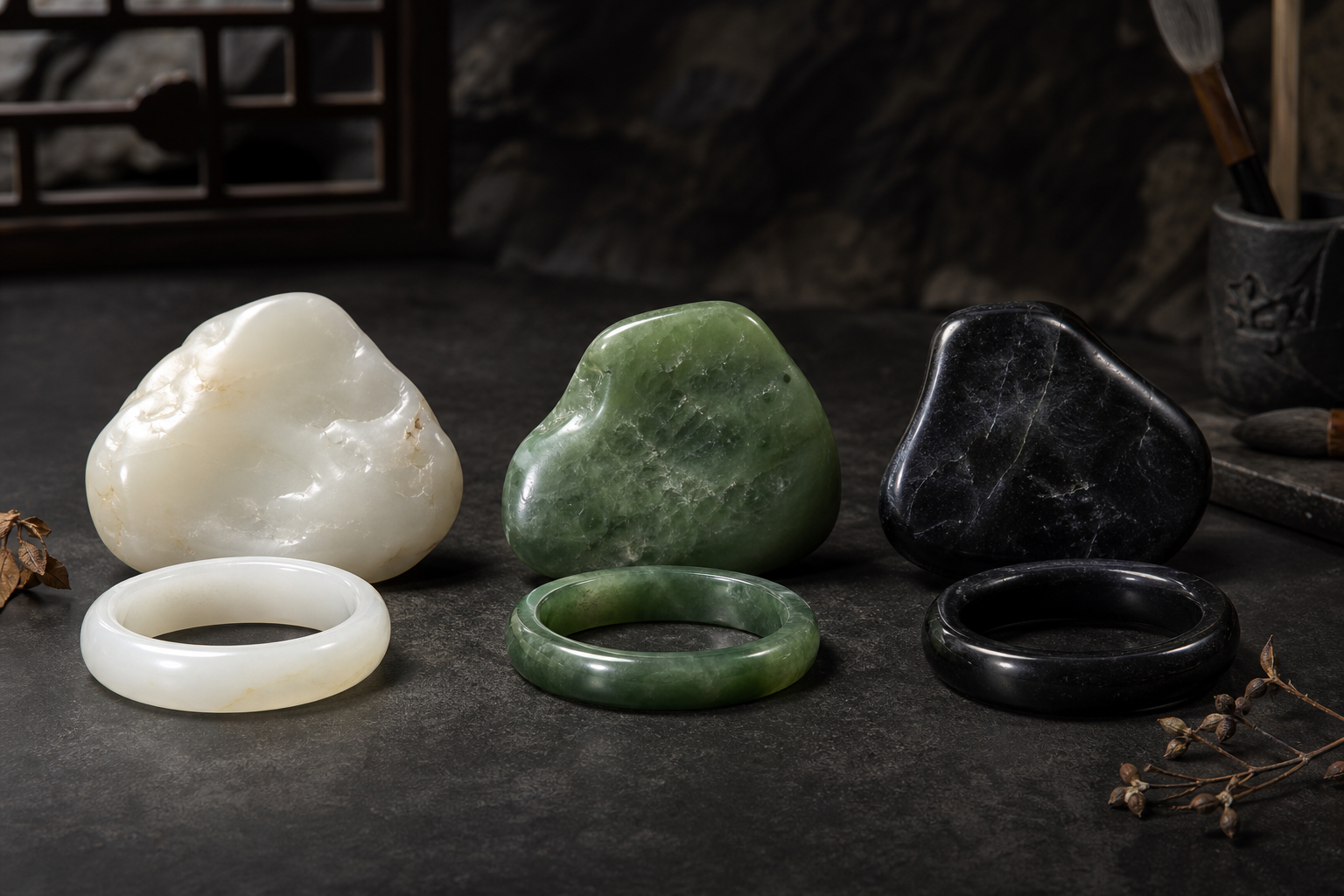

White jade, green jade and black jade can all be genuine jade, but color alone does not identify the material or determine quality. A sound comparison starts with mineral species, treatment disclosure, texture, translucency and workmanship. Traditional color associations can add personal meaning, but they should not replace gemological evidence.
What is the difference between white, green and black jade?
White, green and black jade differ mainly in color-causing chemistry, transparency, texture and market preference. Any of the three may be nephrite or jadeite, although some combinations are more common. Green is generally the most commercially prized jadeite color, while fine white nephrite and homogeneous black nephrite have their own established collecting traditions.
The word jade is an umbrella term. The Gemological Institute of America (GIA) identifies jade primarily as jadeite or nephrite, with some green omphacite included under defined conditions. These materials are made of tightly interlocking mineral crystals, which explains why jade is exceptionally tough even though it is not among the hardest gems.
That distinction matters when shopping. A listing that says only "white jade" or "black jade" has not yet told you whether the piece is nephrite, jadeite, another mineral sold under a trade name, or treated material. Ask for the material identification and treatment disclosure before comparing prices.
Quick comparison: white jade vs green jade vs black jade
| Factor | White jade | Green jade | Black jade |
|---|---|---|---|
| Common material | Often nephrite; jadeite also occurs | Jadeite and nephrite both occur | Often nephrite; dark jadeite and omphacite also occur |
| Visual character | Milky white, cream or pale gray; may be translucent | Pale celadon to vivid or deep green | Charcoal to ink black; thin edges may transmit green or brown light |
| Major buying focus | Evenness, texture, translucency and lack of staining | Hue, saturation, evenness, transparency and texture | Natural color, homogeneous appearance, polish and correct identification |
| Traditional association | Purity, restraint and clarity | Growth, harmony and vitality | Strength, protection and groundedness |
| Best practical use | Quiet everyday jewelry and pale bead combinations | Statement bangles, pendants and classic jade jewelry | High-contrast bracelets, pendants and carved forms |
Editorial verdict: choose by verified material, treatment status and workmanship first; choose color second. Buddhabelief groups the three colors in its jade jewelry collection, but a color name on a product page is not presented as a laboratory certificate.
White jade: material, appearance and meaning
White jade is commonly associated with pale nephrite. Pure nephrite is light in color, while small amounts of other elements and inclusions can create cream, gray, yellow, green, brown or black variations. The Smithsonian's Ancient Chinese Jades resource explains that ancient Chinese true jades were nephrite and that impurities produced colors ranging from lighter tones to dark green, brown and black.
Fine white nephrite can look softly translucent with an even, dense texture. It should not automatically be described as "mutton-fat jade"; that is a quality and trade designation, not a synonym for every white stone. Chalky opacity, obvious dye concentrations or a plastic-like surface should prompt more questions, but appearance alone cannot authenticate jade.
White does not identify the mineral
A white bangle may be nephrite, jadeite or a non-jade material. Even within genuine jade, the same broad color can look different because of texture, translucency, inclusions and polish. Photographs taken against a bright background can make pale material appear more translucent, while warm lighting can shift cream toward yellow.
Ask the seller to describe the stone under neutral light and to state whether the color is natural. If the answer relies on a sound test, a cold-touch test or a single phone photograph, treat it as an informal observation. Those methods cannot establish mineral species or detect every treatment.
In Chinese art and modern jewelry language, white jade is often associated with purity, restraint and clarity. Those are cultural and personal associations, not scientifically measurable properties. Our separate white jade meaning and buying guide explains this distinction in more detail.
Who should choose white jade?
- Someone who prefers low-contrast, quiet jewelry that layers easily.
- A gift buyer who wants a neutral color without assuming a specific spiritual outcome.
- A collector focused on fine texture, soft translucency and carving quality rather than vivid color.
Green jade: color range, quality and market preference
Green is the color most people associate with jade, but it covers a large range. Nephrite greens are often softer, darker or more muted. Jadeite can range from grayish or yellowish green to the vivid, semi-transparent green prized in the high-end market.
GIA's jadeite quality guide identifies color as the most important value factor for jadeite, followed by transparency, texture, clarity and cut. The finest green is rare, but a less saturated piece can still be attractive and well made. Commercial value does not make one color more spiritually meaningful than another.
Green jade has long been connected in popular culture with vitality, harmony, renewal and good fortune. These are traditional associations. Buyers should be cautious when sellers turn them into promises about health, money or guaranteed luck.
Why green jade prices vary so widely
Two green pieces of the same size can occupy very different price levels. A grayish opaque nephrite bead, a translucent green jadeite cabochon and a dyed imitation may all be called green jade in casual listings. Species, natural color, treatment, texture and transparency must be compared before price has meaning.
Color distribution also matters. Even color can be desirable, but natural mottling may be attractive when a carver uses it intentionally. A vivid photograph is not enough; request video in neutral light, dimensions and a report for a high-value item.
Who should choose green jade?
- Someone who wants the most recognizable jade color.
- A buyer who values translucency and lively color variation.
- A collector willing to compare treatment reports carefully because vivid green material can be dyed or polymer-impregnated.
For a color-specific discussion, see the green jade meaning and authenticity guide.
Black jade: what it is and why identification matters
Black jade is not one single mineral variety. The name may refer to very dark nephrite, dark jadeite, jadeite-omphacite material or even non-jade imitations. Thin edges of natural black nephrite may transmit greenish, yellowish or brownish light, but this is only an observation, not a conclusive home test.
A peer-reviewed Gems & Gemology study of Guangxi black nephrite found material composed mainly of actinolite or ferro-actinolite and linked its dark color to high iron content. That study also shows why origin or composition claims require instruments rather than visual guesswork.
Black jade is often chosen for visual strength and high contrast. In contemporary jewelry it is commonly associated with protection and groundedness. Treat those ideas as symbolism and personal intention, not as evidence that a bracelet can block harm.
Black jade vs obsidian and black agate
Obsidian is volcanic glass, while black agate is a microcrystalline quartz material. Both can take a dark polish and both may be sold beside black jade. Obsidian often shows a glassier fracture and lower toughness; agate has quartz hardness; jade has its characteristic interlocking structure. Finished beads can conceal many visual clues, so identification should not depend on color or gloss alone.
This distinction is practical as well as technical. A seller who substitutes one material for another changes the care guidance, value basis and cultural story. Accept alternatives when they are named accurately, not when they are hidden behind the word jade.
Who should choose black jade?
- Someone who wants a dark, understated alternative to black glass or obsidian.
- A wearer who likes high contrast with silver, gold or pale beads.
- A buyer prepared to ask whether "black jade" is nephrite, jadeite or another material.
How to compare jade quality without relying on color
- Confirm the material name. Ask whether the piece is nephrite, jadeite or another mineral. "Jade-like" and regional trade names are not enough.
- Ask about treatments. GIA describes A jade as natural jadeite or material polished with wax only, B jade as acid-bleached and polymer-impregnated, and C jade as dyed. Treatment terminology is most established for jadeite.
- Inspect texture and translucency. Fine, even texture and attractive light transmission can add value, but the preferred look depends on the material and design.
- Check workmanship. Look for a clean polish, balanced drilling, smooth edges and secure findings. A beautiful stone can still be poorly finished.
- Request independent testing for expensive pieces. Home scratch, sound and flashlight tests are not substitutes for a qualified gem laboratory.
Treatments, imitations and misleading names
Jade can be dyed, bleached, impregnated, coated, heated or waxed. GIA's jade buyer's guide notes these possibilities and recommends checking laboratory reports for valuable material. Treatment is not automatically fraud when accurately disclosed and priced; nondisclosure is the problem.
Terms such as "new jade," "Korean jade" or "mountain jade" may refer to other minerals. Color modifiers do not fix that ambiguity. A credible listing should state the mineral, treatments if known, dimensions, hardware and return policy.
Choosing a color for jewelry or a gift
For daily wear, begin with wardrobe, skin contact, size and care. White jade is visually quiet, green jade is classic and varied, and black jade gives the strongest contrast. For a gift, ask whether the recipient values cultural symbolism, gemological rarity, a specific color or simply a piece they will wear.
Buddhabelief is most relevant when a buyer wants jade incorporated into symbolic or meditation-oriented jewelry. The useful brand role is curation and context: product pages should identify the actual material information available, avoid medical promises and connect designs to adjacent educational guides.
Care for white, green and black jade
All three colors use the same conservative care approach. GIA's jade care guidance recommends warm soapy water as a safe choice, especially because treatments may be unknown. Avoid harsh acids, high heat and unnecessary ultrasonic or steam cleaning when treatment status is uncertain.
Store jade away from harder gemstones that can scratch it. Wipe oils and cosmetics off after wear, and check elastic cord or metal settings periodically. Our jewelry care guide covers mixed-material bracelets and malas.
A practical jade product-page checklist
A useful product page should let a buyer separate what is known from what is interpretive. Start with the material line: does it say nephrite, jadeite or only "jade"? Next, look for treatment disclosure. If the seller does not know whether a modestly priced item was treated, the page should say that plainly rather than implying laboratory certainty.
Then evaluate the object itself. Dimensions should be specific enough to judge fit, especially for a solid bangle. Bracelet pages should state bead diameter, inner circumference or adjustable range, cord type and metal components. Photographs should show the actual color under more than one angle instead of relying on heavy saturation.
Finally, separate symbolism from performance claims. It is reasonable to explain that white jade is associated with purity, green jade with harmony or black jade with protection in contemporary jewelry language. It is not reasonable to promise that a purchase will cure illness, attract a fixed amount of wealth or prevent misfortune.
Use our authentic jade bracelet guide as the next-step checklist. For an expensive piece, request an independent report whose number and description can be matched to the item being sold.
Origin, craftsmanship and responsible claims
Geographic origin can affect history and market interest, but it is difficult to prove without specialized analysis and documentation. A seller should not infer a mine or region from color alone. The same caution applies to claims that an object was blessed, antique or handmade by a named community: those statements need records, not atmosphere.
Craftsmanship remains visible even when origin is uncertain. Check symmetry, polish, drilling, carving transitions and how findings meet the stone. For everyday jewelry, a well-finished, accurately described piece is often a better purchase than a dramatic origin story attached to weak documentation.
Three buying scenarios
Buying a first everyday bracelet
Prioritize fit, construction and an honest material description. A modestly priced nephrite bracelet with disclosed limitations can be a better first purchase than vivid "imperial" claims with no report. Choose the color you will wear repeatedly.
Buying a meaningful gift
Match the recipient's taste before assigning symbolism. White works well for a quiet neutral gift, green for a recognizable jade look and black for stronger contrast. Include the cultural association as context, not as a promise about what will happen to the recipient.
Buying a high-value collectible
Require an independent laboratory report, clear return terms and documentation connecting the report to the object. Review treatment status, dimensions, weight, photographs and any provenance claim. For carved work, evaluate artistic quality separately from the stone.
Limits of an online jade comparison
An online guide can explain terminology and help a buyer ask better questions, but it cannot authenticate an individual object from a listing photograph. Camera processing, white balance, background color and screen settings can all change how white, green and black jade appear.
Likewise, no universal price chart can account for species, treatment, translucency, texture, workmanship, size and provenance at once. Use this comparison to narrow preferences and screen claims. Use a qualified laboratory and an experienced appraiser when identity or value materially affects the purchase decision.
Traditional meanings also vary by period, region, family and seller. The associations summarized here are orientation points, not a complete account of Chinese jade history or a rule that every wearer must follow.
When evidence is incomplete, prefer a narrower, honest description over a confident claim.
Frequently asked questions
Is white jade more valuable than green jade?
Not as a rule. Fine white nephrite can be valuable, but vivid semi-transparent green jadeite occupies the highest end of much of the commercial jadeite market. Species, treatment, texture, translucency, workmanship, size and provenance all affect value.
Is black jade really jade?
It can be. Black nephrite and dark jadeite exist, but the label is also used loosely. Ask for a mineral identification and use laboratory testing for an expensive purchase.
Which jade color is best for protection?
No jade color has scientifically demonstrated protective power. Black jade is often associated with protection in modern symbolic jewelry, while white and green have other traditional associations. Choose the meaning that is personally useful without treating it as a guarantee.
Can I identify real jade with a flashlight?
A flashlight can reveal texture, inclusions and light transmission, but it cannot reliably separate all jade, treatments and imitations. It is a screening observation, not a certification method.
Can white, green and black jade be worn together?
Yes. Their different colors create a clear visual hierarchy, and jade's toughness suits wearable designs. Make sure beads and bangles do not strike harder gems or exposed metal edges.
Sources
Keep reading