buddhist-jewelry
Yak Bone Mala Meaning: Impermanence & Tibetan Tradition
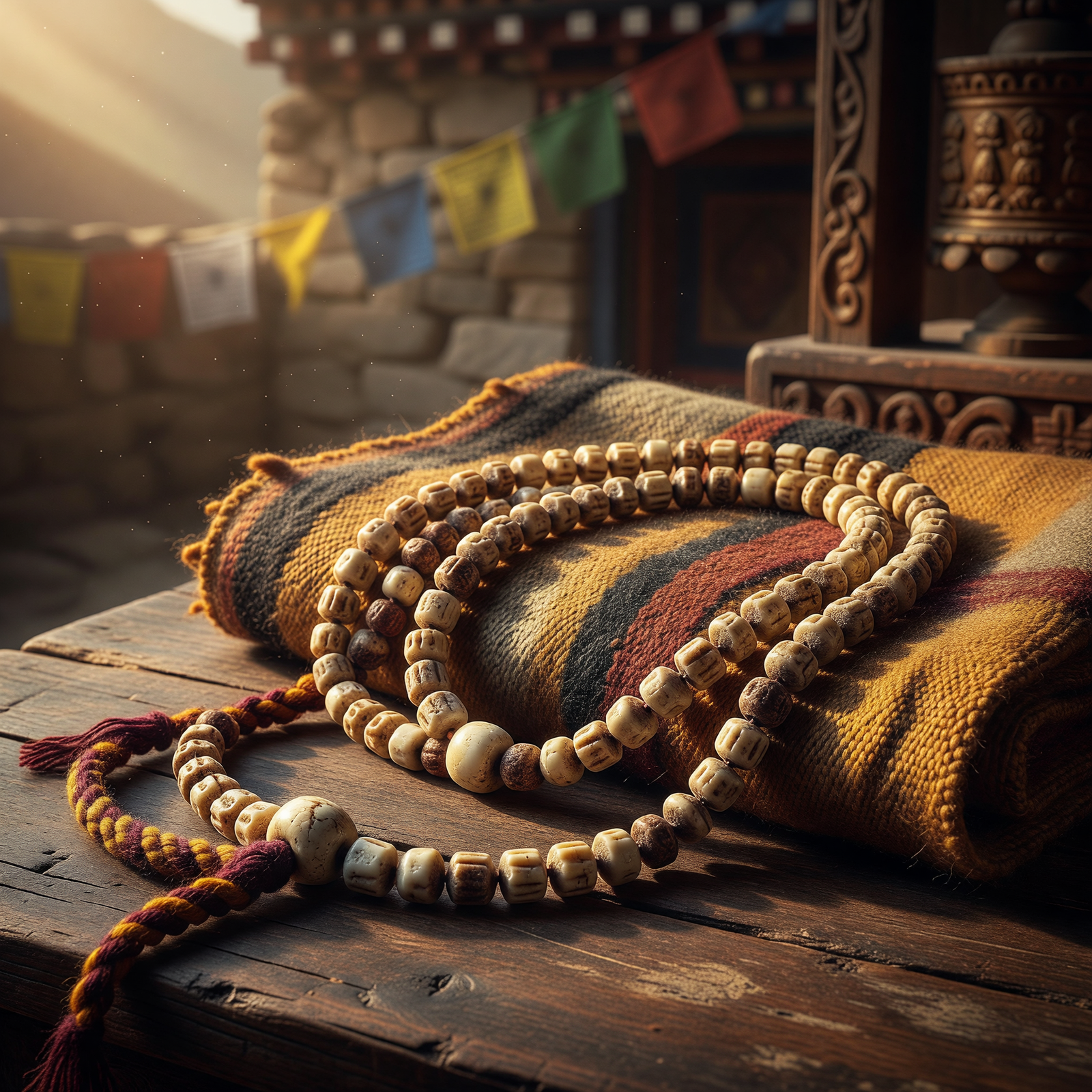
You’re sitting on your cushion, the morning light is just starting to fill the room. You’ve been at this for years. The breath comes in, the breath goes out. But lately, there's a certain flatness to it, a feeling of going through the motions.
Your practice, once a source of deep insight, now feels like a well-worn path you could walk with your eyes closed. You might even feel a subtle frustration, a sense that you've hit a plateau.
The beautiful sandalwood mala in your hands feels smooth and familiar, but it no longer challenges you. This is a common, and important, stage in a long-term practice. It’s often a signal that the mind is ready for a closer, more direct contemplation.
For practitioners like you, understanding the yak bone mala meaning might be the very thing that re-ignites the path, moving you from the comfort of routine to the frontier of profound insight. It’s not only another item in an authentic mala beads collection; it's a direct confrontation with the core of the Dharma.
The Foundation: What a Yak Bone Mala Really Is
Let's clear the air. When you first hear "yak bone mala," the Western mind can conjure some fairly gothic imagery. It sounds stark, maybe even a bit morbid. There's a common misconception that it's an aesthetic choice, a sort of "spiritual punk rock" statement.
This couldn't be further from the truth. In the Tibetan tradition, a yak bone mala isn't about death; it's about life. Specifically, it's about the precious, fleeting, and unrepeatable nature of this very life you're living.
To truly grasp its significance, you have to stand on the Tibetan plateau yourself—at 12,000 feet, where the air is thin and the horizon stretches endlessly. This isn't a land of lush forests with abundant hardwoods for carving beads.
It's a high-altitude landscape, stark and beautiful, where life and death are visibly intertwined. The yak is not only an animal here; it's central to existence. It provides milk, butter for tea, wool for clothes, and muscle for transport.
When a yak dies of natural causes, nothing is wasted. It's an act of deep respect for the animal's life-giving role. Using its bones for a mala is the ultimate expression of this principle—transforming the vessel of a past life into a tool for awakening in this one.
This practice is deeply connected to the Tibetan Buddhist understanding of impermanence, or anicca. It's one of the three marks of existence. We know this intellectually. You've read the books, you've heard the talks.
But holding a mala made of bone makes it visceral. Each bead is a tangible reminder that all conditioned things—our bodies, our thoughts, our relationships, the yak itself—are subject to decay and cessation. It's not a depressing thought.
On the contrary, it's a liberating one. It's a direct, non-negotiable invitation to be fully present, because this moment is all that truly exists. It cuts through the mind's tendency to create endless narratives about the past and future, anchoring you squarely in the now.
So, a yak bone mala isn't a symbol of death. It's a celebration of the life that was, and a powerful exhortation to live the life that is with awareness and purpose. It is the Dharma made tangible, a piece of the Himalayan landscape you can hold in your hand.
Alt text: A close-up of an artisan's hands in our Kathmandu workshop, carefully carving intricate designs onto a single yak bone bead for a mala.
Why This Matters in 2026

You might wonder, "Why this specific, stark reminder now?" In a world saturated with digital abstraction and endless pursuits of permanent security, the raw, earthy reality of a yak bone mala—each bead hand-carved from bone sourced in Bhutan and Nepal—is more relevant than ever.
Let's bring this down from the Himalayan peaks and into the specifics of your life in 2026.
Think about your professional life. You're likely in a position of responsibility. There are quarterly reports, strategic plans stretching five years out, and the constant pressure to build, grow, and secure. Your mind is trained to create stability and predictability.
Yet, you know from experience how quickly a market can shift, a project can get derailed, or a key team member can leave. This creates a low-grade, persistent tension. Holding a yak bone mala during a five-minute pause before a high-stakes meeting is a powerful practice.
As your fingers touch each bead—typically 108 beads, the number representing the 108 afflictions in Buddhist philosophy—you are silently acknowledging the impermanent nature of the situation. It doesn't mean you don't care about the outcome.
It means you loosen your white-knuckle grip on it. This allows you to act with clarity and conviction, rather than from a place of fear or attachment. You become more adaptable, more resilient, because your sense of well-being is no longer entirely dependent on a specific result.
Now, consider your family. Perhaps you're working through a relationship with a spouse where old patterns have created a sense of stalemate. Or maybe you're watching your children grow up with a bittersweet mix of pride and loss, realizing the small child you knew is gone forever.
Or, the most potent practice of all, you are caring for aging parents. Witnessing the slow, inevitable decline of the people who once seemed invincible is perhaps life's most direct teaching on impermanence. In these moments, intellectual understanding of the Dharma can feel hollow.
A yak bone mala becomes a grounding tool—something you can hold in your palm during a difficult conversation, or turn over in your pocket while sitting at a hospital bedside. It's a reminder that this phase of life, too, is transient.
It can help you meet moments of grief, frustration, or sadness with compassion and presence, rather than resistance. It helps you cherish the time you have, fully and without reservation, because you are holding a constant reminder that it is finite.
Even your own practice can become an object of attachment. You might be attached to the idea of "progress," frustrated by the plateau you feel you're on. The yak bone mala is a beautiful antidote to this spiritual ambition.
It reminds you that the goal is not to achieve some permanent state of blissful enlightenment. The practice is about being fully present with the ever-changing flow of experience—the plateaus, the insights, the boredom, the joy.
Each bead is a lesson: this too shall pass. This simple, enduring truth is the key to unlocking a more mature, resilient, and authentic practice. It's what moves you beyond the basics and into the heart of the path.
Real Benefits: How a Yak Bone Mala Works on the Mind
Beyond the rich symbolism, using a yak bone mala in your daily practice cultivates specific shifts in perception and being. It's not magic; it's a form of targeted mental training, using a tactile object to reinforce core Dharma principles.
For a seasoned practitioner, this can be the difference between knowing a concept and truly embodying it.
Deepening the Embodiment of Anicca (Impermanence)
You've likely spent hundreds of hours on the cushion observing the transient nature of thoughts, feelings, and sensations. You know that nothing is permanent. Yet, we live our lives as if everything is. We build careers, relationships, and identities with an implicit assumption of solidity.
A yak bone mala acts as a powerful interruption to this cognitive dissonance. The material itself—once part of a living, breathing creature—is a direct link to the cycle of birth, life, and death. When you recite a mantra, with each bead that passes through your fingers, you are physically handling a a sign of impermanence.
The cool, dense, slightly porous feel of the bone is different from wood or seed. It has a gravity to it. This sensory input works on a pre-verbal level. It bypasses the analytical mind and speaks directly to a closer, more intuitive part of your consciousness.
Over time, this repeated, tactile reminder starts to permeate your worldview. You begin to see the impermanent nature of things not as a philosophical concept, but as a living reality in every moment.
Cultivating Renunciation and Non-Attachment
For those on a path of self-inquiry, the word "renunciation" can sound extreme. It brings to mind images of giving up everything and living in a cave. But in the context of your life, renunciation is far more subtle and practical.
It's not about renouncing your family or your career; it's about renouncing your neurotic attachment to outcomes. It's the practice of letting go. A yak bone mala is a supreme tool for this. Contemplating the origin of the beads—a great, powerful animal that once roamed the high plains and is now gone—puts your own attachments into perspective.
The frustration over a delayed flight, the anxiety about a presentation, the sting of a critical comment—these things, held against the backdrop of life's great cycles, begin to lose their power. The practice becomes: "This feeling of anger is arising.
Like the yak, it had a beginning. Like the yak, it will have an end." This doesn't suppress the feeling; it creates space around it. You are less likely to be swept away by it.
This is the heart of emotional freedom, and a yak bone mala is a daily training partner in this essential work. It offers a more direct and bracing form of wisdom than, say, a sandalwood 108 mala, which carries a gentler presence.
Connecting with the Himalayan Lineage
For a practitioner who values authenticity, the source of your tools matters. A mass-produced object from a factory lacks a certain heart. An authentic yak bone mala is a direct connection to a place, a people, and a living tradition.
When we say our malas are crafted by artisans like Master Tenzin in our Boudhanath workshop, this is not a mere marketing detail. It means your mala was shaped by hands that are part of a lineage.
The bone was sourced ethically and respectfully. The carving techniques have been passed down through generations since the 15th century when Tibetan mala-making first became formalized. Often, the beads are blessed during ceremonies at nearby monasteries, like Sera Monastery, where monks have practiced for over 600 years.
This infusion of intention and heritage is palpable. Holding the mala connects you to the entire ecosystem of Tibetan Buddhism: the challenging environment of the plateau, the deep-rooted devotion of its people, and the unbroken chain of practitioners who have walked this path before you.
It transforms a personal practice tool into a link with a global sangha, reminding you that you are not on this journey alone. This deep sense of connection can be a powerful support, especially when the path feels difficult or solitary.
The full meaning of the 108 beads is amplified when you feel this lineage in your hands.
How to Choose an Authentic Yak Bone Mala

When you decide that a yak bone mala is the right next step for your practice, it's crucial to find an authentic piece. The market is unfortunately filled with fakes made from plastic, resin, or other types of bone passed off as yak.
For a tool of spiritual practice, authenticity isn't just about aesthetics; it's about integrity. An object intended to help you contemplate reality should, at the very least, be real itself.
Here are the criteria to consider:
- Material Feel and Appearance: Real yak bone has a unique character. It's not perfectly uniform like plastic. Look for subtle variations in color—creamy whites, beiges, and sometimes faint greyish or brownish undertones from the natural aging and mineral absorption process. Each bead should have a slight heft and a cool touch. If you tap it gently against a tooth (an old jeweler's trick), it should make a dull 'clink' sound, whereas plastic will sound flat and feel warmer. You might also see tiny, hair-like pores or striations on the surface under close inspection, evidence of its organic origin. Genuine yak bone typically weighs between 4-6 grams per bead, noticeably heavier than resin alternatives.
- The Source and Ethics: This is paramount. An authentic Tibetan mala is made from the bones of yaks that have died from natural causes. This is a foundational principle of compassion and respect for life. We have spent years building relationships with families and communities on the Tibetan plateau who understand this. They ensure that the animal lived a full, natural life. Avoid any seller who cannot speak to the provenance of their materials. A genuine piece is an investment in an ethical supply chain that supports, rather than exploits, the culture it comes from.
- Craftsmanship: Look at the details. Are the beads well-shaped and smooth, allowing them to pass easily through your fingers during mantra recitation? If they are carved, like the popular skull beads, examine the quality of the carving. The work of a skilled artisan like those in our Kathmandu atelier will show precision and character, not the sloppy, molded look of mass-produced fakes. The guru bead and tassel should also be well-constructed, using durable materials. This is the piece you'll still wear in 20 years, so quality matters. Browsing a curated selection of handcrafted Tibetan malas can help you develop an eye for this quality.
- Intention and Blessing: A truly special mala is more than assembled parts. It's created in an environment of practice and intention. Our workshops are located in Boudhanath, a hub of Tibetan Buddhism in Nepal, and the artisans themselves are often practitioners. Furthermore, we often take our finished malas to be blessed by monks from local monasteries. This isn't mystical embellishment; it's an infusion of positive intention and auspicious energy, setting the stage for the mala to be used as a sacred object. You can find more details on material selection in our Mala Beads Complete Guide.
Choosing a yak bone mala is a personal process. It should feel right in your hand. It should resonate with your intention. Other materials, like a Bodhi seed mala, connect you to the Buddha's enlightenment, while a Rudraksha mala has strong ties to Hindu and Buddhist tantric traditions.
The yak bone mala is unique in its direct, unflinching focus on impermanence. It is the choice for the practitioner who is ready to engage with this fundamental truth on a closer level, and to carry that awareness forward into every recitation.
Alt text: A collection of Buddhabelief yak bone malas, showing the natural variation in bead color and texture, laid out on a dark, rustic wooden table.
How To Use It Day To Day in Your Practice
Integrating a yak bone mala into your practice is about more than replacing your old one. It's about shifting your intention to align with the unique properties of the material. While the fundamental mechanics of mantra recitation remain the same, your inner focus can be refined to open up the mala's full potential.
Here are some specific ways to practice with your yak bone mala:
-
Contemplation on the Four Reminders: The Four Reminders (or Four Thoughts that Turn the Mind to the Dharma) form the foundation of Tibetan practice, systematized during the Kagyu lineage's early teachings, and a yak bone mala is the perfect companion for it. Before your main sitting meditation, hold the mala and dedicate a few minutes to each reminder, using the beads to keep your focus:
- First, the preciousness of this human birth. As you touch each bead, reflect on the rare fortune of having the time, capacity, and resources to practice the Dharma.
- Second, the reality of death and impermanence. This is the mala's core strength. Feel the bone—its weight, its coolness against your skin. Acknowledge that this body you inhabit is also impermanent. Let this not be a source of fear, but of urgency and inspiration to practice diligently.
- Third, the infallibility of karma. With each bead, recognize that your actions of body, speech, and mind have consequences. Let this cultivate mindfulness and ethical conduct throughout your day.
- Fourth, the suffering inherent in samsara. Reflect on the pervasive nature of dissatisfaction. Let this cultivate a genuine sense of compassion for all beings caught in this cycle, and strengthen your resolve to awaken for their benefit.
- Mantra with Specific Visualization: While reciting your chosen mantra, add a layer of visualization tied to impermanence. For example, with each recitation of Om Mani Padme Hum, as you pull a bead towards you, you can visualize your own attachments, aversions, and ignorance dissolving. Watch them turn to dust and blow away, just as all compounded things eventually disintegrate. The physical sensation of the bone bead—typically 8 to 10 millimeters in diameter—acts as an anchor for this powerful mental practice. For a refresher on the basics, you can reference our guide on how to use mala beads for meditation.
- As a Moment-to-Moment Reminder: Don't confine your mala to the cushion. Wear it throughout the day. When you find yourself caught in a moment of stress at work or frustration at home, simply touch the beads. Let the cool, solid feel of the bone be a pattern interrupt. Use it as a sensory cue to take a single conscious breath and remember the bigger picture. This simple act can break the chain of reactivity and bring a moment of spacious awareness into an otherwise challenging situation. It's a discreet and powerful way to integrate your practice into the fabric of your daily life.
Common Questions About Yak Bone Malas
Even for an experienced practitioner, a yak bone mala can bring up some specific questions. It's a material with a powerful story, and it's wise to approach it with curiosity and respect. Here are some of the questions we hear most often.
1. Is it ethical to use a mala made from animal bone?
This is the most important question, and the answer lies entirely in the source. From a genuine Tibetan Buddhist perspective, it is only ethical if the animal died of natural causes. The yak is a revered animal, essential to life on the Tibetan plateau above 10,000 feet, and is never harmed for its bones.
Our artisans work with communities in the Amdo and Kham regions that have upheld this tradition since at least the 11th century. The use of the bone is an act of respect, ensuring no part of the cherished animal goes to waste.
It's a world away from industries where animals are exploited. When you choose an authentic mala from a source that can verify its ethical origins, you are participating in a compassionate and sustainable tradition, not one of harm.
2. Are yak bone malas hygienic or safe to wear?
Absolutely. The bones undergo a thorough and lengthy cleaning and curing process before they are ever touched by a carver. They are boiled, cleaned, and sun-dried, often for six to eight weeks in the high-altitude air.
This process sterilizes the bone completely, making it safe and durable. The finished beads are smooth and non-porous on the surface. They are just as clean and safe to wear against your skin as any wood or stone bead.
Over time, like many natural materials, they may absorb some of your skin's oils, which can lead to a beautiful, subtle patina, darkening the beads slightly and making the mala uniquely yours.
3. Do the bones carry the presence or spirit of the animal?
This question touches on a blend of different spiritual ideas. From a strict Tibetan Buddhist viewpoint, the focus isn't on the bone carrying the individual spirit of a particular yak. Instead, the bone is a potent symbol and a direct representation of the universal truth of impermanence and the cycle of life and death.
It's a teaching tool. Its power is its ability to constantly remind your mind of this reality. It doesn't carry the animal's consciousness, but rather the lesson of its (and our) mortal existence. It prompts contemplation, not communication with an animal spirit.
4. How does a yak bone mala differ from a human bone (kapala) mala?
Human bone malas, known as kapala or thöpa malas in Tibetan, are highly specialized implements used in advanced Vajrayana practices. They are not for general use and carry a much more intense and specific symbolism related to confronting death and ego in a tantric context.
They are traditionally made from the bones of 108 different individuals, often sourced from sky burial sites with the proper ritual permissions. A yak bone mala, while potent, is a much more accessible tool for contemplating impermanence for any serious practitioner.
It carries the same core teaching but without the specific, and often misunderstood, tantric requirements of a kapala mala.
5. Why are some yak bone malas carved into skulls?
The skull imagery is another direct, unflinching symbol of impermanence. In Tibetan art, the skull (kapala) is not a morbid or evil symbol. It represents the cessation of the conceptual mind and the transcendence of ego.
It's a reminder of the empty nature of phenomena. A mala with skull beads simply amplifies the core teaching of the bone material itself. It is a favorite among practitioners of Chöd or other lineages that work directly with confronting fear and attachment to the self.
For those on this path, it's a liberating symbol of freedom from the fear of death.
6. How do I care for my yak bone mala?
Care is quite simple. As a natural material, it's best to avoid exposing it to harsh chemicals, perfumes, or prolonged immersion in water. If it needs cleaning, you can wipe it with a soft, slightly damp cloth and let it air dry completely.
As mentioned, it will naturally develop a patina over time from contact with your skin's oils, which is considered a positive sign of its use in practice. Store it in a soft pouch or a dedicated wooden box when not in use.
Treat it with the respect due to any sacred object, and it will serve your practice for a lifetime.
Your Journey Forward
The path of practice is not a straight line upwards. It has seasons. There are periods of rapid growth and insight, and there are plateaus where the terrain seems unchanging. These quieter times are not failures; they are invitations to go deeper, to bring a new quality of attention to your practice.
By 2026 and beyond, as the world continues to present its complexities, having tools that anchor you in fundamental truth will be more vital than ever.
A yak bone mala is more than a string of beads. It is a piece of the Tibetan plateau, a connection to a lineage of devoted practitioners, and a constant, tactile sermon on the nature of reality.
It is a companion for the practitioner who is no longer satisfied with only the soothing aspects of the path and is ready to courageously engage with its most profound and liberating truths. It is a tool to help you navigate your career, your relationships, and your own mind with greater wisdom and less fear.
If you feel that call to deepen your confrontation with impermanence, to move through your current plateau into a new landscape of practice, we invite you to explore our mala bead collection. Perhaps you will find the very piece that is waiting to accompany you on the next stage of your journey.
Keep reading