buddhist-jewelry
Yamantaka — Destroyer of Death in Tibetan Buddhism
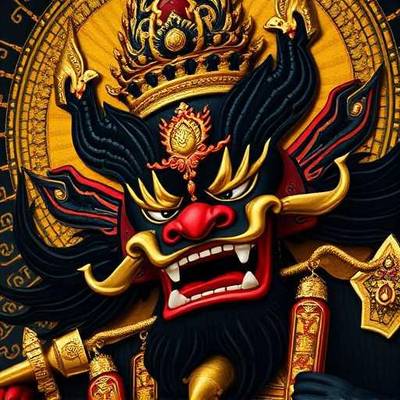
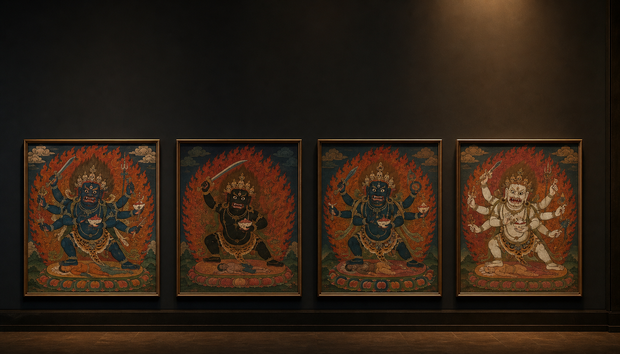
To gaze upon an image of Yamantaka is to be confronted by a whirlwind of terrifying, paradoxical power. Here is a deity with a furious buffalo head, nine faces contorted in wrath, thirty-four arms wielding an arsenal of sharp implements, and sixteen legs trampling a host of beings.
For those unfamiliar with the profound symbolism of Tibetan Buddhism, the immediate reaction can be one of confusion, even fear. How can a tradition rooted in compassion and peace produce such a ferocious figure?
This very question is the gateway to understanding one of the most potent and meaningful deities in the Vajrayana pantheon. Yamantaka is not a demon to be feared, but a sublime expression of enlightened wisdom, a protector whose wrath is the dynamic energy of compassion itself.
He is the ultimate conqueror, not of external foes, but of the one great enemy that binds all beings to suffering: Death. Exploring the rich weave of his form reveals the depths of the Buddhist path, a journey reflected in the sacred art of wrathful deity jewelry and artifacts.
Who Is Yamantaka? The Subduer of Yama
The name "Yamantaka" provides the first and most crucial clue to his identity. It is a Sanskrit compound of two words: Yama, the name of the Hindu and Buddhist Lord of Death, and antaka, meaning "destroyer" or "ender." Thus, Yamantaka is the "Destroyer of Death." This title is not meant in a literal, physical sense, as if he prevents the biological process of dying.
Rather, he destroys the concept of death as a source of terror and a final, absolute end. In Buddhist philosophy, the fear of death is a primary driver of the clinging, aversion, and ignorance that perpetuate the cycle of rebirth and suffering (samsara).
By conquering this fear, one conquers samsara itself.
Yamantaka plays a dual role in Tibetan Buddhism. He is a Dharmapala, or "Dharma Protector." In this capacity, he is a guardian of the Buddhist teachings and its practitioners. He clears away obstacles—both internal, like doubt and laziness, and external, like negative influences—that hinder spiritual progress.
His terrifying appearance serves to frighten away malevolent forces and to shock the practitioner out of complacency. Many powerful protectors, such as the great protector Mahakala, share this function of guarding the path.
More profoundly, Yamantaka is a Yidam, a personal meditational deity. A Yidam is a fully enlightened being who serves as a focus for tantric meditation. Practitioners visualize themselves as the Yidam, not as an act of ego but as a method to internalize the enlightened qualities that the deity represents.
By meditating on Yamantaka, a practitioner directly confronts and transforms the deepest-seated afflictions: anger, hatred, and, above all, the primal fear of mortality. He is also known as Vajrabhairava, the "Adamantine Terrifier," highlighting his indestructible (vajra) nature and his awesome power to inspire fear in the ego and its delusions.
<The Nine Faces and 34 Arms — Full Iconography Decoded
Every single detail of Yamantaka's complex form is rich with symbolic meaning, a visual map of the path to enlightenment. Understanding his iconography is to read a sacred text written not in words, but in imagery.
Let's decode the main elements of his form as Vajrabhairava, his most common intention-setting.
The Nine Faces: A Spectrum of Consciousness
The nine faces of Yamantaka represent the nine major scriptural categories (sutras) of Buddhism. They also symbolize a complete mastery over all directions of perception and thought.
- The Central Head: The main face is that of a ferocious, enraged black buffalo with sharp, pointed horns. This directly mirrors the form of Yama, the Lord of Death, signifying that Yamantaka has met and completely overpowered the force of death on its own terms. The wrath is not ordinary anger but the fierce, unstoppable energy of wisdom that consumes ignorance.
- The Three Right Faces: To the right of the central head are three faces, typically colored yellow, blue, and red. They symbolize the transformation of anger, aggression, and hatred into a potent force for overcoming obstacles.
- The Three Left Faces: To the left are three faces, colored white, grey, and black. These represent the subjugation of desire, greed, and attachment.
- The Face Above: Between the horns of the buffalo head is a smaller, slightly wrathful red face. This is often identified as representing the mastery of all passions.
- The Topmost Head: At the very peak is the serene, peaceful head of a youthful Manjushri, the Bodhisattva of Transcendent Wisdom. This is the most critical element. It reveals Yamantaka's true nature. Despite the terrifying display below, his ultimate essence is the pure, calm, and compassionate wisdom of Manjushri. The wrath is merely a skillful means, an expression of that wisdom.
The Body and Limbs: Method, Wisdom, and Action
Yamantaka's body is a deep, dark blue, the color of space and ultimate reality (dharmakaya). It signifies that his nature is emptiness, the fundamental ground of all existence from which all phenomena arise. He is depicted in union with his consort, Vajravetali.
- The Thirty-Four Arms: Each of his 34 arms, combined with his body, speech, and mind, represents the 37 factors of enlightenment. In his two principal hands, he holds a curved flaying knife (kartika) and a skull cup (kapala) filled with blood. The knife symbolizes the wisdom that cuts through the root of suffering—ignorance and ego-clinging. The skull cup represents blissful consciousness and the transformation of what is normally considered impure (blood) into the nectar of wisdom. His other hands hold a vast array of implements: ritual daggers (phurba) to pin down delusion, axes to sever karmic ties, spears, swords, bells (representing wisdom), and vajras (representing method). This divine arsenal symbolizes the countless skillful means an enlightened being possesses to benefit others.
- The Sixteen Legs: His sixteen legs stand upon a host of beings, including Hindu gods like Brahma and Indra, as well as humans and animals. This is not a display of sectarian dominance. Symbolically, it represents trampling upon all worldly concerns, attachments, and limited states of being. The beings underfoot represent the eight worldly siddhis (remarkable powers) and the eight mundane accomplishments, all of which are transcended on the path to full enlightenment.
- The Consort, Vajravetali: Yamantaka is often shown in sexual union (yab-yum) with his consort, Vajravetali. She is naked, representing a mind free from conceptual obscurations, and holds a flaying knife and skull cup, mirroring his own. Their union is not a depiction of ordinary passion but the supreme symbol of the non-dual nature of reality. Yamantaka (yab, the father) represents method, skillful means, and compassion, while Vajravetali (yum, the mother) represents wisdom and the realization of emptiness. Enlightenment arises from the inseparable union of these two principles.
The Environment of Flames
Yamantaka stands amidst a blazing mass of primordial wisdom fire. This fire does not burn with ordinary heat but represents the intense, dynamic energy of wisdom that consumes every trace of ignorance, delusion, and neurotic thought, purifying the mind completely.

The Story of Manjushri Becoming Yamantaka
The origin story of Yamantaka is a powerful allegory that explains why such a wrathful form is necessary. The tale begins with two holy ascetics who were deep in meditation in a secluded cave, nearing the culmination of their spiritual practice.
One day, a group of thieves entered the cave with a stolen buffalo. Seeing the meditators, and fearing they would be identified, the thieves ruthlessly beheaded them. In their carelessness, they also decapitated the buffalo.
The fury of this unjust act was so immense that the spirit of one of the meditators rose with unimaginable rage. Unable to find his own head in the darkness, he put the buffalo's head on his shoulders and was reborn as Yama, the terrifying Lord of Death.
In his blind fury, Yama killed the thieves and drank their blood from their skulls. But his rage was not satisfied. He threatened to kill every living person in Tibet, depopulating the entire land.
The people were terrified, their prayers and offerings powerless against this unstoppable force of death.
In their desperation, they prayed to Manjushri, the embodiment of the gentle wisdom of all Buddhas. Hearing their pleas, Manjushri understood that confronting such immense anger and terror required a form that was even more powerful and terrifying.
Responding with profound compassion, he manifested as Yamantaka. He took on a form that mirrored and magnified Yama's own—not with one buffalo head, but nine; not with two arms, but thirty-four; not with two legs, but sixteen.
He appeared as the ultimate terror, the "death of Death" itself.
Confronted by this awesome and superior power, Yama was completely subdued. His rage was pacified, and his mind was cleared of its delusion. Yamantaka did not destroy Yama but transformed him. He bound Yama by an oath to cease his rampage and instead become a protector of the Buddhist teachings, a Dharmapala who would guard practitioners from harm.
This story beautifully illustrates the tantric principle of transformation: the most powerful negative energies, like rage and terror, are not to be rejected but met, understood, and transformed by an even greater force of wisdom and compassion.
<Yamantaka in Gelug Tradition — The Highest Yoga Tantra
While revered across different schools of Tibetan Buddhism, Yamantaka holds a particularly pre-eminent position within the Gelug school, founded by the great master Je Tsongkhapa. Alongside Guhyasamaja and Chakrasamvara, Yamantaka is one of the three principal meditational deities (Yidams) of the Gelug lineage.
The practice of Yamantaka is considered a cornerstone of their tantric system.
This practice belongs to the highest class of Buddhist tantra, known as Anuttarayoga Tantra, or Highest Yoga Tantra. This level of practice is considered the most profound and swift path to enlightenment, but it is also the most demanding and complex.
It is not undertaken lightly and requires a formal initiation (wang) and direct instruction from a qualified and experienced lama.
Why is this practice so powerful? Highest Yoga Tantra works directly with the most subtle levels of mind and energy. The core principle is transformation. Instead of trying to suppress or eliminate negative emotions (kleshas) like anger and desire, the practitioner learns to harness their raw energy and transform it into the fuel for enlightenment.
The Yamantaka practice is specifically designed to work with the most powerful and fundamental of these energies: anger and the fear of death.
The meditation involves two stages: the generation stage and the completion stage. In the generation stage, the practitioner, through complex visualizations and mantra recitation, dissolves their ordinary sense of self and arises in the divine form of Yamantaka.
This process dismantles the ego's grip and allows the practitioner to experience the world from the perspective of an enlightened being. In the completion stage, the focus shifts to working with the subtle energies, channels, and drops (nadi, prana, bindu) within the body to bring about a profound psycho-physical transformation, leading to the realization of the clear light mind—the most fundamental level of consciousness, which is the very nature of Buddhahood.
For Gelug practitioners, the Yamantaka sadhana is a complete path to enlightenment, a powerful method for realizing the union of bliss and emptiness and for attaining the state of a Buddha in a single lifetime.
What Yamantaka Represents Psychologically and Spiritually
Beyond the complex rituals and iconography, Yamantaka offers a profound psychological and spiritual teaching that is relevant to everyone. He is the ultimate symbol of confronting our own inner demons. The "death" that he destroys is not only physical cessation but the death of the ego, the small, constructed self that is the source of all our suffering.
On a psychological level, Yamantaka represents the courage to face what we fear most. His wrathful energy is the focused, unhesitating power needed to cut through our own patterns of self-deception, procrastination, and denial.
He embodies a kind of "spiritual warrior" archetype, one who does not shy away from the darkness within but enters it with the light of wisdom to transform it. The anger he displays is not petty, selfish rage.
It is a righteous, compassionate fury directed at ignorance and delusion. It is the energy that says "no" to suffering and its causes.
This is a key concept in understanding all wrathful deities in the Buddhist tradition. Like his fellow protector the Six-Armed Mahakala, Yamantaka's ferocity is a intention-setting of skillful means (upaya).
Just as a loving parent might shout to pull a child from the path of an oncoming car, a Buddha may call in in a wrathful form to shock us out of our dangerous, samsaric habits.
Spiritually, Yamantaka is the embodiment of the enlightened mind's ability to overcome the final obstacle: the dualistic conception of life and death. By meditating on him, one familiarizes the mind with its own fearless, indestructible nature.
The practice prepares the practitioner for the actual process of dying, transforming it from an experience of terror and loss into a gateway for liberation. He teaches that by "dying" to our ego and our fear before our physical death, we can live and die with freedom, clarity, and profound peace.
Yamantaka Jewelry and Thangkas — Appropriate Use
Given the sacred and profound nature of Yamantaka, how should one approach artifacts that bear his image, such as pendants, statues, or thangka paintings? These items are not mere decorations; they are potent symbols and supports for spiritual practice and inspiration.
Wearing a Yamantaka pendant or displaying his image should be done with a sense of respect and mindfulness. It serves as a constant reminder of the qualities he embodies: fearless wisdom, compassionate action, and the power to overcome inner obstacles.
For a practitioner, it is a connection to their Yidam and their vows. For someone inspired by the path, it is a source of strength and a reminder to face life's challenges with courage.
Here are some guidelines for respectful use:
- Placement: A thangka or statue of Yamantaka should be placed in a high, clean, and respected area of your home, such as a personal altar or a dedicated meditation space. It should not be placed on the floor or in a bathroom.
- Intention: When you wear a piece of sacred wrathful deity jewelry, do so with a positive intention. Let it remind you to be courageous in the face of your own anger and fear, and to act with wisdom and compassion.
- Understanding: Take the time to understand the meaning behind the image. Seeing Yamantaka not as a monster but as a intention-setting of Manjushri's wisdom transforms the object from a simple ornament into a powerful tool for personal growth.
By treating these sacred images with the reverence they deserve, we honor the profound teachings they represent and invite their transformative energy into our lives.
Frequently Asked Questions
- 1. Is Yamantaka evil or a demon?
- No, absolutely not. This is a common misconception due to his wrathful appearance. Yamantaka is a fully enlightened Buddha, a intention-setting of Manjushri, the Bodhisattva of Wisdom. His terrifying form is a skillful means used out of compassion to subdue the most powerful negative forces, primarily the ego and the fear of death.
- 2. Who is Yamantaka's consort?
- His consort is Vajravetali. Her name means "Adamantine Ghoul" or "Vajra Zombie." In the context of their union (yab-yum), she represents the perfection of wisdom (prajna) and the realization of emptiness, while Yamantaka represents skillful means and compassion. Their union symbolizes the non-dual nature of enlightenment.
- 3. What is the Yamantaka mantra?
- The core mantra of Yamantaka is OM YAMANTAKA HUM PHAT. Like all tantric mantras, its power is not only in the literal meaning of the words but in the vibrational quality that connects the practitioner to the deity's enlightened energy. It is a potent tool for purifying negative karma and overcoming obstacles when recited with proper motivation and, ideally, after receiving transmission from a qualified teacher.
- 4. Why is Yamantaka a buffalo-headed deity?
- He adopts the buffalo head to directly mirror and overpower Yama, the Lord of Death, who took that form in the origin myth after being unjustly killed along with a buffalo. By manifesting in a superior, more powerful version of Yama's form, Yamantaka demonstrates his complete mastery over the forces of death and anger.
- 5. Can anyone practice Yamantaka meditation?
- No. The practice of Yamantaka is part of Highest Yoga Tantra, which requires a formal initiation (empowerment or wang) from a qualified lama who holds the authentic lineage. Attempting these complex practices without proper guidance can be ineffective and potentially harmful. However, anyone can appreciate his symbolism and draw inspiration from his qualities of courage and wisdom.
- 6. How is Yamantaka different from Mahakala?
- While both are powerful wrathful figures, their primary roles differ. Yamantaka is principally a Yidam, a meditational deity for attaining enlightenment. The practitioner visualizes themself as Yamantaka to realize their own Buddha-nature. Mahakala is primarily a Dharmapala, a Dharma Protector. While he is also an enlightened being, his practice is more focused on invoking his aid to clear obstacles and protect the practitioner and the teachings. There is overlap, but this Yidam/Dharmapala distinction is the key difference in their function.
- 7. What does "Yamantaka" literally mean?
- The name is a Sanskrit compound of "Yama" (the Lord of Death) and "antaka" (ender or destroyer). It translates directly to "The Destroyer of Death" or "The Ender of Yama."
The Death of Death Itself
Yamantaka, the Adamantine Terrifier, is far more than a fearsome image from a distant culture. He is a profound symbol of the human potential to face our ultimate fear and transform it into boundless wisdom and compassion.
He teaches us that the greatest obstacles are not external forces, but the delusions within our own minds. His nine faces, thirty-four arms, and blazing fire are not a portrait of a demon, but a dynamic illustration of the enlightened mind in action—powerful, multifaceted, and utterly fearless.
To understand the Yamantaka meaning is to understand that true courage is not the absence of fear, but the willingness to meet it head-on with the sharp blade of wisdom. He is the promise that the cycle of suffering, driven by the terror of impermanence, can be brought to an end.
By embracing this principle, we can begin to conquer the "little deaths" we face every day—the death of our ego's demands, our attachments, and our limiting beliefs—and in doing so, truly begin to live.
Explore the power of these teachings through our collection of authentic wrathful deity artifacts, each piece a reminder of the unconquerable spirit within.



Keep reading