News
Taoist Jewelry: A Collector's Guide to Meaning & Authenti...
Navigate Your Journey
You might be standing in front of your collection cabinet, the soft light catching the intricate silverwork of a Tibetan Gau box. Next to it sits a serene, pale green jade pendant you picked up years ago.
They feel different, born of distinct worlds, yet you sense a thread connecting them—a shared reverence for the unseen, a similar language of form and spirit. This is a common experience for collectors who are drawn to the profound aesthetics of the East.
You know there’s a story there, but the market is awash with confusing claims and mass-produced replicas. You're not only looking for another object; you're seeking a genuine connection to a tradition, a piece that carries the weight of authenticity.
This guide is for you. It’s a bridge between the Taoist principles of harmony and the deep symbolism found in authentic Tibetan jewelry.
Taoist Jewelry Symbols is json { "title": "Taoist Jewelry: A Collector's Guide to Meaning & Authenticity (2026)", "meta_description": "A deep get into Taoist jewelry for the serious collector.
The Foundation: What Taoist Jewelry Really Is
The first misconception to set aside is that Taoist jewelry is merely a collection of Yin-Yang pendants and Bagua (eight trigram) amulets sold in tourist shops. While these are potent symbols, they are just the surface layer.
To truly understand these pieces, you have to see them not as accessories, but as cosmological tools—miniature maps of the universe designed to align the wearer with the fundamental flow of nature, the Tao.
At its core, this tradition is rooted in careful observation of the natural world. Taoist sages during the Zhou Dynasty (1046–256 BCE), long before Laozi was credited with the Tao Te Ching, spent their lives watching the cycles of the seasons, the movement of the stars, and the subtle energies of the landscape.
They saw that the same patterns that governed the cosmos were mirrored within the human body. Health, fortune, and spiritual clarity were not things to be acquired, but states of being to be returned to by achieving harmony with this natural order.
This is where the materials become paramount. A piece of jade wasn't chosen for its beauty alone; it was valued for its perceived qualities of purity, resilience, and its connection to the earth's deep, stabilizing energy.
Wood from a peach tree, especially one struck by lightning, was believed to hold potent exorcistic power. Cinnabar, the vibrant red mineral mined in Hunan Province, was central to alchemical practices aimed at achieving immortality.
Each material was a carrier of a specific kind of Qi, or life-force energy.
This philosophy has striking parallels with the pre-Buddhist Bön tradition of Tibet, which also held mountains, lakes, and stones as sacred dwelling places for spirits. When we work with our artisan partners in the Himalayan borderlands of Yunnan and Sichuan, we witness this syncretism firsthand.
A carver might be working on a Buddhist mantra one day and a Taoist symbol the next, not as a contradiction, but as a recognition of two different languages describing the same underlying reality.
True Taoist jewelry, therefore, is an embodiment of this philosophy—a wearable piece of the natural world, imbued with intention and history, designed to remind you of your own place within the great, flowing current of life.
Why This Matters More Than Ever in 2026

You might wonder why focusing on the authenticity of a centuries-old tradition is so critical right now. In 2026, we find ourselves working through a world that is increasingly abstract and dematerialized. Our lives are lived through screens, our art is generated by algorithms, and our connections are often mediated by digital platforms.
In this environment, a tangible object with a verifiable history isn't just a luxury; it's an anchor.
Consider these specific scenarios:
1. The Search for the Real in an AI-Generated World.
Every day, you're likely bombarded with images, text, and even "art" created by artificial intelligence. It can be beautiful, but it lacks a soul, a story, a human hand.
A hand-carved jade pendant from Xinjiang, with its subtle imperfections and the cool, weighty feel of the stone, offers a powerful antidote. Holding it is a direct connection to a specific artisan, a specific quarry, and a lineage of craftsmanship stretching back to the Tang Dynasty.
It's a declaration that you value the slow, deliberate work of human hands over the instantaneous output of a machine. In a world of deepfakes, this piece is your touchstone for what is real and enduring.
2. The Collector's Quest for Provenance.
The online marketplace is a minefield for collectors. A search for "Taoist amulet" can yield thousands of results, 99% of which are likely mass-produced resin or plastic items from a factory in an industrial district.
The descriptions are filled with mystical-sounding jargon designed to obscure their soulless origins. For you, the value isn't in the symbol itself, but in its authentic expression. Knowing that your piece came from a small workshop near Mount Qingcheng, a sacred Taoist mountain in Sichuan, or was sourced by people who have spent years building relationships on the ground—that is the entire point.
Provenance is the firewall against the flood of fakes. It's the difference between owning a mere decoration and becoming the custodian of a cultural artifact.
3. A Framework for working through Complexity.
Beyond the object itself, the philosophy it represents offers a remarkably relevant toolkit for modern challenges. The principles of Taoism—Wu Wei (effortless action), Yin-Yang (dynamic balance), and living in harmony with natural cycles—are not esoteric concepts.
They are practical strategies for managing burnout, making better decisions, and finding peace amidst chaos. Your Bagua pendant is not only a protective charm; it's a mnemonic device. It's a reminder, every time you see it or touch it, to take a breath, observe the interplay of forces in your life, and find the path of least resistance.
In 2026, we don't need more life hacks; we need deeper, more resilient philosophical frameworks. This jewelry is a key to one of the most elegant ever devised.
On the left, a mass-produced resin amulet with tell-tale mold lines. On the right, a hand-carved Buddhabelief jade piece showing the unique character and depth of true craftsmanship.
Real Benefits: How These Pieces Actually Work
It's easy to be skeptical about how a piece of stone or wood can have a tangible effect on your life. The "how" isn't about magic; it's about a combination of material science, psychological resonance, and the focused intention of the maker. It operates on three distinct levels.
The Energetics of Materials: Jade, Cinnabar, and Sacred Woods
The foundation of a piece's influence lies in its material composition. In Taoist thought, as in many traditions documented since the Han Dynasty, matter is not inert. Every substance possesses a unique energetic signature, or Qi.
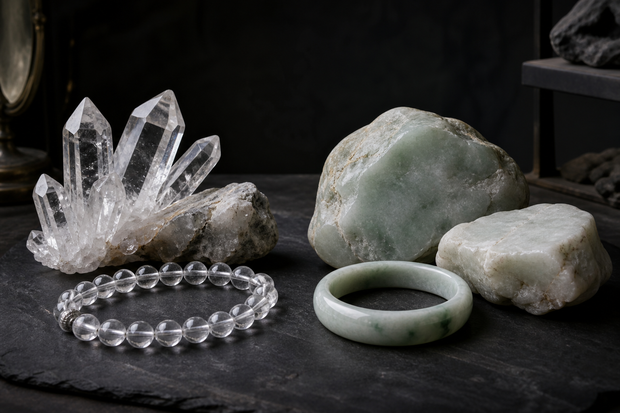
- Jade (玉, Yù): In Chinese culture, jade is more precious than gold. It's considered the "stone of heaven," a bridge between the spiritual and earthly realms. Its physical properties are key to its meaning: it's cool to the touch, suggesting serenity and temperance. It's remarkably tough—a jade bangle can survive a fall that would shatter most stones—symbolizing integrity and resilience. It's believed to resonate with the body's own energy, absorbing negative Qi and promoting physical and emotional well-being. When you wear a jade piece, you're not only wearing a stone; you're carrying a symbol of purity and a conductor of balanced energy.
- Cinnabar (朱砂, Zhūshā): This vibrant red mercury sulfide has a powerful history in Taoist alchemy. It was a key ingredient in elixirs aimed at achieving longevity and even immortality. Its fiery red color associates it with Yang energy—active, protective, and potent. In jewelry, it's used as a powerful ward against negative influences and malevolent spirits. While pure cinnabar is toxic, modern artisans use safe, stabilized forms or synthetic alternatives that carry the symbolic weight without the physical risk. An authentic piece will always prioritize safety while honoring the material's protective legacy.
- Sacred Woods: Woods like peach wood (桃木, Táomù) and sandalwood hold a special place. Peach wood is famously known as a tool for exorcism in Chinese folklore, its branches used to sweep away negativity. Sandalwood, much like in Tibetan and Hindu traditions, is prized for its calming aroma and its ability to focus the mind during meditation. A bracelet of sandalwood beads—typically strung with 108 beads in the Buddhist tradition—is a tool for tranquility, its scent a constant, gentle reminder to return to the present moment.
Symbolic Resonance: A Language for the Mind
If materials are the hardware, symbols are the software. They are complex ideas distilled into a single, potent image that speaks directly to your subconscious mind. They function as constant, silent affirmations.
- Yin-Yang (太極圖, Tàijítú): This is the most famous Taoist symbol, but it's often misunderstood as simple opposition (good vs. evil, light vs. dark). Its true meaning runs deeper. It represents the dynamic, inseparable, and complementary interplay of all forces in the universe. The dark contains the seed of the light, and the light contains the seed of the dark. Nothing is static. Wearing it is a reminder to embrace complexity, to find the quiet within the noise, and to understand that periods of rest (Yin) are essential for periods of action (Yang).
- The Bagua (八卦): The eight trigrams are a complete cosmological system. Each trigram is a combination of three lines (solid for Yang, broken for Yin) and represents a fundamental aspect of reality: Heaven, Earth, Thunder, Wind, Water, Fire, Mountain, and Lake. Arranged in a circle, they form a map of energetic states and their transformations. A Bagua amulet is a powerful symbol of universal order and protection, believed to create a field of balanced energy around the wearer, deflecting negativity and aligning them with the harmonious flow of the cosmos.
- The Five Elements (五行, Wǔ Xíng): This system of Wood, Fire, Earth, Metal, and Water describes the cycles of change and interaction. Unlike the static building blocks of Greek elements, the Wu Xing are all about process. Wood fuels Fire; Fire creates Earth (ash); Earth bears Metal; Metal carries Water; Water nourishes Wood. Understanding this cycle allows one to see the interconnectedness of all things. Jewelry incorporating the five elements (often through different colored stones) is a tool for personal balance, helping you identify which elemental energy you may need to cultivate in your life. It's a fascinating parallel to a deep lexicon of Buddhist and Bon symbols, which use a different elemental system to describe reality.
The Artisan's Intent: The Unseen Ingredient
This is the element that we at Buddhabelief believe is most crucial, and the one most often missing from mass-market items. An object's energetic quality is shaped by the consciousness of its creator. Consider the difference between a worker in a loud, chaotic factory churning out hundreds of identical items per hour, and an artisan like our partners in the quiet mountain valleys near the Tibetan plateau.
The artisan works with a reverence for the materials and a deep understanding of the symbols they are carving. Their process is a form of meditation. Every cut, every polish is imbued with focused intention.
This focus, this quiet mind, this respect—this is the real "blessing." It's an unseen layer of quality you can't measure with a caliper, but you can feel it when you hold the piece in your hand.
It's the difference between a hollow shell and a vessel filled with meaning.
How To Spot the Real Thing Taoist Jewelry: A Collector's Checklist

working through the market requires a discerning eye and a healthy dose of skepticism. For a collector like you, authenticity is everything. Here are the key criteria to use when evaluating a potential investment piece, moving beyond simple aesthetics to true quality.
Criterion 1: Material Honesty and Integrity
The first test of authenticity is the material itself. Counterfeits flood online marketplaces, and knowing what to look for is your best defense.
- Jade: Real nephrite or jadeite has a specific gravity that makes it feel heavy and dense for its size. It should feel cool and smooth to the touch, almost like soap. A simple test is the "sound test": gently tap two pieces of real jade together (or tap one with another known piece), and it should produce a high-pitched, resonant chime. Plastic or glass will produce a dull thud. Be wary of jade that is too uniform in color; natural jade almost always has variations, veins, or inclusions.
- Wood: Authentic sandalwood should have a subtle, persistent, and natural fragrance that doesn't smell perfumy or chemical. For woods like peach or ebony, look at the grain. Is it natural and slightly irregular? Mass-produced wooden beads are often made from cheap, soft wood that has been stained and lacquered to look like something it's not.
- Metals: If a piece is advertised as silver, it should have the appropriate hallmarks (e.g., "925"). Be suspicious of prices that seem too good to be true. Many "Tibetan silver" items online are actually a nickel-copper alloy with no silver content at all.
Criterion 2: The Signature of the Hand
Look for evidence of human craftsmanship. Mass production prioritizes speed and uniformity; true artisanship celebrates character and precision.
- Carving Details: On a hand-carved piece, lines will have a certain vitality to them. They may not be perfectly symmetrical, and you might see minuscule tool marks under magnification. Molded resin or plastic pieces, by contrast, will have soft, rounded edges and often a tiny, faint seam where the two halves of the mold met.
- Knotting and Assembly: On a bracelet or necklace, examine the knots. Are they tight, even, and skillfully tied? The quality of the cord and the finishing of the knots are often a sign of the overall care put into the piece. Many of our Tibetan jewelry collection pieces feature intricate, traditional knotting styles that take years to master.
Criterion 3: Symbolic and Cultural Accuracy
This is where a little knowledge goes a long way. Counterfeits often get the details wrong because the makers don't understand the meaning behind the symbols.
- Bagua Arrangement: There are two primary arrangements of the Bagua. The "Former Heaven" (or Fuxi) arrangement is symmetrical and represents the ideal, primordial state of the universe. The "Later Heaven" (or King Wen) arrangement is asymmetrical and represents the call in world of change and cycles. A knowledgeable artisan will use the correct one for the intended purpose of the amulet. A cheap knock-off might just jumble the trigrams randomly.
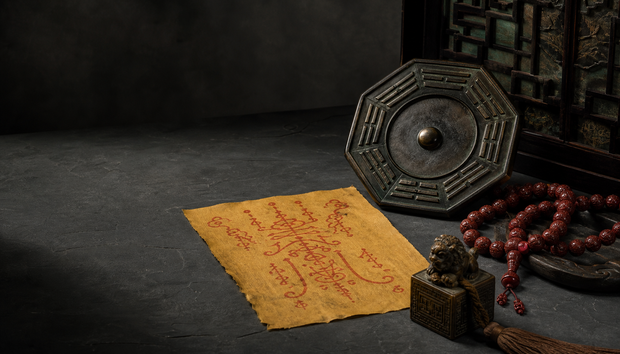
- Calligraphy: If the piece includes Chinese characters, are they rendered with grace and accuracy? The calligraphy on talismans (Fulu) is a specific art form. Sloppy, incorrect, or nonsensical characters are a dead giveaway of an inauthentic piece.
By applying these criteria, you move from being a passive buyer to an active, informed collector. You begin to appreciate not only the object, but the skill, knowledge, and tradition it represents. This is also where you can find beautiful overlaps with pieces designed for spiritual protection from other traditions, which often share this emphasis on authentic materials and intentional craftsmanship.
The hands of a master artisan in our network, bringing a Bagua symbol to life with focused intention and time-honored techniques.
How to Actually Use and Care for Your Pieces
Once you've made the investment in an authentic piece, its journey with you is just beginning. For those walking a contemplative path, proper use and care are not only about preservation; they are about building a relationship with the object and the philosophy it embodies.
This isn't about complex rituals, but about simple, mindful practices.
1. Creating a Place of Honor
Your pieces deserve more than a dusty drawer. Designating a specific place for them is an act of respect that deepens their significance. This doesn't have to be an elaborate altar.
It could be a dedicated shelf on your bookshelf, next to your copies of the Tao Te Ching or books on Chinese art. It could be a beautifully lined box or a specific spot on your dresser.
The act of intentionally placing the piece there when you're not wearing it transforms it from a mere accessory into a focal point for contemplation. When you pick it up, you do so with purpose.
2. Wearing with Intention
The simple act of putting on your jewelry can become a meaningful daily practice. Instead of rushing, take a moment. Hold the piece in your hand. Feel its weight, its temperature, its texture.
As you fasten the clasp or slip the bracelet over your wrist, bring its core meaning to mind. If it's a Yin-Yang pendant, you might set the intention to find balance in your day's activities.
If it's a jade amulet sourced from Xinjiang, you might take a moment to connect with a feeling of calm and resilience. This small ritual, taking no more than ten seconds, frames your day and activates the symbolic power of the piece.
It becomes a conscious choice, much like the practice of reciting mantras, to align yourself with a positive principle.
3. Physical and Energetic Cleansing
Proper care ensures your piece will last for generations.
- Physical Cleaning: For most materials like jade, stone, and metal, a simple wipe-down with a soft, damp cloth is sufficient. Avoid harsh chemicals, detergents, or ultrasonic cleaners, which can damage natural materials. For wood, a very light application of a natural oil (like jojoba or sandalwood oil) once or twice a year can keep it from drying out.
- Energetic Cleansing: Over time, pieces worn for protection or balance are thought to absorb ambient energies. Periodically cleansing them can restore their clarity. This is a practice found across cultures, from those using protective symbols like the Hamsa to shamans in the Andes. Simple methods include placing the piece in moonlight overnight (especially during a full moon), resting it on a bed of salt for a few hours (ensure the material won't be corroded), or using sound from a singing bowl or bell to vibrationally clear it. The key is your intention to purify and refresh the piece.
By integrating these simple practices, your collection ceases to be static. It becomes a dynamic, interactive part of your life—a source of beauty, a tool for mindfulness, and a tangible connection to the wisdom passed down through centuries of Himalayan practice.
Explore our Taoist Eight Trigram amulet.
Common Questions from Discerning Collectors
Is wearing Taoist jewelry a form of religious worship?
Not necessarily. For those drawn to contemplative practice, it's an engagement with a philosophical system rather than religious worship. Taoism itself has two main branches: philosophical (Daojia), focusing on texts like the Tao Te Ching, and religious (Daojiao), with a pantheon of deities and formal rituals.
A simple Yin-Yang or Bagua pendant is often worn as a personal reminder of principles like balance, harmony, and the natural flow of life (Wu Wei). It's a way to carry a piece of this traditional teachings with you.
For a collector, its value lies in its connection to this rich intellectual and cultural history, much like one might collect Christian icon art without being a devout practitioner. The key is your personal intention and the respect you hold for the tradition it comes from.
Can I wear Taoist and Buddhist jewelry together?
Absolutely. In many parts of the Himalayas, particularly in the borderland regions of Yunnan and Sichuan, you'll find these traditions have coexisted and blended for centuries. Local belief systems often incorporate elements from Taoism, Tibetan Buddhism, and older Bön traditions.
Artisans in these areas may not see a rigid separation. A craftsman in the Lijiang valley might carve a Bagua symbol with the same reverence they use for an Endless Knot. From a symbolic perspective, they often complement each other.
Both traditions value compassion, balance, and understanding the nature of reality. Wearing a Taoist piece for grounding and a Buddhist mala for mindfulness can be a beautiful and harmonious expression of your personal path.
It reflects a closer understanding of the interconnectedness of these great wisdom traditions.
What's the difference between the Chinese and Tibetan Five Elements?
This is an excellent question that gets to the heart of subtle cultural distinctions. The Chinese system, Wu Xing (五行), consists of Wood (木), Fire (火), Earth (土), Metal (金), and Water (水). It's a dynamic system focused on cycles of generation and control—Wood feeds Fire, Fire creates Earth (ash), etc.
It's foundational to everything from medicine to Feng Shui. The Tibetan system, or Mahābhūta, derives from ancient Indian cosmology documented in texts from the 8th century onward and consists of Earth, Water, Fire, Air, and Space (or Ether).
This system is often seen as more compositional, describing the very building blocks of the phenomenal world, from the physical body to the cosmos. While they share three elements by name, their conceptual underpinnings differ.
Wu Xing is about process and interaction, while the Mahābhūta is about constituent nature. Recognizing this difference is a hallmark of a discerning collector.
How do I know if a piece is truly from an artisan?
This is the central challenge for any serious collector. First, look for the story. An authentic piece has a history, a provenance. We believe in transparency, which is why we tell you about Master Tenzin or the artisans in our Kathmandu atelier.
Second, examine the craftsmanship. Look for the subtle imperfections that signal a human touch—the slight asymmetry in a hand-carved bead, the feel of hand-polished stone versus a machine-tumbled finish. Mass-produced items often have tell-tale mold lines or an unnatural uniformity.
Finally, build a relationship with a source you trust. A reputable seller will be able to answer detailed questions about materials, techniques, and the cultural context of a piece. They won't just sell you an object; they'll share its lineage with you.
Is it cultural appropriation to wear Taoist jewelry?
This is a thoughtful and important concern. The distinction lies between appropriation and appreciation. Appropriation often involves taking a sacred symbol out of context, trivializing its meaning, and profiting from it without acknowledging its origins.
Appreciation, on the other hand, involves a genuine desire to learn, respect, and honor the tradition. If you've taken the time to understand what the Yin-Yang truly represents, if you wear a Bagua amulet with a sense of respect for its cosmological depth, you are engaging in appreciation.
It becomes a bridge of cultural understanding. The problem arises when these symbols are reduced to mere fashion trends. As a collector, your inherent interest in the history, meaning, and provenance of a piece places you firmly on the side of appreciation.
What is the most powerful Taoist protection symbol?
While 'power' is subjective, several symbols are traditionally considered highly protective. The Bagua, or eight trigrams, is perhaps the most well-known. A 'Former Heaven' Bagua is used for protection and creating sacred space, while a 'Later Heaven' Bagua is used for Feng Shui adjustments.
Talismans with calligraphy (Fulu) drawn by a Taoist master are also considered extremely potent, as they are believed to invoke the authority of specific deities. Figures like Zhong Kui, the vanquisher of ghosts, or the Green Dragon and White Tiger, are also powerful guardians.
However, the true potency of any piece often comes from the wearer's own understanding and intention, combined with the integrity of the object's creation. A simple, well-made piece worn with mindful intent can be more effective than an ornate one worn as a mere trinket.
How does the concept of 'Qi' (Chi) relate to this jewelry?
Qi is the fundamental life-force energy that flows through all things in Taoist thought. Taoist jewelry is often designed to interact with and harmonize the Qi of the wearer. The choice of material is paramount.
Jade, for instance, is believed to have a gentle, purifying Qi that can soothe the spirit and protect the body. Cinnabar is thought to have a very yang, protective Qi that can ward off negative influences.
The symbols carved onto the jewelry act as focal points or modulators for Qi. A Yin-Yang symbol, for example, isn't just a picture of balance; it's a conceptual tool to remind and encourage your own body's Qi to find its natural equilibrium.
Wearing such a piece is an act of mindful acupressure for your energetic field, a constant, subtle influence guiding you toward harmony.
Your Journey with These Living Symbols
Your collection is more than an assembly of beautiful objects. It is a library of wisdom, a physical catalog of humanity's deepest inquiries into the nature of existence. Each piece, whether it speaks of the Taoist flow or the Buddhist path, is a chapter in that story.
As we continue our journey into 2026 and beyond, into a future that promises to be ever more complex and digitally saturated, these tangible anchors to reality will only become more precious.
The piece you choose is not an escape from the world, but a tool to navigate it with greater grace and understanding. It's a reminder on your wrist or against your chest that the principles of balance, harmony, and natural flow are not abstract ideals, but living forces you can align with at any moment.
I've seen a thangka thrice-folded in a pilgrim's bag at Jokhang Temple, its silk worn soft by decades of devotion—that is the piece you'll still wear in 20 years, its surface polished smooth by your touch, its meaning deepened by your life's experiences.
We invite you to explore the pieces that call to you, to find the symbols that resonate with your own path. See them not only as acquisitions, but as companions for the journey ahead.
Let them be your quiet reminders of the luminous and elegant order that underlies all things, a truth you can carry with you, always. We hope you find the perfect piece among our collection of sacred Tibetan pieces, each with its own story waiting to become part of yours.
Keep reading