
News
Yin Yang Symbol Meaning 2026: Balance, Taoism and
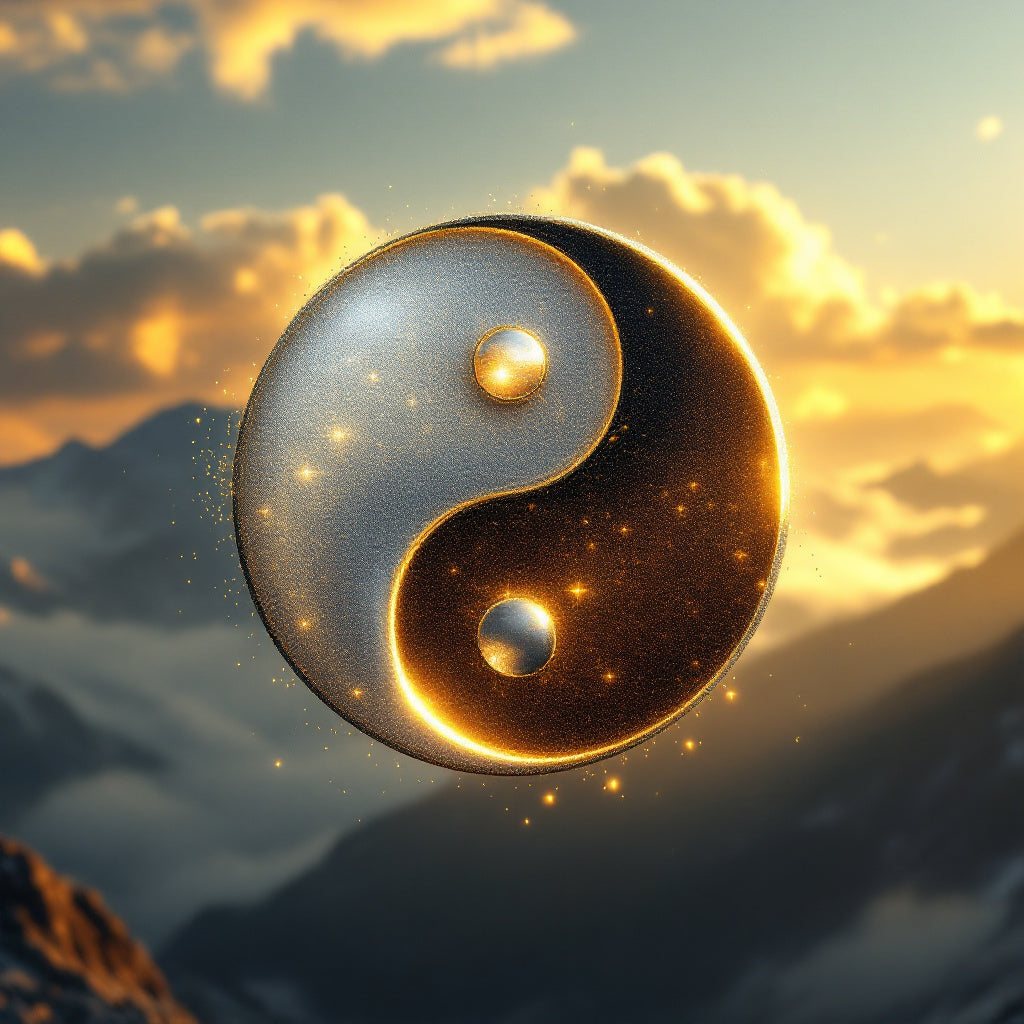
You've seen it on a friend's necklace, on a yoga studio wall, maybe tattooed on someone's wrist at the coffee shop. The yin yang symbol feels familiar — almost too familiar. Which is exactly why most people have never stopped to ask what it actually means.
Not the bumper-sticker version. The real one. The one that comes from a living philosophical tradition that's been shaping how humans think about time, health, relationships, and the cosmos for over two thousand years.
If you've been drawn to this symbol — and you're here, so you probably have been — it's worth knowing what you're actually holding. This article gives you the full picture: where the symbol came from, how Tibetan Buddhism absorbed and transformed it, what the Five Elements have to do with it, and how to carry it in a way that means something in your actual life in 2026.
Alt text: Ancient Chinese taijitu yin yang symbol carved in dark stone with worn edges showing age
Yin Yang Symbol Balance is which is exactly why most people have never stopped to ask what it actually means.
What the Yin Yang Symbol Really Is
The first thing to clear up: the yin yang symbol is not Buddhist in origin. That surprises many who encounter it through Buddhist or spiritual spaces. It comes from Taoism — specifically from a cosmological model called taijitu (太極圖), which translates roughly as "diagram of the supreme ultimate." The earliest visual form we recognize today was formalized by Song Dynasty Neo-Confucian philosopher Zhou Dunyi around 1070 CE, though the underlying philosophy of yin and yang as complementary forces appears in texts like the I Ching (Book of Changes) dating back to at least 700 BCE, and the concept itself is older still.
Here's what the symbol is actually saying. The circle represents the totality of existence — everything that is. Within that totality, there are two forces in constant motion: yin (the dark swirl) and yang (the white swirl).
Yin is associated with receptivity, darkness, rest, the feminine principle, water, the moon, winter, and inward movement. Yang is associated with activity, light, heat, the masculine principle, fire, the sun, summer, and outward movement.
The critical detail — the one that gets lost in pop culture versions — is the small dot of each color inside the other's territory. That dot is the whole point. It means that within every yin there is a seed of yang, and within every yang there is a seed of yin.
Nothing is purely one thing. The darkest night carries the seed of dawn. The height of summer already holds the turning toward autumn.
This is not a symbol about "balance" in the way we use that word when we talk about work-life balance — as if the goal is a perfect 50/50 split that you maintain through good scheduling.
Taoist balance is dynamic. It's a river, not a scale. The two forces are always moving, always transforming into each other, always in relationship. The philosopher Alan Watts, who spent decades making Taoist and Buddhist ideas accessible to Western readers, described the taijitu as representing "the mutual arising of opposites" — they don't just coexist, they create each other.
You cannot know warmth without cold. You cannot know rest without exertion. The symbol is a map of that interdependence.
The misconception worth naming directly: the yin yang symbol does not mean "good and evil in balance." That's a Western overlay, probably influenced by the visual similarity to dualistic religious symbols. In Taoist cosmology, neither yin nor yang is good or bad.
They're both necessary. Both are expressions of the Tao — the underlying reality that cannot quite be named or grasped. The Tao Te Ching, attributed to Laozi (6th–4th century BCE), opens with "The Tao that can be named is not the eternal Tao." So the symbol points at something that resists definition, which is part of why it has traveled so far across cultures and centuries.
Understanding this foundation matters before you wear it, because it changes what you're actually carrying. Our yin yang jewelry collection is designed with this original meaning in mind — not as a decorative motif, but as a functional reminder of how reality actually works.
Why the Yin Yang Symbol Matters Specifically in 2026

There's a reason this symbol keeps resurfacing. It's not nostalgia. It's not trend cycles. It's that the specific pressures of contemporary life keep recreating the exact conditions the symbol was designed to address.
Walk through your average week. You wake up already behind — notifications from overnight, a mental to-do list that started running before you opened your eyes. You push through the day at a pace that isn't sustainable, you get home exhausted, and then you feel guilty for not doing more.
You're in pure yang — constant output, constant activation, constant forward motion. And the body keeps the score. Burnout isn't a personality flaw; it's what happens when yang runs without yin to balance it.
Rest isn't laziness in the Taoist framework. It's the dark swirl. It's necessary. Without it, the whole system collapses.
Or consider the opposite: you've been in a quiet period. Maybe a relationship ended, maybe you left a job, maybe you're just in one of those seasons where life feels slow and you're not sure what you're building toward.
That's yin — and there's nothing wrong with it. But if you've been told your whole life that productivity equals worth, yin periods feel like failure. The symbol is a reminder that the seed of the next yang phase is already inside this quiet time.
The dot. It's already there.
In 2026, the conversation around nervous system regulation, somatic practices, and "rest as resistance" has moved from wellness niches into mainstream discourse. What's striking is that these frameworks — polyvagal theory, the science of recovery, circadian rhythm research — are all essentially describing yin and yang in biological language.
The parasympathetic nervous system (rest, digest, restore) and the sympathetic nervous system (fight, flight, activate) are not enemies. They're supposed to cycle. The problem is that modern life has jammed the dial toward sympathetic activation and called it normal.
The yin yang symbol, worn as jewelry or placed in your environment, functions as what we might call an environmental anchor — a physical object that carries a concept you want to return to.
This is actually a well-documented function of symbolic objects across cultures. Tibetan Buddhist practitioners use physical objects — malas, amulets, thangka paintings — for exactly this purpose. A mala's 108 beads, each one a tactile reminder.
The object isn't magic. It's a prompt. Every time you see it or touch it, it asks you a question: Where am I right now? Am I in balance? What does this moment need?
The symbol also speaks to something those in their late twenties and early thirties are working through: the tension between ambition and meaning. You want to build something. You also want to feel present.
You want a relationship. You also want independence. You want to be seen. You also want privacy. These don't have to be contradictions. The taijitu says they're a dance. The goal isn't to resolve the tension — it's to move within it with more grace.
For those exploring Taoist ideas alongside Buddhist practice, our guide to explore taoist teachings for modern life goes deeper into how these frameworks from the Zhou Dynasty apply to the specific pressures of contemporary living.
Alt text: Woman holding yin yang pendant between fingers during morning meditation near window with soft light
How Buddhism Absorbed the Yin Yang — And What It Added
Buddhism and Taoism have a long, complicated, and genuinely fascinating relationship in East Asia. When Buddhism arrived in China from India around the 1st–2nd century CE, it didn't arrive into a blank slate. It arrived into a culture that already had sophisticated philosophical frameworks — Taoism and Confucianism chief among them.
What happened over the following centuries is one of the great cross-cultural philosophical conversations in human history.
The Chinese Buddhist Synthesis
Early Chinese Buddhist translators faced an immediate problem: Sanskrit Buddhist concepts didn't have direct Chinese equivalents. So they borrowed Taoist vocabulary. The Sanskrit word dharma was translated using the Taoist word dao (道). The concept of nirvana was rendered using Taoist ideas about non-action and natural flow.
This wasn't sloppy translation — it was a genuine philosophical negotiation. Over time, Chinese Buddhist schools like Chan (which became Zen in Japan) developed a distinctly Taoist flavor. The Chan emphasis on naturalness, on the present moment, on non-striving — these are deeply Taoist resonances within a Buddhist framework.
The yin yang concept found particular resonance with Buddhist ideas about interdependence — what the tradition calls pratītyasamutpāda, or dependent origination. In plain language: nothing exists independently. Everything arises in relationship to everything else.
A flame exists only in relationship to fuel, oxygen, and heat. Your sense of self exists only in relationship to your experiences, your relationships, your body, your culture. The yin yang symbol is a visual representation of this same insight: yin and yang don't exist independently.
They define each other.
The Tibetan Buddhist Layer
Tibetan Buddhism developed along a different geographic and philosophical route than Chinese Buddhism — it came primarily from the Indian Vajrayana tradition rather than the Chinese Chan synthesis. But Tibetan cosmology has its own parallel structures that resonate deeply with yin yang thinking.
The most obvious parallel is the Tibetan concept of yab-yum — the iconographic depiction of a male deity in union with a female consort. This is not erotic imagery in the conventional sense. It represents the union of wisdom (feminine principle, prajna) and compassionate action (masculine principle, upaya).
Neither is complete without the other. Wisdom without compassion becomes cold and abstract. Compassion without wisdom becomes sentimental and ineffective. The union is the point. Sound familiar?
Tibetan Buddhism also works extensively with the concept of duality and non-duality. The entire arc of Vajrayana practice moves from seeing things as separate (self/other, sacred/profane, good/bad) toward recognizing the non-dual nature of reality.
The yin yang symbol, in this context, functions as a pointer toward non-duality — not by erasing the difference between the two forces, but by showing that they're always already in relationship, always already containing each other.
The Five Elements Connection
This is where it gets particularly rich. Both Taoist and Tibetan Buddhist traditions work with elemental frameworks, and while they're not identical, the resonances are striking.
Taoist cosmology describes Five Elements (Wu Xing): Wood (木), Fire (火), Earth (土), Metal (金), and Water (水). These aren't static categories — they're phases of transformation, each generating and checking the others in a continuous cycle.
Wood feeds Fire; Fire creates Earth (ash); Earth contains Metal; Metal carries Water (as in a metal vessel); Water nourishes Wood. This is the generative cycle. There's also a controlling cycle: Wood parts Earth; Earth dams Water; Water extinguishes Fire; Fire melts Metal; Metal cuts Wood.
The system is dynamic, relational, and in constant motion — exactly like the taijitu.
Tibetan Buddhism works with Five Elements too, though configured differently: Earth, Water, Fire, Air, and Space (or Ether). These elements correspond to the five Buddha families, five colors, five directions, five skandhas (aggregates of experience), and five wisdom energies.
In Tibetan medicine (Sowa Rigpa), illness is understood as elemental imbalance — too much fire energy manifests as inflammation and agitation; too much water energy manifests as sluggishness and depression. Healing is rebalancing.
When you encounter a yin yang symbol in a Tibetan Buddhist or Himalayan context — and you do, particularly in Tibetan regions of Yunnan, Qinghai, and in Nepali Buddhist communities with strong Chinese influence — it's often embedded within this Five Elements framework.
The symbol isn't just about two forces; it's about the whole system of transformation those two forces generate.
Our guide to the Five Thunder Talisman explores how Taoist elemental forces are encoded in protective symbols — a useful companion read if the elemental framework resonates with you.
Choosing an Authentic Yin Yang Piece — What Actually Matters

The market for yin yang jewelry is enormous and mostly undifferentiated. You can find a mass-produced yin yang pendant for $4 on any fast-fashion platform. So what makes a piece worth investing in, and how do you tell the difference?
The answer has a few layers.
Material integrity. Authentic pieces in the Tibetan and Himalayan tradition are made from materials that carry their own symbolic weight. Sterling silver (92.5%) is the standard for quality metalwork in Nepal and Tibet — it's durable, takes detail well, and has been the foundation of Himalayan jewelry craft since at least the 17th century.
Brass with silver overlay is common and acceptable for everyday wear. What you want to avoid is zinc alloy with chrome plating, which is what most fast-fashion "silver" pieces are made from. It tarnishes quickly, can cause skin reactions, and has no connection to the tradition it's claiming to represent.
For yin yang pieces specifically, black onyx and white jade or white howlite are traditional stone pairings — they visually reinforce the symbol's meaning while carrying their own material properties. Onyx has been used in Tibetan and Chinese amulet traditions since the 8th century.
Jade (nephrite, not the dyed plastic sold as jade in tourist markets) has a 7,000-year history in Chinese culture as a stone of virtue, protection, and connection to heaven and earth.
Craftsmanship markers. In our Kathmandu atelier, the artisans use a technique called repoussé for raised metalwork — hammering from the reverse side to create dimension — combined with hand engraving for detail work. The result has a slightly irregular quality that machine-stamped pieces don't have.
That irregularity is not a flaw. It's evidence of a human hand. When you're looking at a piece online, zoom into the detail images. Machine-stamped pieces have perfectly uniform depth and absolutely consistent line weight.
Hand-worked pieces don't.
Symbolic accuracy. This sounds minor but matters more than you'd think. The proportions of the taijitu are specific — the two teardrop shapes should be equal, the dots should be centered within each swirl, and the overall circle should be clean and complete.
Cheap reproductions often get the proportions slightly wrong, which subtly distorts the meaning. The symbol is a diagram. Diagrams need to be accurate to function.
What type of piece suits you. A pendant worn close to the chest is the most traditional form — in Tibetan practice, amulets worn at the heart center are considered most potent for protection and intention-setting.
A ring carries the symbol on the hand, which is active and expressive — appropriate if you want the reminder during work and interaction. A bracelet sits at the wrist, near the pulse point, which has its own significance in both Ayurvedic and Chinese medicine traditions (the radial pulse is the primary diagnostic point in both systems). — explore our Tibetan jewelry collection for authentic pieces.
Browse our Tibetan yin yang symbols — each piece includes details on materials, the artisan workshop it came from, and the specific tradition it draws on.
If you're drawn to the broader Taoist protective tradition, our explore bagua amulet pairs naturally with yin yang pieces — the Bagua (eight trigrams) is the cosmological map that surrounds the taijitu in classical Taoist iconography.
Alt text: Close-up of handcrafted sterling silver yin yang pendant with black onyx and white jade stones on dark cloth
How to Actually Use the Yin Yang Symbol in Daily Practice
Wearing a symbol is one thing. Having a relationship with it is another. Here's how to move from decoration to practice — without making it complicated.
Morning check-in. Before you put on your yin yang pendant or bracelet, hold it for thirty seconds. Not in a performative way — just a moment of contact. Ask yourself honestly: what does today need?
If your week has been high-output, relentless, full of meetings and decisions and performance — today probably needs more yin. Build in a lunch break where you actually stop. Take the long route home.
Eat dinner without screens. If you've been in a slow, withdrawn, low-energy period — today might need more yang. Make one phone call you've been avoiding. Move your body. Do the thing.
The symbol doesn't tell you what to do. It asks you to notice where you are in the cycle.
The transition ritual. One of the most practically useful applications of yin yang thinking is at transitions — the moments between different modes of being. The commute between work and home is a transition.
Touching your pendant at that moment and consciously shifting modes — from output to presence, from professional to personal — is a small but genuinely effective practice. Tibetan Buddhist practitioners use objects similarly: touching a mala at the beginning of meditation signals to the nervous system that it's time to shift modes.
I've watched this work in retreat settings, where the same gesture repeated over weeks becomes almost involuntary — your body recognizes the cue before your mind catches up.
Placement in your space. If you have a meditation corner, a desk, or even just a windowsill where you keep meaningful objects, a yin yang piece placed there functions as a visual anchor throughout the day.
In classical Feng Shui texts from the Song Dynasty, the taijitu placed in the center of a space represents the balancing of all directional energies. You don't need to be a Feng Shui practitioner for this to be useful — you just need the symbol in your field of vision during moments when you want to return to center.
Using it during difficult conversations. This sounds unusual but works. When you're in a conversation that's becoming polarized — an argument, a negotiation, a difficult family dynamic — touching your yin yang piece is a physical reminder that the other person's position contains something valid, even if you can't see it yet.
That's the dot. Their dot is in your swirl. Yours is in theirs. It doesn't mean you agree. It means you stay curious.
Our yin yang pendant is designed specifically for daily wear — the bail (the loop at the top) is reinforced for durability, and the finish is treated to resist the tarnishing that comes from skin contact and moisture.
For a closer look at how Taoist principles can structure daily life rather than just accessorize it, our piece on Taoist teachings for modern life is worth an hour of your time.
Common Questions About the Yin Yang Symbol
Is the yin yang symbol Buddhist or Taoist?
It's Taoist in origin — specifically from the Chinese cosmological tradition formalized in the Song Dynasty (960–1279 CE), though the underlying philosophy of yin and yang appears in texts dating back to at least 700 BCE.
Buddhism and Taoism have deeply influenced each other in East Asia over two millennia, and the yin yang symbol has been absorbed into some Buddhist contexts, particularly Chinese Buddhist and Zen traditions. In Tibetan Buddhism, you won't find the taijitu as a primary symbol, but the underlying concepts — interdependence, the union of complementary principles, the dynamic nature of all phenomena — are central to Vajrayana philosophy.
So the honest answer is: Taoist origin, with genuine resonance in Buddhist thought. Wearing it as someone interested in both traditions is not a contradiction. It's actually a historically accurate reflection of how these traditions have always interacted.
Does the black side represent evil?
No — and this is one of the most persistent and damaging misreadings of the symbol. In Taoist cosmology, neither yin nor yang carries a moral charge. Black (yin) represents receptivity, rest, the feminine principle, water, night, and inward movement.
White (yang) represents activity, light, the masculine principle, fire, day, and outward movement. Neither is good or evil. Both are necessary. The confusion comes from overlaying Western dualistic frameworks — particularly the Christian opposition of light (good) and dark (evil) — onto a symbol that has no such structure.
The taijitu is explicitly non-dualistic. It's saying that the two apparent opposites are aspects of a single, unified reality. Moral judgment of either force misses the point entirely.
Can I wear a yin yang symbol if I'm not Taoist or Buddhist?
Yes, with awareness. The tradition doesn't require initiation or formal affiliation — these are philosophical and cosmological symbols, not sacraments. What matters is that you understand what you're wearing well enough to represent it honestly.
If someone asks you about your pendant and you can explain that it comes from Taoist philosophy and represents the dynamic interdependence of complementary forces — that's respectful engagement. Wearing it purely as a trend accessory without any understanding of its origin is the kind of cultural carelessness that flattens living traditions into logos.
You're reading this article, which means you're already doing it right.
What's the difference between the yin yang symbol and the Bagua?
The taijitu (yin yang symbol) and the Bagua (八卦, eight trigrams) are related but distinct. The taijitu represents the primal duality — yin and yang as the two fundamental forces. The Bagua represents the eight permutations that arise when you combine yin and yang in groups of three lines (trigrams): Heaven, Earth, Water, Fire, Wind, Thunder, Mountain, Lake.
In classical Taoist iconography, the taijitu sits at the center of the Bagua — the primal duality surrounded by its eight elaborations. Together they form a complete cosmological map. Our Bagua amulet uses this complete structure, making it a more comprehensive protective talisman than the yin yang symbol alone.
Is there a "right" way to wear the yin yang symbol — which side up?
In traditional Taoist iconography, the symbol is typically oriented with the yang (white) swirl on top and the yin (dark) swirl below — reflecting the cosmological relationship between heaven (yang, above) and earth (yin, below).
However, the taijitu is designed to be read as a rotating symbol — it's perpetually in motion, which is the whole point. There's no fixed "right side up" in the way there is for, say, a cross or a Star of David.
Wear it however it sits naturally on your body. The meaning doesn't change with orientation.
How does yin yang relate to the concept of karma?
They're related but not identical. Karma (from Sanskrit, meaning "action") is a Buddhist and Hindu concept about the moral causality of actions — intentional actions create conditions that shape future experience. Yin yang is a Taoist concept about the natural cyclical structure of all phenomena, without a moral dimension.
The connection point is causality: both frameworks say that what you do now shapes what comes next, and that apparent opposites are in relationship. But karma has an ethical weight that yin yang doesn't.
In Buddhist practice, you work with karma through intention, ethics, and meditation. You work with yin yang through awareness of cycles and conscious adjustment of your energy. They're complementary frameworks, not the same thing.
Can the yin yang symbol be used in meditation?
Yes, and it's a genuinely useful object for a specific kind of practice. Trataka — the practice of focused gazing on a single object — is used in both Hindu and Buddhist traditions to develop concentration.
Gazing at a yin yang symbol during trataka practice has a built-in philosophical dimension: as you hold your gaze on the symbol, you can contemplate the relationship between the two swirls, notice how your eye naturally follows the curve from one into the other, and use that movement as a prompt for contemplating interdependence in your own life.
Start with five minutes. Sit comfortably, hold or place the symbol at eye level, and simply look. When your mind wanders (it will), return to the symbol. The symbol becomes the anchor.
How do I know if a yin yang piece is actually from the Himalayan tradition versus mass-produced?
A few practical tests. First, check the weight — authentic sterling silver has a satisfying density that zinc alloy doesn't. Second, look for a hallmark — 925 stamped on the piece means 92.5% silver.
Third, examine the surface under good light — hand-worked pieces have subtle variations in depth and line that machine-stamped pieces don't. Fourth, ask about provenance — a reputable seller should be able to tell you where the piece was made and by whom.
We work with artisans in our Kathmandu atelier, and every piece in our balance-themed jewelry collection comes with that information. If a seller can't tell you where a piece was made, that's your answer.
Alt text: Artisan hands in Kathmandu workshop carefully engraving yin yang symbol onto silver pendant with traditional tools
Your Journey with This Symbol in 2026
You started this article with a symbol you'd seen a hundred times. You're ending it with something different — a map. A two-thousand-year-old map of how forces move, how opposites contain each other, how nothing stays still and nothing is purely one thing.
That's not a small thing to carry.
If you're ready to carry that question in a form you can touch — something made with care, from a tradition that takes these ideas seriously — explore our Daoist protection jewelry. Each piece is made in our Kathmandu atelier by artisans who understand what they're making.
Not as a product. As a practice.
The dot is already there. The turning has already begun.
", "faq_schema_data": [ { "question": "Is the yin yang symbol Buddhist or Taoist?", "answer": "The yin yang symbol is Taoist in origin, specifically from Chinese cosmological tradition formalized during the Song Dynasty (960–1279 CE), though the philosophy of yin and yang appears in texts dating back to at least 700 BCE. Buddhism and Taoism have deeply influenced each other in East Asia over two millennia, and the yin yang symbol has been absorbed into some Buddhist contexts, particularly Chinese Buddhist and Zen traditions. In Tibetan Buddhism, the taijitu isn't a primary symbol, but the underlying concepts — interdependence, the union of complementary principles, the dynamic nature of all phenomena — are central to Vajrayana philosophy. Wearing it as someone interested
Keep reading