God's Rites
Jixiang Tianmu (Palden Lhamo) Guide
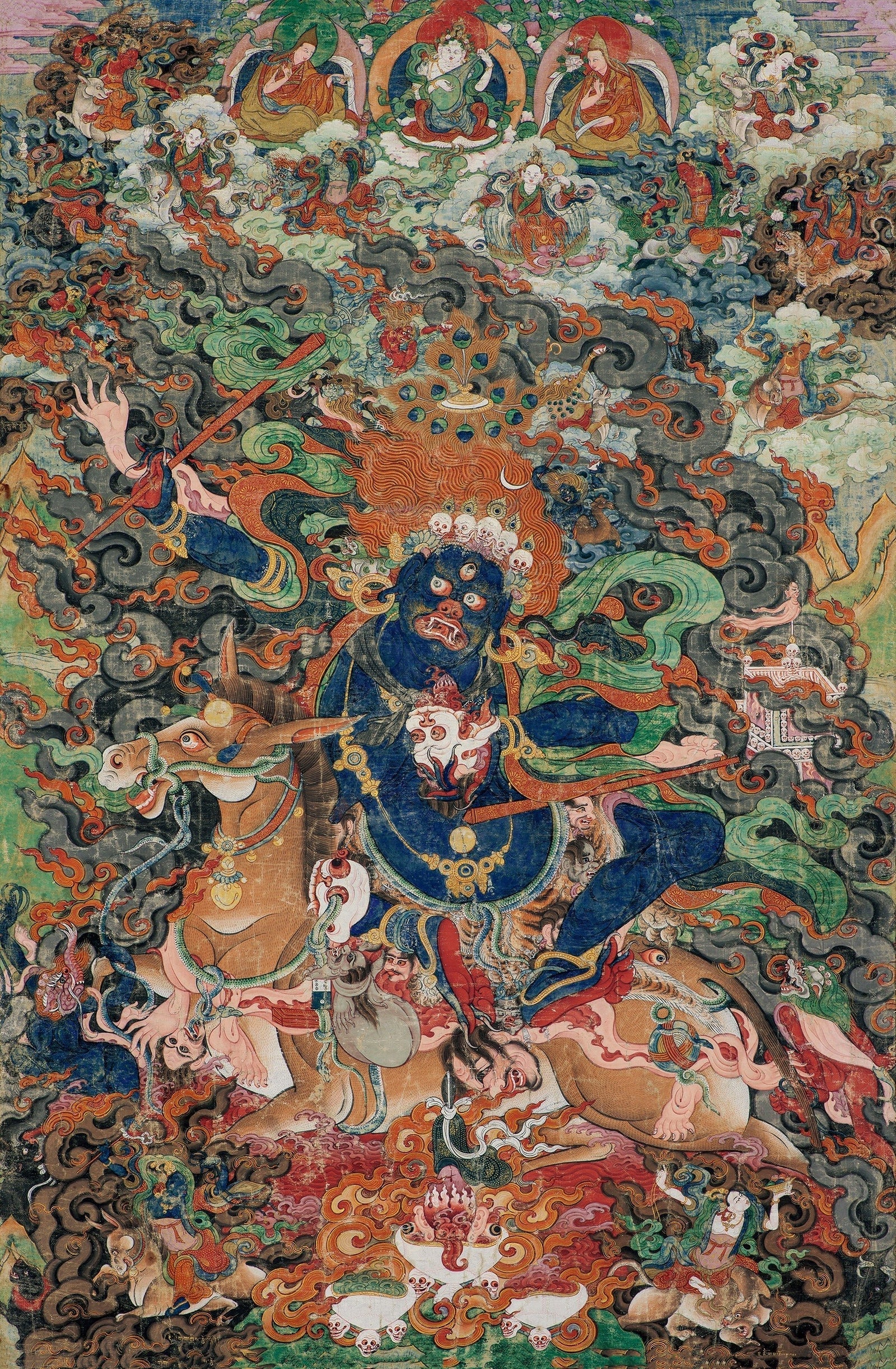
Jixiang Tianmu is a Chinese name used for Palden Lhamo, an important wrathful female protector in Tibetan Buddhism. She is also known through Sanskrit and Tibetan names such as Shri Devi and Palden Lhamo. She should not be reduced to a generic “goddess of fortune,” because different forms belong to a larger class of protector goddesses with distinct iconography and traditions.
Direct answer: Jixiang Tianmu, or Palden Lhamo, is a wrathful protector associated especially with Tibetan Buddhist traditions. A familiar two-armed form rides side-saddle on a mule, but Palden Lhamo names more than one form. Identify a specific image through its arms, attributes, mount, inscription and museum or lineage record.

Who is Jixiang Tianmu?
“Jixiang Tianmu” is the Chinese rendering commonly attached to Palden Lhamo. The National Palace Museum in Taipei catalogues a seventeenth- to eighteenth-century sculpture under the paired title Jixiang Tianmu / Palden Lhamo. That museum record gives a firm bridge between the Chinese name and the Tibetan Buddhist figure.
Palden Lhamo is often translated as “Glorious Goddess.” Rubin Museum's Project Himalayan Art identifies her as Shri Devi or Remati and describes her as an important wrathful protector goddess, especially prominent in Gelug contexts. The name can refer broadly to a class of female protectors, so one story or appearance should not be applied to every form.
Palden Lhamo, Shri Devi and Magzor Gyalmo
These names overlap but are not always exact synonyms for one image. Himalayan Art Resources explains that Shri Devi is a larger class of protector deities. Magzor Gyalmo, “Queen Who Repels Armies,” is one two-armed, mule-riding form within that larger class and is described there as a wrathful emanation of Sarasvati. Other Shri Devi forms have different identities and attributes.
| Name | How to use it carefully |
|---|---|
| Jixiang Tianmu | Chinese name commonly used for Palden Lhamo |
| Palden Lhamo | Tibetan name used for an important protector and a broader class of forms |
| Shri Devi | Sanskrit name used in catalogues for the larger protector class |
| Magzor Gyalmo | A specific two-armed, mule-riding form; not every Palden Lhamo image |
How to recognize the familiar mule-riding form
The National Palace Museum sculpture has one face and two arms. Its right hand raises a sandalwood staff and its left holds a skull cup. The figure has three eyes, wrathful ornaments and a mule mount. The saddle includes iconographic objects such as dice and a bag associated with disease in the catalogue description.
The Vatican Museums also catalogues Palden Lhamo side-saddle on a mule with wrathful features. Museum records establish what is visible on specific objects; they should not be turned into instructions for ritual use or universal claims about every Palden Lhamo form.

What does her wrathful appearance mean?
In Tibetan Buddhist art, wrathful appearance communicates forceful protector activity. Palden Lhamo's flames, third eye, fierce face and unusual ornaments belong to that visual language. The imagery is meant to be read within Buddhist art and practice, not as evidence that the figure is evil.
Rubin Museum describes Palden Lhamo as an important wrathful protector and the only female among the eight great protector deities. The Vatican Museums notes her importance as protector of the Dalai Lama, Panchen Lama and Lhasa. These institutional descriptions are more precise than the commercial phrase “goddess of fortune and abundance.”
Is Jixiang Tianmu a goddess of wealth?
Not as a complete definition. The Chinese word “jixiang” can sound auspicious, and modern product language often emphasizes fortune. But the museum and Himalayan art records identify Palden Lhamo primarily through protector roles and specific forms. Calling her simply a wealth goddess obscures that context.
A symbolic object may remind a wearer of courage, responsibility or protection of Buddhist teaching. Those are interpretations, not proof of guaranteed prosperity, obstacle removal or personal safety.
How to identify an image responsibly
- Check the mount. A mule is a major clue for Magzor Gyalmo-type imagery.
- Count arms and record attributes. The staff and skull cup support identification of the familiar two-armed form.
- Look for the saddle objects and retinue. These details can distinguish a catalogued form.
- Read the source label. Museum title, date, region and provenance matter.
- Avoid universal claims. Palden Lhamo is a class with more than one form.
Wearing or displaying Palden Lhamo imagery
Art-historical information does not replace lineage instruction. Protector practices may have specific ritual contexts. For home display or jewelry, keep the image clean, handle it respectfully and avoid presenting a commercial item as a guaranteed source of wealth or protection.
The Palden Lhamo thangka piece is a modern product interpretation rather than an antique museum object. Compare it with the broader thangka pendant collection and our guide to wrathful deities in Tibetan Buddhism. The Mahakala forms guide shows how a different protector class is identified.
Frequently asked questions
Is Jixiang Tianmu the same as Palden Lhamo?
Jixiang Tianmu is a Chinese name used for Palden Lhamo. Exact identification still depends on the form shown.
Is Palden Lhamo a demon?
No. Tibetan Buddhist and museum sources identify her as a wrathful protector. Fierce iconography does not mean an evil role.
Why does Palden Lhamo ride a mule?
The mule is a defining attribute of familiar forms such as Magzor Gyalmo and helps distinguish her in Himalayan art.
Does Palden Lhamo jewelry guarantee wealth?
No. It can carry cultural and personal meaning, but a commercial object cannot guarantee wealth, safety or spiritual attainment.
Sources
Keep reading