buddhist-jewelry
Wrathful Deities: The Guide to Fierce Compassion
Wrathful Deities in Tibetan Buddhism: Why Fierce Compassion Exists
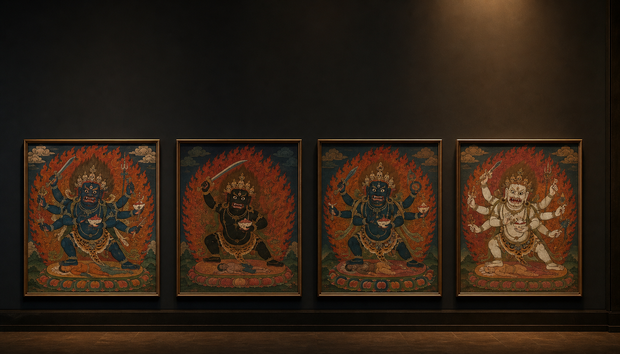
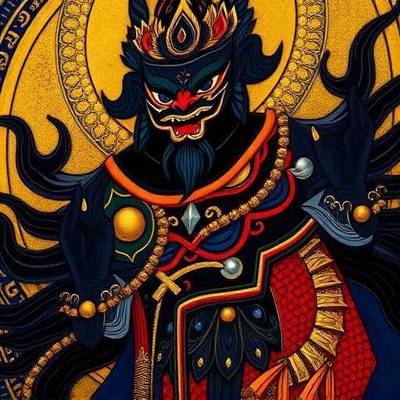
Fangs bared in a terrifying snarl. A garland of severed heads. Eyes blazing with cosmic fire, surrounded by a whirlwind of flame. For those new to Tibetan Buddhism, especially from a Western or Theravada background, this imagery can be deeply unsettling.
How can a path dedicated to peace, mindfulness, and compassion produce such terrifying figures? This apparent contradiction lies at the very heart of the Vajrayana path, revealing a profound and dynamic understanding of enlightenment.
The existence of wrathful deities in Tibetan Buddhism is not a flaw or a corruption; it is a a sign of the limitless, skillful means of compassion. These figures are not demons to be feared, but powerful protectors and catalysts for transformation, whose fierce forms are a direct expression of their vow to destroy suffering.
To understand them is to unlock a closer layer of the Dharma, one that doesn't shy away from the world's harsh realities but meets them with an even greater force for good, a truth embodied in our collection of wrathful deity jewelry.
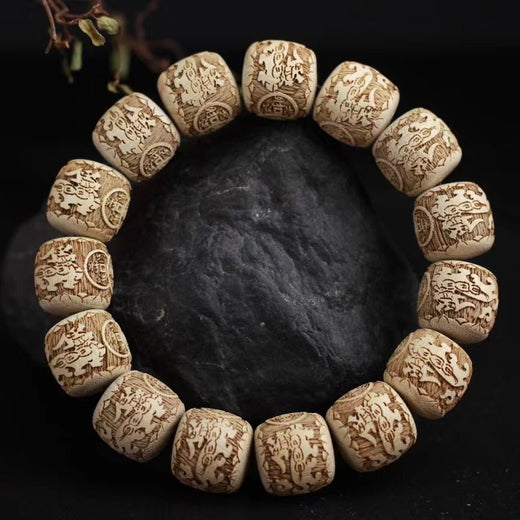
Crafted by hand at partner monasteries in Nepal and Tibet, each piece is made by skilled artisans following traditional Himalayan methods, then consecrated by resident monks.

Wrathful Deities Buddhism is for those new to Tibetan Buddhism, especially from a Western or Theravada background, this imagery can be deeply unsettling.
The Logic of Wrathful Deities — Compassion Requires Fierce Action
To grasp the purpose of wrathful deities, we must first expand our definition of compassion. We often imagine compassion as a gentle, soothing presence—a soft hand, a kind word. This is one valid expression.
But is it always the most effective? Imagine a child running toward a busy street. A gentle, "Please stop, dear," might not be enough. A loving parent would shout, grab the child, and pull them back from danger.
The action is sudden, forceful, and might even seem aggressive, but it is born from the deepest love and a desperate desire to prevent harm. This is the essence of fierce compassion.
Wrathful deities are the cosmic equivalent of this protective parent. They are not expressions of ordinary anger, which is rooted in ego, attachment, and aversion. Their "wrath" is a pure, transcendent energy, completely free from hatred.
It is the dynamic, powerful, and uncompromising activity of an enlightened mind. In Buddhist philosophy, this is known as upaya, or skillful means. Just as a surgeon must cut into a body to remove a life-threatening tumor, wrathful deities use their fierce energy to cut through the "tumors" of the mind: ignorance (avidya), hatred (dvesha), and greed (raga).
These are the three poisons that trap us in the cycle of suffering (samsara).
Many of the most prominent wrathful deities are, in fact, fierce manifestations of the most peaceful and compassionate Bodhisattvas:
- Mahakala, the great protector, is an emanation of Avalokiteshvara, the Bodhisattva of Compassion.
- Yamantaka, the conqueror of death, is an emanation of Manjushri, the Bodhisattva of Wisdom.
- Vajrapani, who embodies the power of all Buddhas, is often depicted in a wrathful form to symbolize the energetic force needed to overcome obstacles.
Their terrifying appearance is a strategic tool, a form of spiritual "shock and awe" designed to subdue forces that gentle methods cannot. Their symbolism is not literal but a rich language of transformation:
- Blazing Fire: This is not the fire of hell, but the fire of wisdom (jnana) that burns away delusion, obscurations, and negativity, purifying the mindstream.
- Fangs and Bared Teeth: These represent the power to cut through ignorance and destroy the dualistic thinking that is the root of suffering.
- Garlands of Skulls or Severed Heads: This macabre imagery is a stark reminder of impermanence (anicca) and the death of the ego. The 51 heads in some depictions symbolize the purification of 51 distinct negative mental states.
- Third Eye: The eye of wisdom in the center of the forehead sees reality as it truly is, beyond conventional appearances and illusion.
- Weapons (Flaying Knives, Swords, Tridents): A flaying knife (kartika) severs attachment to the ego and skin-deep appearances. A wisdom sword (like Manjushri's) cuts through the net of delusion.
- Trampling on Figures: When a wrathful deity stands on a human or demonic form, it symbolizes the subjugation of the ego, attachments, and the forces of ignorance. They are not killing a being, but conquering a negative principle.
These deities arise to protect practitioners, to defend the Dharma from corruption, and to conquer the most stubborn inner and outer obstacles on the path to enlightenment. They are a declaration that compassion is not passive; it is an active, unstoppable force for liberation.
The Major Wrathful Deities of Tibetan Buddhism
The pantheon of wrathful deities is vast, but they generally fall into several categories. Understanding these roles helps clarify their function within the complex world of Tibetan Buddhist practice. The primary distinction is between Yidams and Dharmapalas.
Yidams (Meditational Deities): A Yidam is a fully enlightened being adopted as a practitioner's main focus for meditation. The practitioner visualizes themselves as the Yidam, thereby internalizing the deity's enlightened qualities of wisdom, compassion, and power.
Wrathful Yidams like Yamantaka, Hevajra, or Chakrasamvara are used in advanced tantric practices to rapidly transform deep-seated negative emotions and defilements into wisdom.
Dharmapalas (Dharma Protectors): Dharmapalas, or "protectors of the teaching," are figures who have vowed to protect the Buddhist doctrine, its institutions, and its practitioners from harm. They guard against obstacles that arise from both within (negative thoughts, laziness) and without (adverse circumstances, malevolent forces).
While some Dharmapalas are enlightened Buddhas (like Mahakala), others may be powerful worldly spirits or gods who were subdued by a great master like Padmasambhava and bound by oath to serve the Dharma. They act as guardians, ensuring the conditions for practice remain favorable.
Within these roles, some of the most significant and frequently encountered wrathful deities in Tibetan Buddhism include:
- Mahakala: The "Great Black One," a principal Dharmapala and one of the most important protectors across all schools of Tibetan Buddhism.
- Yamantaka: The "Slayer of the Lord of Death," a wrathful Yidam who represents the ultimate victory of wisdom over death and ignorance.
- Palden Lhamo: The primary female Dharmapala of Tibet, a fierce and powerful guardian of the Dalai Lamas and the Tibetan government.
- Vajrapani: Embodying the power of all Buddhas, he is often depicted in wrathful form to symbolize the force that shatters delusion.
- Ekajati: A female protector known for her single eye, single tooth, and single breast, symbolizing her non-dual understanding of reality. She is a primary guardian of the Dzogchen teachings.
- Vajrakilaya: A powerful Yidam whose practice is focused on destroying the ultimate obstacle—the ego—symbolized by his ritual dagger (phurba).
Each of these figures has a unique origin story, iconography, and specific function, representing a different flavor of fierce, compassionate activity.
Mahakala — Dharma's Greatest Protector
Among all the wrathful deities in Tibetan Buddhism, Mahakala stands as one of the most revered and powerful. His name translates to "The Great Black One," a reference not to evil, but to his nature as the ultimate, unmanifest reality (dharmakaya)—like the color black, which absorbs all other colors.
He is considered the wrathful expression of Avalokiteshvara, the very embodiment of compassion.
The legend of his origin is telling. Avalokiteshvara, looking down upon the suffering of beings, felt such immense sorrow that his head shattered into eleven pieces. The Buddha Amitabha reassembled the pieces, creating a head with many faces to better perceive suffering.
But Avalokiteshvara realized that a gentle approach was not enough to help beings mired in dense negativity and powerful delusion. In that moment of profound compassionate resolve, he emanated the dark blue/black form of Mahakala, a being with the power and ferocity to overcome any obstacle to enlightenment.
Mahakala is a Dharmapala, a protector of the Dharma. His primary function is to eliminate hindrances and create favorable conditions for practitioners. He is a guardian of monasteries, a protector of sacred texts, and a personal guardian for those who rely on him.
There are many forms of Mahakala, with the most common being:
- Two-Armed Mahakala (Bernagchen): The personal protector of the Karmapas and the Karma Kagyu school. He holds a flaying knife (kartika) to cut through ego-clinging and a skull cup (kapala) filled with blood, symbolizing the transformation of negative energies into wisdom nectar.
- Four-Armed Mahakala: This form is favored by the Drikung Kagyu and Nyingma schools. Each of his four arms represents one of the four karmas or enlightened activities: pacifying, enriching, magnetizing, and destroying (obstacles).
- Six-Armed Mahakala (Shadभुजा महाकाल): A intention-setting favored by the Gelug school, of which the Dalai Lama is the head. His iconography is rich with meaning, as detailed in this Six-Armed Mahakala practice guide. He is seen as a fierce yet compassionate guardian who swiftly comes to the aid of practitioners.
His iconography is a masterclass in tantric symbolism. He typically stands amidst a blaze of wisdom fire, showing his power to consume all neurotic states. His three eyes perceive the past, present, and future.
The crown of five skulls represents the transformation of the five poisons (anger, desire, ignorance, pride, jealousy) into the five wisdoms. The tiger skin around his waist signifies his control over pride and aggression.
By understanding this complex visual language, one begins to see not a demon, but a dynamic, multi-faceted expression of enlightened activity. For a closer exploration of his forms and functions, our complete Mahakala guide provides extensive detail.

Yamantaka — The Slayer of Death
If Mahakala is the ultimate protector, Yamantaka is the ultimate conqueror. His very name means "Slayer of Yama" or "Terminator of Death." He represents the victory of enlightened wisdom over the ultimate fear that binds all unenlightened beings: the fear of mortality.
Yamantaka is the wrathful intention-setting of Manjushri, the Bodhisattva of transcendent wisdom.
His origin story explains his purpose. A holy man was meditating deep in a cave when two thieves entered with a stolen bull. Upon discovering the meditator, they beheaded him. In his rage, the man's spirit took on a terrifying form, put the bull's head on his own headless body, and killed the thieves, drinking their blood from their skulls.
Blinded by fury, he went on a rampage, threatening to depopulate all of Tibet. The people cried out to Manjushri for help. To subdue this force of death and rage, Manjushri manifested an even more terrifying form: Yamantaka.
He appeared with multiple heads, arms, and legs, mirroring the demon's form but magnified to an infinitely more powerful degree. The demon, Yama, was humbled and transformed into a protector of the Dharma.
This story is a profound allegory. "Yama" is not only an external demon; he is the inner lord of death—our own ego-clinging and our fear of impermanence. Yamantaka's practice is designed to confront and dismantle this fundamental fear.
By meditating on Yamantaka, the practitioner visualizes themselves as the "slayer of death," realizing the deathless nature of mind that lies beyond the birth and death of the physical body. It is one of the highest and most complex practices in the Gelug school of Tibetan Buddhism.
Yamantaka's iconography is perhaps the most complex among the wrathful deities:
- The Bull's Head: Represents his conquest of Yama, the Lord of Death, who is often depicted with a bull's head.
- Thirty-Four Arms: Each hand holds a different ritual implement, symbolizing the 34 avenues to enlightenment according to a specific tantra.
- Sixteen Legs: These trample on various gods, animals, and demons, symbolizing the overcoming of all worldly limitations and the sixteen types of emptiness.
- Central Face: The main face is that of a wrathful buffalo, while a smaller, peaceful face of Manjushri often rests on top, indicating that his wrathful form is merely an expression of wisdom.
The practice of Yamantaka is not for beginners and requires direct transmission from a qualified lama. However, understanding his symbolism reveals the profound psychological depth of tantric practice. He teaches that the way to overcome fear is not to run from it, but to meet it with an even greater force of wisdom and realize its empty nature.
For those drawn to this powerful figure, the Yamantaka meaning and practice guide offers further insights.
Palden Lhamo and Female Wrathful Protectors
The dynamic energy of fierce compassion is not exclusively male. The feminine principle in its wrathful aspect is embodied most powerfully by Palden Lhamo, the only female among the eight great Dharmapalas. Her name means "Glorious Goddess," and she is the primary protector of Tibet, the Gelug school, and the personal guardian of the lineage of the Dalai Lamas.
Her energy is wild, untamable, and utterly uncompromising in her mission to protect the Dharma. Her origin story is one of the most intense in the Tibetan pantheon. In a previous life, she was a queen in a kingdom of demons in Lanka.
Her husband, the king, was a vehement enemy of the Dharma, and she was unable to sway him. She had vowed to a Buddhist master that if she could not convert the king, she would end his lineage.
When she realized her efforts were futile, she performed a terrible act born of ultimate compassion: she took the life of her own son, the demonic heir, to prevent him from growing up to destroy the teachings of the Buddha.
She flayed his skin to use as a saddle blanket for her mule. As she fled, the enraged king shot a poisoned arrow at her, which struck the flank of her mule. Palden Lhamo healed the wound, transforming it into an eye, a perpetual reminder of her vigilance and the great sacrifice she made for the sake of all sentient beings.
This story, while shocking, illustrates the absolute nature of a Bodhisattva's vow. Palden Lhamo's act was not one of maternal cruelty but of cosmic responsibility, choosing the long-term liberation of countless beings over a single, personal attachment.
Her iconography reflects her wild and powerful nature:
- Riding a Mule: She rides her mule sideways across a sea of blood and fat, churned up by the destruction of ego and defilements.
- The Eye on the Mule: A constant reminder of her watchfulness and the wound she took in service of the Dharma. *Symbolic Items: She carries a skull cup filled with blood and a trident or staff. Hanging from her saddle are dice, used to determine the fate of beings, and a bag full of diseases, which she can unleash upon enemies of the Dharma or withhold from its followers.
- Dark and Skeletal Form: She is depicted as a dark-skinned, emaciated crone, symbolizing her freedom from all worldly attachments and conventional beauty.
Palden Lhamo is not alone. Other female wrathful figures like Ekajati and Simhamukha (the lion-headed Dakini) also play vital roles as protectors and Yidams, demonstrating that the enlightened energies of wisdom and compassion transcend gender, manifesting in whatever form is most effective to tame the minds of beings.
How Practitioners Work With Wrathful Deities
For an outside observer, it might seem that practitioners are "worshipping" these fearsome gods out of fear, like appeasing an angry spirit. This is a fundamental misunderstanding. In the Vajrayana tradition, working with a wrathful deity is a sophisticated and transformative psychological and spiritual practice.
The core principle is not supplication, but identification. The practice, which must be received from a qualified teacher through an empowerment or initiation (wang), involves several stages:
- Generating Bodhicitta: Every practice begins with cultivating the motivation of bodhicitta—the altruistic wish to attain enlightenment for the benefit of all sentient beings. This ensures the powerful energy of the practice is aimed correctly.
- Visualization (Generation Stage): The practitioner dissolves their ordinary sense of self into emptiness. From that emptiness, they visualize themselves arising as the deity. They don't just see the deity in front of them; they *become* the deity. They feel Mahakala's unshakeable stability, Yamantaka's death-conquering wisdom, or Palden Lhamo's fierce, protective love.
- Mantra Recitation: The practitioner recites the deity's mantra, which is the sonic essence of their enlightened mind. This further deepens the connection and helps to purify the practitioner's own mindstream.
- Identification with Qualities: The goal is to internalize the deity's enlightened qualities. By visualizing themselves as Yamantaka, the practitioner confronts their own fear of death. By becoming Mahakala, they tap into their own innate power to overcome obstacles. The wrathful form acts as an antidote to their own inner demons—transforming their personal anger into fierce wisdom, their attachment into discerning compassion.
The deity is understood on multiple levels. On an outer level, they are a protector. On an inner level, they are a catalyst for transforming negative emotions. On a secret level, they are the inherent nature of one's own mind.
The practice is a powerful method for realizing that the qualities of enlightenment are not external but are already present within us. The fierce imagery serves to awaken these dormant potentials in the most direct and powerful way possible.
This profound connection can be supported by daily reminders, such as wearing one of the powerful wrathful deity amulets from our collection.
Wrathful Deity Jewelry — Who It's For
Given the profound nature of these deities and the necessity of formal practice, who is it appropriate for to wear jewelry depicting them? Wrathful deity jewelry, like thangkas or statues, serves as a powerful point of connection, protection, and reminder.
It is for:
- Dedicated Practitioners: For those who have received empowerments and engage in the practice of a specific deity, wearing an image of their Yidam or Dharmapala is a way to maintain a constant connection and reminder of their vows and the deity's qualities throughout the day.
- Those Seeking Protection: Practitioners feel a strong connection to a protector like Mahakala or Palden Lhamo and wear their image as a form of spiritual protection. This is not seen as a remarkable charm that works independently, but as an act that strengthens one's own positive intention and reliance on the forces of enlightenment. It is a request for the deity's compassionate gaze to be upon them, helping to clear obstacles from their path.
- Admirers of the Dharma: For students of Tibetan Buddhism who may not have a formal practice but have deep respect and faith in these figures, wearing a wrathful deity pendant can be an expression of that faith. It is a way of honoring the profound depth of the Vajrayana path and its methods for overcoming suffering.
- Anyone Needing Fierce Inspiration: In a world full of challenges, the image of a wrathful deity can be a source of strength. It's a reminder that compassion doesn't have to be passive, that we can meet our inner and outer obstacles with courage, wisdom, and an unshakeable resolve to do good.
Wearing a piece from our collection of wrathful deity pendants and rings is a personal statement of connection to this powerful lineage of fierce compassion. It is an acknowledgment that sometimes, the greatest love is expressed not with a gentle touch, but with a powerful, protective roar that shatters illusion.
Explore the Vajrakilaya amulet.
Frequently Asked Questions
1. Are wrathful deities in Tibetan Buddhism evil or demonic?
No, they are the opposite. Wrathful deities are manifestations of enlightened beings like Buddhas and Bodhisattvas. Their fierce appearance is a skillful means (upaya) to overcome the most powerful obstacles to enlightenment and to protect practitioners.
Their "wrath" is not ordinary anger but the dynamic, energetic expression of wisdom and compassion, completely free from hatred or malice. They are more like fierce guardians than demons.
2. Do I need a special initiation or permission to wear wrathful deity jewelry?
To engage in the formal meditation practice (sadhana) of a wrathful deity as a Yidam, you absolutely need an initiation (wang) from a qualified teacher. However, wearing jewelry or having a statue for protection and as a source of inspiration does not require initiation.
It is considered an act of faith and devotion. It is important, however, to treat the image with respect—don't place it on the floor or in an unclean place. Keeping it around your neck is an ideal way to show reverence.
3. What's the difference between a Yidam and a Dharmapala?
A Yidam (meditational deity) is a fully enlightened being that a practitioner visualizes themselves as in order to realize their own Buddha-nature. It is a very personal practice for inner transformation. A Dharmapala (Dharma protector) is a being who has vowed to protect the Buddhist teachings and its followers from outer and inner obstacles.
While one can do protector prayers, one does not typically visualize oneself *as* the Dharmapala in the same way as a Yidam. Some figures, like Yamantaka, function primarily as Yidams, while others, like Palden Lhamo, function primarily as Dharmapalas.
Mahakala can be practiced as both.
4. Why are wrathful deities often shown trampling on other figures?
This is highly symbolic. The figures being trampled are not actual living beings but representations of negative concepts. For example, a deity might trample on figures representing the ego, ignorance, greed, or hatred. It symbolizes the complete subjugation and transcendence of these negative forces.
It is a visual metaphor for the victory of enlightenment over the causes of suffering.
5. Can I pray to a wrathful deity for worldly help, like success or protection from enemies?
Yes, but with the right motivation. Dharmapalas are often called upon to clear obstacles to one's spiritual practice and daily life. It is perfectly acceptable to pray for their help in overcoming illness, financial difficulties, or harmful situations, as these are all obstacles to practicing the Dharma.
The key is to do so with a bodhicitta motivation—wishing to overcome these problems so that you can be of better service to others and continue on the path. The goal is not purely selfish gain, but creating conducive conditions for spiritual growth.
6. Is this kind of fierce imagery unique to Tibetan Buddhism?
While the specific pantheon of wrathful deities is a unique feature of Vajrayana (Tibetan) Buddhism, the concept of protective, fierce spiritual figures is not entirely unique. In East Asian Buddhism, figures like the Wisdom Kings (Myōō in Japan, Ming Wang in China) serve a similar function of protecting the Dharma with a wrathful appearance.
Hindu deities like Shiva in his Bhairava form or the goddess Kali also display fierce aspects. However, the systematic use of these figures as Yidams for inner transformation is most developed and central in Tibetan Buddhism.
7. It's still hard for me to see the compassion in such angry-looking faces. How can I reframe this?
Try to see it through the lens of function. Look past the fangs and fire and ask, "What is this energy *doing*?" It is burning away ignorance. It is cutting through ego. It is terrifying the forces of delusion.
It is protecting you from your own worst habits. It is the unwavering, non-negotiable love of a parent who will do anything to keep their child safe. The fierce expression is aimed not at you, but at the suffering and the causes of suffering that bind you.
It is the face of compassion that has taken off its "nice" mask to deal with a serious problem.
The Unshakeable Vow of Fierce Compassion
The path of the Buddha is a path of truth. It acknowledges that the world contains not only peace and serenity but also immense suffering, stubborn ignorance, and powerful destructive forces. The wrathful deities in Tibetan Buddhism are the path's answer to these harsh realities.
They are a profound teaching that compassion is not a fragile sentiment but a resilient, dynamic, and sometimes ferocious power.
They teach us that to truly help others, we must be willing to be strong, to set boundaries, and to confront negativity head-on, both in the world and within ourselves. They are the ultimate protectors, the surgeons of the spirit, and the catalysts for our deepest transformation.
By understanding their symbolic language and compassionate intent, we move from fear to reverence, recognizing in their fiery forms the unwavering promise of liberation. We invite you to explore this profound symbolism and find a personal connection within our authentic collection of wrathful deity talismans.


Keep reading