buddhist-jewelry
Mahakala Mantra Guide 2026: Meaning & Authentic Practice
You’ve been sitting for years. You know the terrain of your own mind—the usual traffic of thoughts, the subtle shifts in awareness, the quiet hum beneath it all. But lately, you may have noticed a kind of stillness that isn't peace.
It’s a plateau. The practice feels… flat. The clarity you once found feels distant, obscured by a subtle fog of doubt or a persistent, low-grade anxiety about your career, your family, or the state of the world.
It’s in these moments that the gentle, all-accepting approach can sometimes feel insufficient. You’re not looking for an escape, but for a tool with a sharper edge to cut through the inertia. This is often the point in a practitioner's journey where the energy of the protectors becomes relevant.
The Mahakala mantra isn’t a beginner’s chant; it’s a focused instrument for clearing the very obstacles you’re facing now, a potent reminder that compassion can also be fierce, dynamic, and incredibly protective. It's a key part of the world of wrathful protector deity jewelry that many serious practitioners find themselves drawn to.
The Foundation: What the Mahakala Mantra Really Is
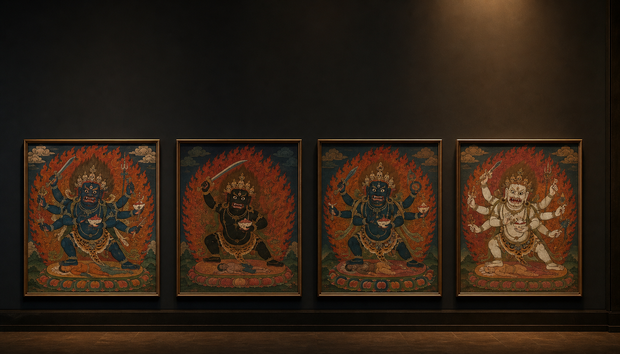
When you first encounter images of Mahakala, the immediate impression is one of overwhelming force. The fangs, the crown of skulls, the formidable posture—it's easy for the uninitiated to mistake this for a depiction of a demon or a malevolent spirit.
This is perhaps the single greatest misconception about Dharmapalas (Dharma Protectors) in the Tibetan tradition. Mahakala is not a worldly god to be appeased for material gain, nor is he an embodiment of anger.
He is the wrathful expression of Avalokiteshvara, the bodhisattva of compassion. Think of it this way: a loving parent might speak softly to a child, but if that child runs towards a busy street, the parent's cry will be sharp, loud, and commanding.
The motivation is identical—love and protection—but the expression is dictated by the urgency of the situation. Mahakala's energy is that urgent, protective cry.
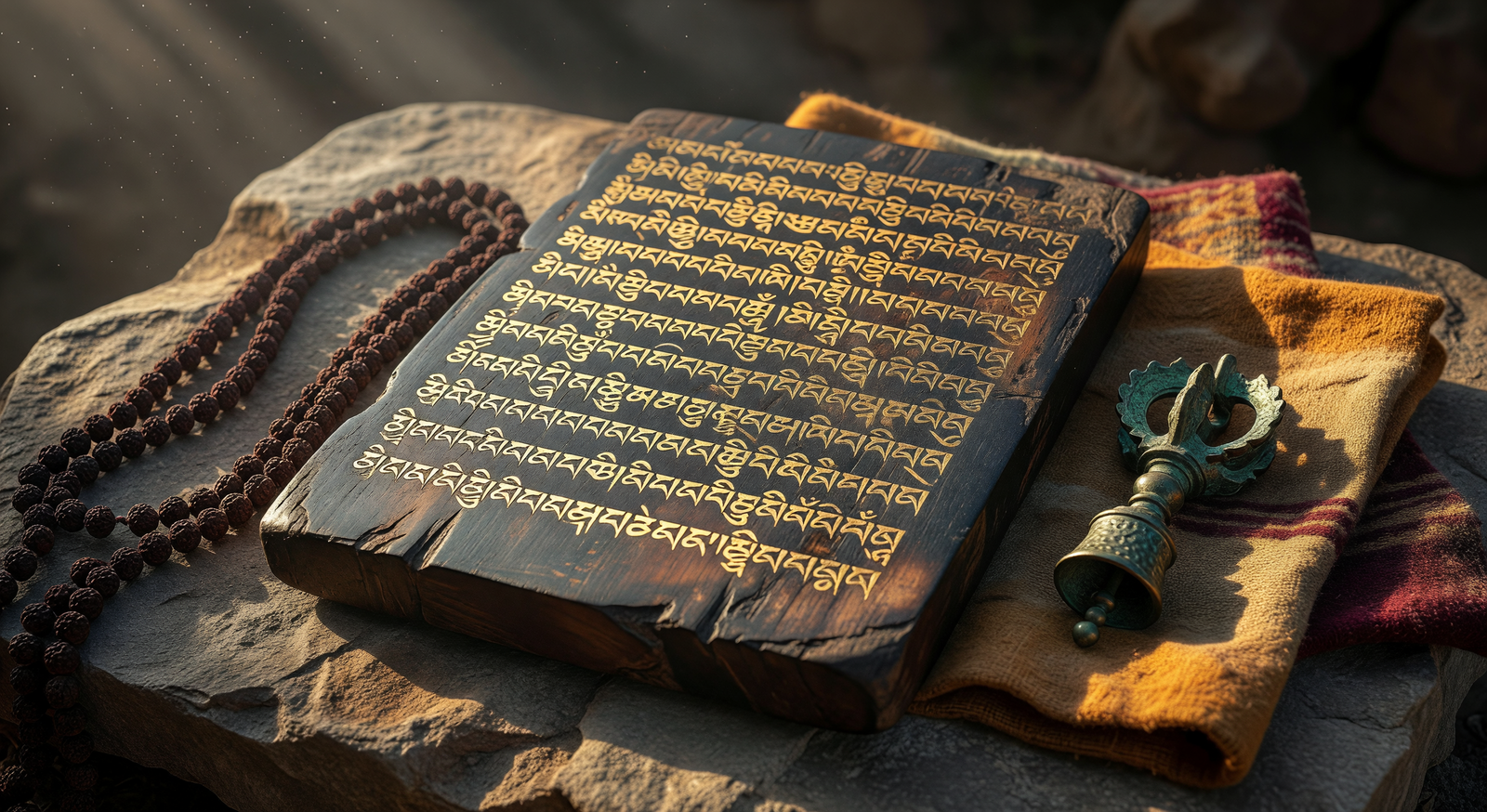
The core mantra, Om Shri Mahakala Hum Phat (ॐ श्री महाकाल हूं फट्), is a distillation of this compassionate power. It's not only a string of exotic sounds; each syllable is a key unlocking a specific aspect of this protective energy.
Let's break it down, not as a scholar would, but as a practitioner needs to understand it.
- OM (ॐ): This is the primordial sound, the resonance of the universe itself. It represents the form body of all Buddhas and connects your personal energy to the universal. It's the opening note that says, "I am aligning with ultimate reality."
- SHRI (श्री): This is a Sanskrit honorific, often translated as "glorious," "resplendent," or "majestic." It's a term of deep respect. By including it, you aren't just summoning a force; you are acknowledging its enlightened nature and paying homage to its wisdom. It adds a quality of richness and auspiciousness.
- MAHAKALA (महाकाल): This is his name. "Maha" means great, and "Kala" means time or black. He is the "Great Black One," or "The Great Time." This points to his nature as being beyond time and form. He represents the ultimate, unchanging nature of reality (dharmakaya), which is often symbolized by the color black—the color that absorbs all other colors, the unmanifest potential from which everything arises.
- HUM (हूं): A crucial seed syllable in Vajrayana practice since the 8th century transmission into Tibet. HUM represents the indestructible, diamond-like mind of enlightenment (vajra mind). It's a syllable of power, purification, and the unification of wisdom and method. When you chant HUM, you are invoking that unshakeable quality within yourself and in Mahakala.
- PHAT (फट्): Pronounced more like a short, sharp "peh!" in Tibetan practice. This is not a gentle syllable. PHAT is an action word. It means to cut, to destroy, to liberate. It is the sound that shatters obstacles, severs attachments, and annihilates negativity. It's the sonic equivalent of Mahakala's flaying knife (kartika), cutting through delusion and ego-clinging with surgical precision. It is the decisive, final action that clears the path.
So, when you recite the mantra, you are not only asking an external force for help. You are engaging in a dynamic process: Aligning with ultimate reality (OM), with deep respect (SHRI), invoking the timeless, compassionate protector (MAHAKALA), accessing your own indestructible enlightened mind (HUM), and decisively cutting through all that obstructs your path (PHAT).
It is a complete practice in five syllables.

Why This Matters for Your Practice in 2026
The challenges you face as a dedicated practitioner are rarely the dramatic, cinematic obstacles that get romanticized in retreat stories. They are subtle, corrosive, and deeply embedded in the very fabric of our lives.
By 2026, these challenges have only intensified. They are not about fending off physical threats, but about protecting your mind and your practice in an environment designed to fracture your attention and commodify your spirit.
Consider your professional life. As a leader or senior professional, you're likely working through complex ethical landscapes, perhaps involving AI, data privacy, or intense corporate pressure. The demand is for constant availability, for a mind that is always "on," processing, and producing.
This creates a powerful momentum that can easily bleed into your practice, turning meditation into another task on your to-do list, another metric to optimize. The Mahakala mantra acts as a boundary. Reciting it before starting your workday—I learned this practice from a teacher in Dharamshala who had spent fifteen years in retreat—is not about ensuring a profitable quarter; it's about creating a psychic shield that allows you to engage with your responsibilities from a place of clarity and integrity, rather than from a place of reactivity and stress.
It helps you cut through the noise and make decisions aligned with your deepest values, not only the loudest demands.
Then there is the challenge of the "practice plateau." After years of dedicated sitting, the initial insights have been integrated, and the path can feel like a long, featureless plain. The subtle hindrances—doubt, spiritual lethargy (acedia), a recurring sense of restlessness—become the primary obstacles.
These are not gross distractions but sticky, deep-seated patterns. The energy of Mahakala, invoked through the mantra, is uniquely suited to address this. The "PHAT" syllable is a direct antidote to lethargy. It's a jolt of focused energy that cuts through the mental fog and re-ignites your determination.
It's not about forcing progress, but about clearing the subtle energetic debris that is causing you to feel stuck.
Finally, there's the protection of your inner sanctuary. Your family life, your relationships, and your responsibility to aging parents all require immense emotional and mental energy. It is easy for the compassion you cultivate on the cushion to become drained by the endless demands of daily life.
The Mahakala practice helps you establish a "protected container" for your practice and your own well-being. It's a way of saying, "This space—this time on the cushion, this inner calm—is non-negotiable." It gives you the strength to set healthy boundaries, to say "no" when necessary, and to preserve the inner resources you need to show up for others authentically, without burning out.
In this sense, the fierce protector becomes the greatest ally of sustainable compassion. a closer exploration of Mahakala as a protector reveals just how integral this role is for householder practitioners.
The Real Benefits: How the Mantra Works on Your Path
Engaging with the Mahakala mantra is not about wish-fulfillment. It's a sophisticated method for transforming the mind and its environment. The benefits unfold on multiple levels—psychological, energetic, and practical. For a seasoned practitioner like you, these benefits are less about sudden miracles and more about lasting shifts in how you navigate your inner and outer worlds.
Clearing the Inner Obstacles to Deepening Your Practice
The most significant obstacles after a decade of practice are internal. They are the subtle karmic traces, the habitual thought patterns, and the deep-seated tendencies that keep you tethered to samsara. The Mahakala mantra works like a targeted spiritual solvent.
The resonance of the chant, combined with focused intention, begin to loosen the grip of these patterns. Doubt (vicikitsa) is a classic hindrance; the mantra's decisive energy cuts through the endless "what if" scenarios.
Restlessness (uddhacca) is countered by the grounding, powerful resonance of "HUM"—a sound that practitioners in the Jokhang Temple in Lhasa have chanted for centuries. Spiritual sloth (thina-middha) is shattered by the explosive energy of "PHAT." It's a form of active, energetic housekeeping for the mind.
By regularly clearing these subtle obstacles, you create the conditions for deeper states of concentration (samadhi) and insight (vipassana) to arise naturally, moving you off the plateau.
Cultivating Decisive, Wrathful Compassion in Daily Life
Compassion is often misunderstood as a soft, passive quality. Vajrayana teaches that true compassion is often fiercely active. It's the courage to have a difficult conversation with a struggling family member, the integrity to stop an unethical project at work, or the self-respect to end a toxic relationship.
This is "wrathful compassion." The Mahakala mantra is a training ground for this quality. As you work with its energy, you may find yourself becoming less hesitant, more able to act from a place of deep-seated conviction.
The mantra helps you cut through the fear of disapproval or the desire to please everyone, which are often the biggest impediments to compassionate action. You learn to wield your personal power with precision and wisdom, protecting what is wholesome and severing what is not.
This is a vital skill for anyone in a position of responsibility. Those walking this path see this reflected in the powerful forms of our our Mahakala jewelry range, each piece a reminder of this active, protective force.
Creating a Sacred Container for Your Life and Practice
Your practice doesn't just happen on the cushion; you carry it with you throughout the day. The Mahakala mantra helps to establish and maintain a field of protective energy around you. This isn't a mystical forcefield, but a tangible shift in your own presence.
When your mind is imbued with the stability and clarity of the practice, you are less susceptible to the draining energies of others—the office politics, the ambient anxiety of the news cycle, the negativity you might encounter.
It's like weather-proofing your mind. You can still perceive the storm, but it doesn't soak you to the bone. This allows you to conserve your vital energy for what truly matters: your practice, your family, and your purpose.
For practitioners who travel or work in high-stress environments—a journalist in Kathmandu, a doctor in a rural clinic, a business leader working through corporate demands—this benefit is invaluable. The mantra becomes a portable temple, a sacred space you can access anywhere, anytime, simply by turning your attention to it.

How To Spot the Real Thing Mahakala Pieces
As your connection to this practice deepens, you might feel drawn to having a physical representation—a statue for your altar, a thangka, or a piece of personal jewelry. This isn't about spiritual consumerism; it's about creating a tangible link to the practice, a constant reminder that you carry with you.
When choosing such an item, authenticity is paramount. A mass-produced trinket lacks the lineage and intention that make these objects potent supports for practice. Here's what to look for.
First, consider the source. Where does the piece come from? We've spent years in the Himalayas building relationships with specific artisan families and monastic communities—metalworkers in the Kathmandu Valley, bone carvers in Lhasa, thangka painters in Bhaktapur.
An authentic item has a story. It was likely crafted by someone who is themselves a practitioner, who understands the iconography not only as artistic detail but as sacred geometry. When Master Tenzin in our Boudhanath workshop carves a Mahakala pendant, he is reciting mantras.
That intention is infused into the metal or bone. Ask where the piece was made and who made it. A reputable source will be proud to tell you. — explore our Tibetan jewelry collection for authentic pieces.
Second, look at the materials and iconography. Traditional materials like silver (representing the moon/method), brass (representing the sun/wisdom), copper, or ethically sourced bone all have specific energetic properties. The details in the carving should be correct.
For example, in a depiction of the Six-Armed Mahakala, each hand holds a specific implement—a curved knife, a skull cup, a lasso—and each has a precise meaning. A sloppy or incorrect representation shows a lack of understanding and respect for the tradition.
The piece should feel potent, not only decorative. It should have a certain weight, a presence that speaks to the quality of its creation.
Third, and perhaps most importantly, is the element of blessing. An authentic piece from the Tibetan tradition is often more than a beautifully crafted object; it is a vessel for spiritual presence. We work with monks from Sera Monastery and other respected lineages to have our pieces blessed.
This isn't a vague, mystical process. It involves specific rituals (pujas) where the objects are placed on the altar, and monks chant the relevant mantras for hours or even days—sometimes three days for a single piece—consecrating them and infusing them with the protective energy of the deity.
This transforms the item from a mere symbol into a true support for your practice. When you wear one of our Mahakala protection pendants, you are carrying that lineage and that blessing with you.
It becomes an investment piece—a companion on your path that you'll have for decades to come.
How to Actually Use the Mantra in Your Daily Practice
Integrating a new mantra into an established practice should be done with intention and respect. The Mahakala mantra is potent, and it's best approached not as a casual affirmation, but as a specific tool for a specific purpose. Here's a simple, grounded way to begin.
1. Get the Pronunciation Right: Authenticity starts with pronunciation. While Sanskrit and Tibetan pronunciations can vary, a common and effective way for practitioners to chant is: OM SHREE MA-HA-KA-LA HOOM PEH! Notice the changes.
"Hum" is often pronounced closer to "Hoom" in the Tibetan tradition, with a deep, resonant sound that you feel in your chest cavity. And "Phat" is not "fat." It's an explosive, short "Peh!" (sometimes spelled Phet).
It should be uttered with a sharp exhalation, like you are physically cutting something in the space in front of you—the way a Tibetan lama demonstrates it during empowerment ceremonies. Practice saying it slowly at first, feeling the resonance of each syllable moving through your body from your lower abdomen upward.
2. Set the Right Time and Intention: This is not a mantra to be chanted idly while driving or washing dishes. Its energy is sharp and focused. The best times to use it are:
- At the beginning of your meditation session: Recite it 3, 7, or 21 times to clear the space (both inner and outer) and set a protective boundary for your sit. This helps settle the mind and ward off distractions before they arise.
- Before a challenging situation: If you have a difficult meeting, a crucial conversation, or are entering a stressful environment, you can silently recite the mantra a few times. The intention is not to control the outcome, but to fortify your own clarity and stability so you can navigate the situation with wisdom.
- When feeling overwhelmed: If you feel swamped by negative thoughts, anxiety, or the energy of a particular place or person, find a quiet space and recite the mantra. Visualize the energy of the mantra cutting through the negativity and re-establishing your center.
3. A Simple Visualization: You don't need to be a thangka painter to do a simple, effective visualization. As you chant, you can visualize a sphere of deep, dark blue or black light forming around you—the same indigo-black you see in traditional Mahakala thangkas.
This is not a dark, empty space, but a vibrant, potent, and protective one. With each recitation of "PHAT," imagine any obstacles—doubt, fear, distraction, external negativity—being instantly incinerated as they touch the edge of this sphere.
See them vanish into emptiness, not through violence, but through the overwhelming power of enlightened wisdom. Keep it simple. The feeling of being secure, grounded, and protected is more important than a perfectly detailed mental image.
Explore the Vajrakilaya amulet.
Common Questions from Practitioners
Those walking the path of wrathful deity practice often encounter genuine questions about how to work skillfully with these energies. It's wise to approach this aspect of the path with curiosity and care. Here are some of the things you might be wondering about.
Is it appropriate for a lay practitioner to use a powerful mantra like this?
Yes, absolutely. In the Tibetan tradition, while some advanced practices require specific empowerments (wang), the core mantras of major deities like Mahakala are often practiced by laypeople for protection and clearing obstacles. The key is your motivation.
If you are reciting the mantra with the intention to protect your Dharma practice, to act more compassionately in the world, and to clear the path to enlightenment for the benefit of all beings, then your practice is well-founded.
It's not about seeking worldly power or harming others. Approaching the mantra with respect, a clear and compassionate intention, and a sense of humility is far more important than any formal status. The protectors are allies to all who sincerely walk the path.
What's the difference between Six-Armed, Four-Armed, and other forms of Mahakala?
The different forms of Mahakala are not different beings; they are different emanations that arose to suit the needs of different practitioners and lineages. Each form emphasizes a particular aspect of his enlightened activity.
The Six-Armed Mahakala (Shadभुजा महाकाल) is an emanation of Avalokiteshvara and is a protector of the Shangpa Kagyu school, later adopted by the Gelugpas in the 15th century. His practice is particularly focused on overcoming obstacles for serious meditators and those in retreat.
The Four-Armed Mahakala is the primary protector of the Karma Kagyu school and is associated with four types of enlightened activity: pacifying, enriching, magnetizing, and subjugating. The two-armed forms, like Bernagchen (Black-Cloaked Mahakala), are often even fiercer and more swift in their action.
For you, the specific form is less important than your connection to the energy itself. Most practitioners start with the form associated with their particular lineage or the one that they feel the most intuitive connection to.
How do I know if the mantra is "working"?
This is a subtle but important question. The effects are unlikely to be dramatic flashes of light or sudden windfalls of good luck. Look for the changes in your own mind and experience. You might notice that you are less easily thrown off-center by daily frustrations.
You might find a renewed sense of determination and clarity in your morning meditation. You may realize that a situation at work that previously caused you great anxiety now seems more manageable. The work of the mantra is to clear away the inner static so that your own innate wisdom can function more freely.
The sign that it's working is not the arrival of something new, but the departure of the old hindrances: less doubt, less hesitation, more clarity, and a quiet, unshakeable confidence in your path.
Can I wear a Mahakala pendant without a formal empowerment?
Yes. Wearing a blessed image of a protector deity is a very common and accepted practice in Tibetan Buddhism for lay practitioners. It serves as a constant source of reminder and protection. Think of it as keeping a photo of a deeply respected teacher or mentor with you.
It connects you to their qualities and inspires you to embody them. An empowerment (wang) is a formal ritual that grants you permission to visualize yourself *as* the deity in advanced generation-stage practices. Simply chanting the mantra and wearing a blessed pendant for protection and inspiration does not require this level of formal initiation.
It is an act of devotion and a way to keep your intention aligned throughout the day, fully supported by the entire tradition.
Will this practice make me more angry or aggressive?
This is a very common and understandable concern. The answer is no; in fact, it should do the opposite. The wrath of Mahakala is not ordinary, ego-driven anger. It is the fierce, focused, and impersonal energy of wisdom that destroys delusion.
Working with this energy actually helps to pacify your own anger. When you have access to this clean, powerful, protective energy, you are less likely to be triggered into reactive, petty anger by life's annoyances.
You learn to differentiate between the destructive emotion of anger and the constructive, decisive energy needed to solve problems. The practice should lead to more stability and less reactivity, not more aggression. It channels your power into wise action rather than emotional outbursts.
How many times should I recite the mantra?
Consistency is more important than volume. A traditional short practice might involve reciting the mantra 21 or 108 times (one round of a mala). However, even reciting it just 3 or 7 times with focused intention before your meditation can be very potent.
Some practitioners undertake a commitment to recite a certain number over a period of time (e.g., 100,000 recitations) as a preliminary practice (ngöndro) to deeply purify obstacles. For your purposes, start small. A short, consistent daily practice is far more effective than sporadic long sessions.
Pay attention to the quality of your recitation, not only the quantity. Feel the meaning and the energy of each syllable. Let the practice grow organically as you become more comfortable with it.
Your Journey Forward: A Path Cleared with Intention
The path of a long-term practitioner is not always one of gentle ascent. It has plateaus, valleys, and thickets of doubt that require a different kind of tool. The Mahakala mantra is that tool.
It is the sharp, compassionate instrument for clearing the subtle but persistent obstacles that arise on the journey. As you look toward 2026 and beyond, the challenges to maintaining a deep and authentic practice will only grow more subtle and pervasive.
The need for a protected, sacred space within yourself—one I've felt necessary after years of sitting in Dharamshala monasteries—is not a luxury; it is a necessity.
Embracing this practice is not about adding another complex ritual to your life. It's about consciously inviting a quality of fierce, unwavering, compassionate protection to your path. It is a commitment to cutting through your own inertia, to protecting your precious time on the cushion, and to working through the world with clarity and courage.
Let this mantra be your ally, and let the tangible presence of authentic wrathful deity pieces—whether cast in bronze or hand-carved in bone—be a constant reminder of the unshakeable strength that resides at the very core of your practice, and at the heart of the Dharma itself.

Keep reading