News
Chuba Clothing: Meaning & Tibetan Dress Guide
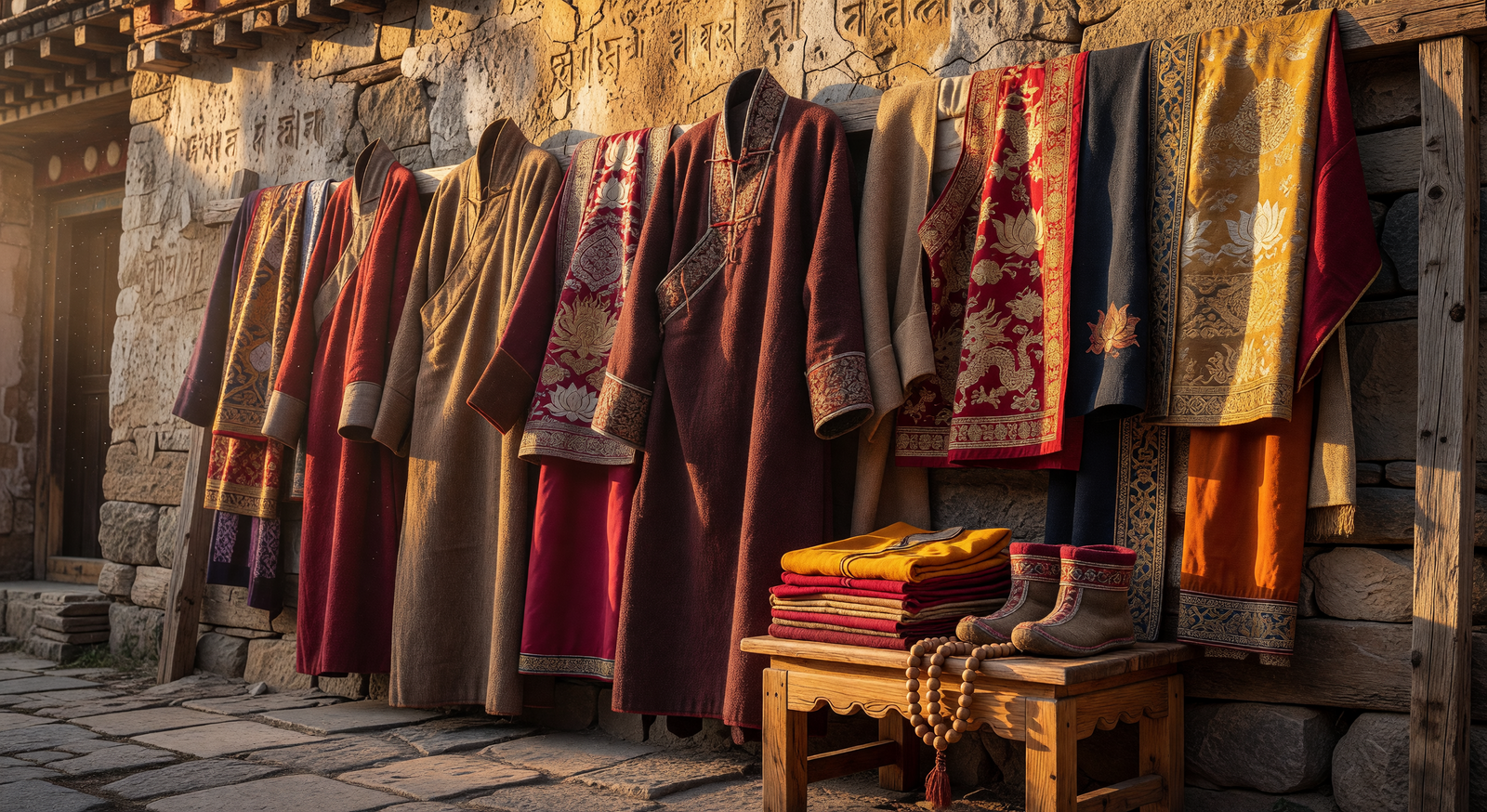
Chuba clothing is the traditional robe worn across Tibet, made in regional styles for daily life, festivals and religious settings. Its wrap construction, long sleeves and layered fabrics reflect the plateau climate as well as local identity, status and custom.
You’re sitting on your couch, scrolling through your phone after a long day. Your feed is a blur of fast-fashion hauls, fleeting trends, and influencers talking about their latest 'must-have' item that will be forgotten by next season.
It all feels a bit hollow, a bit disconnected from anything real. You might feel a quiet longing for something with weight, with story, with soul. Something that connects you to a tradition deeper than a checkout code.
This is where the journey into the world of Tibetan clothing begins. It’s not about finding a new aesthetic; it’s about discovering a piece of wearable history, a tangible connection to the Himalayas that you can hold.
What Is Chuba Clothing?
Walk through the Barkhor circuit in Lhasa and you'll see Tibetans in their vibrant, layered garments—not as beautiful costumes for festivals, but as the daily armor of their lives. That's where the real understanding begins.
The biggest misconception is that Tibetan clothing is primarily decorative. In reality, every fold, every fabric, every color is born from a deep conversation between the people, the land, and the spirit. It's not a costume; it's a toolkit for life on the roof of the world.
Take the chuba, the iconic long-sleeved robe. Its design isn't an arbitrary fashion choice. It's a masterpiece of practicality forged by the extreme Himalayan climate—where temperatures drop to minus 20 degrees Celsius in winter.
The long sleeves can be pulled over the hands for warmth or shrugged off and tied at the waist during a strenuous, sun-drenched afternoon trek. At night, a nomad can untie their chuba, lay it out, and it becomes a warm, durable blanket.
It is a home you wear on your back, a shelter from the wind, sun, and cold. The generous, overlapping folds at the chest create a large, secure pocket—a traditional 'day pack' for carrying everything from tsampa (roasted barley flour) to personal prayer items.
The materials themselves tell a story. Heavy, handwoven wool from highland sheep (changluk) provides exceptional insulation. The shimmering silk brocades, often used for collars and trim, weren't just for beauty; they were a sign of wealth and status, often acquired through long, arduous trade routes that took months to traverse.
This is clothing that embodies resilience. It's a physical record of a life lived in close harmony with a demanding, awe-inspiring environment. When you touch a piece of authentic Tibetan clothing, you're not only feeling fabric; you're feeling the echo of mountain winds, the warmth of a nomadic hearth, and the quiet strength of a culture that has endured since at least the 7th century.
Why This Matters in Your Life, Right Now

Walk through Lhasa's Barkhor Circuit and you'll see the chuba worn as daily armor against wind and weather, as identity, as prayer. But what does it mean for you, working through deadlines, relationships, and the constant hum of digital notifications?
Why should a piece of Himalayan heritage matter in your world? The answer lies not in escaping your life, but in bringing more intention into it.
First, consider the tidal wave of fast fashion. You're likely aware of the environmental and human cost of a $10 t-shirt. The constant pressure to buy more, to keep up with micro-trends, leads to a cycle of consumption that often leaves you feeling empty and your closet full of things you don't truly love.
A piece of traditional Tibetan clothing is the antithesis of this. It is the ultimate expression of 'slow fashion.' When our artisans in Kathmandu, led by Master Tenzin, spend weeks weaving a single shawl—sometimes four to six weeks for a single piece—they are embedding their skill, patience, and mindfulness into the threads.
Choosing one such piece over dozens of mass-produced items is a conscious act. It's a vote for quality over quantity, for cultural preservation over fleeting trends. This isn't just a garment; it's an investment in a philosophy of living with less, but better.
This is the piece you'll still wear in 20 years, its story intertwined with your own.
Second, in a life lived increasingly through screens, we crave tangible connection. You might be feeling the burnout from endless Zoom meetings or the subtle anxiety that comes from comparing your life to curated Instagram feeds.
A handwoven garment is a grounding force. The slight, perfect imperfections of a hand-stitched seam, the substantial weight of real wool—often 400 grams or more per shawl—the scent of natural dyes from indigo and madder root—these are sensory experiences that pull you back into your body and into the present moment.
It's a physical link to a real person, an artisan in our Boudhanath workshop, whose hands created this for you. It's a reminder that a world of deep, quiet, authentic craft still exists. Holding it is a form of meditation in itself.
Finally, this is about wearing your intention. You don't just put on clothes; you put on a mindset. When you start your day by mindfully draping a soft wool shawl over your shoulders before your morning meditation, you are creating a sacred space.
You are signaling to yourself that this time is different, this time is for you. It's a simple, physical act that can shift your entire mental state, helping you move from a place of reaction and anxiety to one of calm and purpose.
It's a way of bringing the quiet of the mountains into the noise of your city apartment.
The Real Benefits: How Sacred Garments Work
You might wonder how a piece of clothing can offer anything beyond warmth and style. The benefits are subtle but real, working on your inner state as much as your outer appearance. It's less about a mystical shift and more about creating the conditions for your own inner wisdom to emerge.
We see it as a practice of weaving mindfulness into the very fabric of your daily life.
Enclothed Cognition: The Psychology of Wearing Your Practice
There's a fascinating psychological concept called 'enclothed cognition,' which suggests that the clothes you wear can systematically influence your thoughts and behaviors. When a doctor puts on a white lab coat, they often report feeling more focused and attentive.
The coat isn't magic, but it's a powerful symbol that activates a set of associations in their brain. The same principle applies here. When you wrap yourself in a Zen, the maroon shawl worn by Tibetan monks and nuns, you're not pretending to be a monastic.
Instead, you're donning a powerful symbol of calm, compassion, and introspection. The color itself, a deep, earthy red, is associated with the sacred. The simple act of wearing it during your meditation or while you journal can serve as a non-verbal cue to your mind: it is time to be present, it is time to be gentle with yourself. It becomes a supportive tool, a gentle reminder that helps you access the qualities you wish to cultivate within yourself.
A Living Connection to Lineage and Artisans
Authentic Tibetan garments can carry visible evidence of the person who made them. This is not a mystical claim; it is a human one. Handwoven textiles often show small variations in weave, stitching and finish that industrial reproductions smooth away.
A credible seller should be able to identify the workshop or region, describe the materials and construction, and explain whether a garment was handmade, hand-finished or factory-produced. Treat vague lineage stories without supporting provenance as marketing rather than proof.
When you choose one of these garments, you are becoming part of that lineage. You are directly supporting Pema and her family, ensuring that this vital cultural skill doesn't just survive but thrives. This knowledge transforms the garment from a mere product into a relationship.
You are connected to the hands that made it, and this connection infuses the piece with a warmth and meaning that no machine can replicate.
The Subtle Language of Color and Symbol
Tibetan culture is rich with a visual language of symbols and colors, and their clothing is a primary canvas. While you don't need to be an expert to appreciate the beauty, understanding a few basics can deepen your connection immensely.
The deep maroon and saffron of monastic robes symbolize a renunciation of worldly attachments and a commitment to the path of dharma. For laypeople, vibrant colors are a celebration of life. The combination of five primary colors (blue, white, red, green, yellow) often seen in Pangden aprons or prayer flags represents the five elements and the five wisdoms.
You might see the Endless Knot (pata) embroidered on a collar, a symbol of the interdependent nature of all things and the unending wisdom of the Buddha. Wearing a garment with these elements isn't about making a loud statement.
It's a quiet, personal reminder of these essential concepts. It's a way to carry these teachings with you, not as abstract ideas, but as a felt presence in your day.
How to Spot Authentic Tibetan Clothing

When you decide to bring a piece of this tradition into your life, the most important step is choosing with awareness. The market is flooded with imitations, and telling the difference can feel daunting.
It is simpler than it first appears: look for signs of handwork, appropriate natural materials, construction suited to the garment type and a seller who can explain where and how the piece was made.
First, pay attention to the materials. Authentic Tibetan garments are made from natural fibers suited to the Himalayan environment. Look for the substantial, slightly coarse texture of hand-spun sheep or yak wool sourced from herds above 12,000 feet.
Feel for the unmistakable softness of fine pashmina from Kashmir or the crisp, cool touch of raw silk or sturdy cotton. If a description mentions polyester, rayon, or acrylic, it's a sign of a mass-produced item that misses the entire point of the tradition.
The materials are the soul of the garment. They should feel like they came from the earth, not a factory.
Second, look for the hand of the artisan. Turn the garment inside out. Do you see neat, but slightly irregular hand-stitching? Are the patterns woven directly into the fabric, rather than printed on top?
These are the beautiful imperfections that signal true craftsmanship. A machine produces flawless uniformity; a human hand produces character. This is a key insight we share in our essentials guide to sacred garments.
Be wary of sellers who aren't transparent about where their items are made or who makes them. We take pride in sharing the stories of the artisans in our Tibetan workshop because their work is the heart of what we do.
Here are a few types of garments you might consider for your life:
- The Zen (Monastic Shawl): This is perhaps the most accessible and versatile piece. It's a large, simple rectangle of fabric, usually in maroon or saffron wool, measuring roughly 5 by 8 feet. It's perfect for draping over your shoulders during meditation, wrapping around yourself on a cool evening, or even using as a beautiful throw in your home. It's a piece of wearable sanctuary.
- The Chuba (Robe): The traditional robe is a significant investment piece. For a Western lifestyle, it can be worn as a stunning, unique overcoat in cooler weather or for special, intentional gatherings. Its wrap-style design is surprisingly comfortable and adaptable. Our detailed Chuba guide explores its history and variations.
- Himalayan Vests (Tetung): These are a wonderful blend of tradition and modern wearability. A beautifully tailored wool vest with traditional frog closures, often lined with silk brocade, can be worn over a simple shirt or sweater, adding a touch of Himalayan elegance and warmth to your everyday wardrobe.
- Silk Blouses (Wonju): Often made of vibrant silk brocade hand-loomed in Bhutan or Tibet, these long-sleeved blouses are traditionally worn under a chuba. However, they are stunning on their own, paired with simple trousers or a skirt, for an elegant and meaningful statement piece.
How to Actually Weave These Garments Into Your Life
Owning an authentic piece of Tibetan clothing is one thing; making it a part of your life is where the real value unfolds. It's not about waiting for a special occasion. It's about finding small, everyday moments to connect with its purpose.
The goal is to let the garment support your journey, not to put it on a pedestal.
Start with a simple morning ritual. Before you reach for your phone, take your Zen shawl. As you unfold it, take a conscious breath. Feel its texture and weight—the soft lanolin of hand-carded wool, the slight warmth it holds even before draping.
Wrap it over your shoulders as you sit for just five minutes of quiet. You can use your Headspace app or simply focus on your breath. The shawl acts as a physical boundary, creating a cocoon of intention that separates this time from the rest of your day's demands.
It's a simple, powerful way to begin with presence.
Integrate it into your creative or focused work. If you work from home or have a creative practice like journaling or painting, make one of these garments your 'work uniform.' Slipping on a comfortable Himalayan vest or wrapping a shawl around you can be a signal to your brain to switch into a different mode.
It helps create a ritual around your work, imbuing it with a sense of purpose and calm that can be hard to find when your living room is also your office.
Caring for your garment is also a practice of mindfulness. These aren't disposable items to be tossed in a hot wash. Most wool pieces simply need to be aired out on a line or over a chair.
For cleaning, gentle hand-washing in cool water with a mild soap is best. As you carefully press the water out and lay it flat to dry—a process that takes two to three days—you are extending the life of the garment and honoring the resources and skill that went into its creation.
This act of care is a meditation in itself, a quiet rebellion against a throwaway culture. It reinforces the value of the piece not only as an object, but as a cherished companion on your path.
Common Questions About Tibetan Clothing
Is it cultural appropriation for me to wear Tibetan clothing?
This is a thoughtful question that deserves a clear answer. The key difference lies between appropriation and appreciation. Appropriation is taking a culturally significant item out of context, often for a costume or a fleeting fashion trend, without understanding or respecting its origin.
Appreciation, on the other hand, is wearing it with genuine respect for the culture, an understanding of its meaning, and, crucially, in a way that supports the original artisans. When you purchase an authentic garment from a source like us, who partners directly with Tibetan and Nepali artisans in the Kathmandu Valley and Lhasa regions, you are participating in cultural preservation, not appropriation.
The intention is to honor the tradition, not to mimic it as a costume. We suggest wearing these pieces in a respectful manner—a shawl for meditation is beautiful; a full chuba worn to a party as a gag is not.
Do I need to be a Buddhist to wear these garments?
Absolutely not. You do not need to identify as a Buddhist to appreciate the beauty, craftsmanship, and philosophy behind these pieces. Those on a path of self-inquiry and slow living are drawn to them for their connection to mindfulness, slow fashion, and authentic artistry.
However, having a basic understanding of the cultural and spiritual context will undoubtedly enrich your experience. Knowing that the maroon of your shawl is connected to monastic life, or that the knot pattern on your vest symbolizes interdependence, adds a layer of meaning.
We see these garments as invitations to explore these concepts, open to anyone with a curious and respectful heart, regardless of their personal spiritual path.
What is the main difference between a men's and a women's chuba?
While the fundamental design of the chuba is similar for both men and women, there are some traditional distinctions. Women's chubas (chuba) are typically ankle-length and long-sleeved, often constructed from silk brocade or wool damask.
They are often worn with a colorful striped apron called a pangden, which signifies a woman is married. Men's chubas (lokpa) are often slightly shorter, reaching to the knee, to allow for more mobility, especially for horse riding across the Tibetan plateau.
They are also commonly worn with one sleeve off and tied around the waist, a practical style for working. However, in modern contexts, these distinctions are becoming more fluid, and many styles can be considered unisex, especially when worn as an overcoat.
How can I be sure a piece is authentically made?
The best way to ensure authenticity is to know your source. Ask questions. Where was this made? Who are the artisans? A reputable seller will be proud to share this information. Beyond that, use your senses.
Look for natural materials like wool, silk, and cotton—check the weight and feel of the fabric in your hands. Examine the stitching—is it precise yet shows the slight variation of a human hand? Authentic patterns are typically woven or embroidered, not printed.
The price should also be a clue. A handwoven wool chuba that takes six to eight weeks to create cannot be sold for $50. An authentic piece is an investment in time, skill, and high-quality materials, and its price will reflect that.
Are these clothes practical for a modern, Western lifestyle?
While a full, formal chuba might be reserved for special occasions, many other pieces are deeply practical and versatile. A wool Zen shawl is as functional as any high-quality scarf or wrap, perfect for travel, cool offices, or meditation.
A Himalayan vest is a stylish and warm layer for autumn and winter. A silk wonju (blouse) can be dressed up for an evening out or paired with jeans for a unique, artistic look.
The key is to see them not as a complete traditional outfit, but as individual, meaningful pieces that you can integrate into your existing wardrobe to add a layer of story, texture, and intention.
How are the garments from Buddhabelief blessed?
We believe in being very clear about this process, as it's deeply meaningful. Our blessing is not a vague spiritual activation. Certain items in our collection, particularly those intended for practice like malas or Zen shawls, are brought to our partner monastery, Sera Monastery in Lhasa, or to the sacred space at the Boudhanath Stupa in Kathmandu.
There, the monks perform their regular daily or monthly pujas (ritual ceremonies). The items are placed in the temple during these ceremonies, allowing them to absorb the blessing and intention of the chanting, prayers, and mantras.
It's a process of infusion with sacred intention, performed by ordained practitioners in a consecrated space. We ensure this is done with the utmost respect and authenticity.
Your Journey, Woven with Intention
We started this conversation on your couch, feeling a sense of disconnect from the fleeting digital world. The journey through the world of Tibetan clothing is an answer to that feeling. It's a path back to the tangible, the meaningful, and the enduring.
It's not about adopting a new identity or wearing a costume. It's about choosing to weave more intention, more story, and more connection into the life you already lead.
As you move forward, think about the person you want to be. Perhaps it's someone a little more grounded, a little more mindful, a little more connected to the things they choose to bring into their life.
Choosing one well-documented garment over a series of short-lived trends can support longer use and more considered buying. Verify the fiber, construction, origin and care requirements before treating any seller's artisan story as fact.
Buddhabelief does not currently sell chuba clothing. Use the material, construction and provenance checks above when comparing garments, and avoid sellers who cannot explain the origin of a piece.
Keep reading