News
Jade Necklace Meaning 2026: Complete Guide to Jade Jewelry
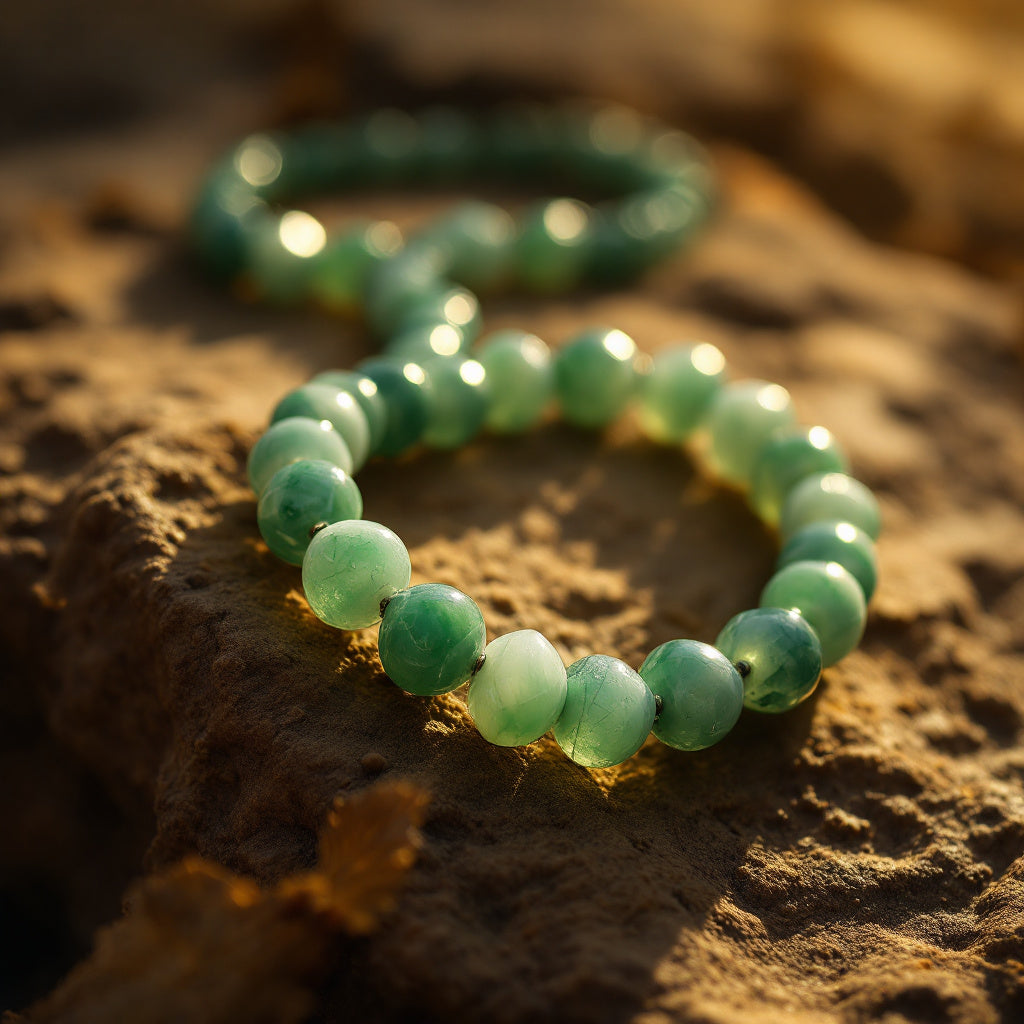
Your friend has been practicing Buddhism for three years. She meditates every morning, has a small altar in her apartment, and wears a simple string of beads she bought at a dharma center in Colorado.
Her birthday is in two weeks. You've been circling the idea of a jade necklace — something that feels genuinely meaningful, not only pretty — but every time you search, you hit a wall of contradictory information, dubious "healing crystal" claims, and products that look suspiciously uniform for something supposedly hand-carved.
You want to get this right. This guide is written for exactly that moment. We'll walk you through what jade actually means in Tibetan Buddhist tradition, how to tell real jade from convincing fakes, and how to choose a piece that will still matter to her twenty years from now.
Browse our authentic Tibetan jewelry alongside this guide if you want to see what we're describing in practice.
What Jade Actually Is (And the Misconception That Costs People Money)
Here is the single most important thing to understand before you buy a jade necklace: "jade" is not one stone. It is two entirely different minerals that share a name because 18th-century European traders couldn't tell them apart, and the confusion has never fully resolved itself in the consumer market.
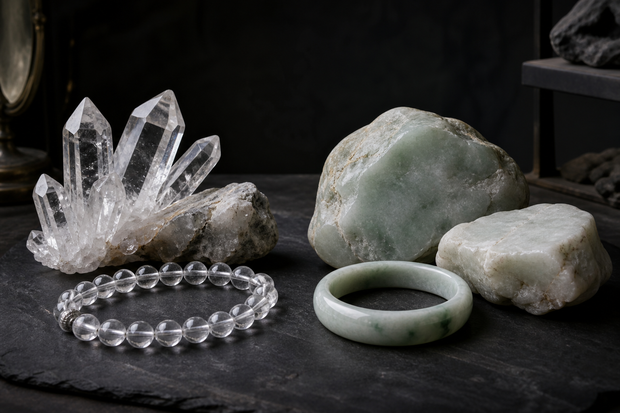
Nephrite is the older of the two in terms of human history. It's a calcium magnesium silicate, dense and fibrous in structure, which gives it extraordinary toughness — nephrite is harder to shatter than steel, which is partly why Neolithic cultures across Central Asia, China, and Mesoamerica used it for tools and ceremonial objects long before anyone thought of it as jewelry.
The jade objects found in Tibetan and Himalayan cultural contexts — the ritual vessels, the small carved amulets, the beads that appear in museum collections from Lhasa and Shigatse — are almost always nephrite.
It comes in a wide range of colors: creamy white (called "mutton fat" jade in Chinese appraisal tradition, the most prized grade of nephrite), forest green, mottled gray-green, black, and occasionally a warm honey yellow.
A piece of nephrite the size of a thumb can weigh nearly as much as a stone marble, a density that practitioners notice immediately when holding it.
Jadeite is the newcomer. It's a sodium aluminum silicate, harder than nephrite on the Mohs scale (6.5–7 versus nephrite's 6–6.5), and capable of producing a more vivid, saturated color — particularly the intense emerald green that most Westerners picture when they hear the word "jade." Jadeite is rarer, more expensive at the top end, and almost entirely sourced from Myanmar (Burma).
The finest jadeite — "Imperial jade," translucent and intensely green — commands prices that rival fine diamonds. Jadeite became dominant in Chinese decorative arts during the Qing dynasty (1644–1912) when Burmese trade routes opened, but it has a much shorter history in Tibetan Buddhist use than nephrite does.
The misconception that costs people money: Most jade sold online as "Tibetan jade" or "Buddhist jade" is neither jadeite nor nephrite. It is serpentine, aventurine, bowenite, or dyed quartzite — stones that can look similar to jade but have none of its density, durability, or cultural lineage.
The giveaway is price: authentic nephrite in a simple pendant form starts around $40–80 for smaller pieces of mid-grade material; jadeite of any quality starts higher. If you're seeing "jade" necklaces for $8–15 with free shipping, you are not looking at jade.
In Tibetan Buddhist material culture, jade appears most often as a secondary stone in composite pieces — combined with coral, turquoise, and silver in the elaborate pectoral ornaments called gau, or as smooth beads in a mala alongside other stones.
It is not as central to Tibetan practice as turquoise (which has deep indigenous Tibetan roots) or coral, but it carries consistent symbolic weight, particularly in the Himalayan Buddhist communities of Bhutan, Sikkim, and the Tibetan diaspora communities in Nepal where Chinese cultural influence has long been present.
A mala I saw in a monastery near Kathmandu in 2019 paired nephrite beads with amber and silver spacers, each stone chosen for both its spiritual resonance and its ability to withstand decades of daily handling.
Understanding this distinction matters practically. When you're choosing a jade necklace as a meaningful gift, you want to know what you're actually giving — and you want the person receiving it to be able to look at it honestly and feel good about what it is.
Why Jade Necklace Meaning Matters More Right Now
There's a particular kind of gift-giving anxiety that has intensified in the last few years. Those on a path of self-inquiry are more aware of cultural appropriation concerns, more skeptical of wellness marketing, and simultaneously more hungry for objects that carry genuine weight.
The jade necklace sits at an interesting intersection of all of this.
Jade has been a meaningful object in human culture longer than most religions have existed. The Maori of New Zealand carved nephrite into hei-tiki pendants passed through generations. The Olmec of ancient Mexico treated jade as more sacred than gold.
In China, jade's cultural significance stretches back to the Neolithic Hongshan culture (roughly 4700–2900 BCE), where it was used in burial rites and as markers of spiritual authority. The Confucian scholar-gentleman was expected to wear jade at all times because jade's physical qualities — its coolness, its hardness, its subtle translucency — were seen as embodying virtues: benevolence, wisdom, courage, purity, and harmony.
This is not mystical marketing language. This is documented cultural history. And it means that when you give someone a jade necklace with genuine intent, you are participating in one of the longest-running human conversations about what makes an object sacred.
For someone going through a difficult transition — a divorce, a health scare, a major career change — jade's association with steadiness and endurance is apt. Nephrite in particular, with its fibrous structure that makes it nearly impossible to shatter, is a physically honest metaphor for resilience.
You're not giving someone a pretty stone; you're giving them something that has literally survived geological pressure for millions of years, compressed under the Kunlun Mountains where the finest nephrite still originates.
For a new mother, white nephrite has been used in Chinese and Tibetan-influenced traditions as a protective amulet for infants and mothers for centuries. The smooth, cool quality of the stone — and its association with purity and nurturing — makes it a culturally grounded choice for a birth gift, particularly in communities where jade bangles are placed on newborns within days of birth.
For someone retiring or completing a long chapter, jade's association with accumulated wisdom and the culmination of a life well-lived makes it more appropriate than almost any other stone. In Chinese tradition, jade was specifically associated with the elder years — the time when a person had earned the right to wear it.
For a Buddhist practitioner specifically, the color meanings within Tibetan Buddhist iconography add another layer. The five Buddha families each have associated colors, and those colors map onto jade's natural palette in ways that make color choice meaningful rather than arbitrary.
We'll go into that in detail in the next section.
The 2026 context worth noting: the global market for "spiritual jewelry" has expanded significantly, which means both more options and more noise. The challenge for a thoughtful gift-buyer is not finding jade jewelry — it's finding jade jewelry that is actually jade, actually made with care, and actually connected to the traditions it claims to represent.
That's the gap this guide is trying to close. Our complete guide to Buddhist symbols and their meanings can help you understand the broader iconographic context if you want to go deeper.

Jade Color Meaning in Tibetan Buddhist Tradition
Color in Tibetan Buddhism is not decorative. It is a precise language. The five colors of the Buddha families — white, yellow, red, green, and blue/black — each correspond to a specific Buddha, a specific wisdom, a specific transformation of a poison into an enlightened quality.
When jade appears in these colors, those associations carry over, at least in the lived practice of Himalayan Buddhist communities where jade has been part of material culture since at least the 15th century, when Tibetan monasteries began commissioning carved jade ritual objects from Chinese workshops.
Green Jade: Growth, Compassion, and the Action of Awakening
Green is the color of Amoghasiddhi, the Buddha of the north, associated with the wisdom of all-accomplishing action — the transformation of jealousy into fearless, effective compassion. In practical terms, green jade is connected to growth: the growth of a practice, of a relationship, of a life.
It is the color most commonly associated with Tara, the female bodhisattva of compassionate action, whose twenty-one forms include Green Tara as the primary emanation of active protection and swift response to suffering.
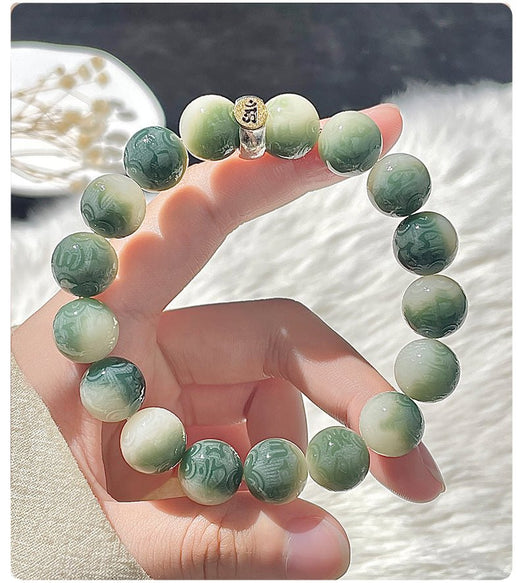
Green jade — whether the deep forest green of high-quality nephrite or the vivid emerald of fine jadeite — is the most culturally resonant choice for those actively building something: a new spiritual practice, a new business, a new family.
It is also the most commonly available, which means quality variation is significant. A deep, evenly colored green nephrite with good translucency is a very different object from a pale, mottled piece dyed to appear richer.
The finest pieces show a consistent saturation across at least 70 percent of the stone's surface.
White Jade: Purity, the Vairochana Principle, and Protection of New Beginnings
White is the color of Vairochana, the central Buddha of the mandala, associated with the dharmadhatu wisdom — the wisdom that recognizes the fundamental purity of all phenomena. White nephrite, particularly the "mutton fat" grade prized in Chinese connoisseurship, has a warmth and depth to it that photographs poorly but feels extraordinary in the hand: smooth, slightly warm to the touch after a moment, with a creamy opacity that is nothing like the cold whiteness of quartz or marble.
White jade is the traditional choice for protection of new life — newborns, new marriages, new chapters. In Tibetan-influenced Himalayan communities, white jade amulets were placed near infants, often carved with protective mantras on the reverse side.
For a gift context, white jade is particularly appropriate for a new mother, someone beginning a serious meditation practice, or someone who has just come through a period of illness or grief and is genuinely starting fresh.
Lavender Jade: Spiritual Protection and the Rare Gift
Lavender jade — a pale purple variety of jadeite caused by the presence of iron and manganese during formation — is the rarest natural color in the jade spectrum and the most recently appreciated in terms of formal valuation.
In Tibetan Buddhist color symbolism, purple and violet are associated with the dissolution of ego boundaries, with the liminal space between ordinary consciousness and awakened mind, and with protection during spiritual transitions.
Lavender jade is not a traditional Tibetan material in the way that nephrite is — it's a jadeite variety that has entered the broader Himalayan Buddhist aesthetic more recently, through the influence of Chinese Buddhist communities in Taiwan, Hong Kong, and the diaspora.
But its color resonance with spiritual protection is genuine and consistent with the iconographic tradition. It is also, practically speaking, a striking and unusual piece that most people have never seen — which makes it a memorable gift for someone who has "everything" in terms of conventional jewelry.
If you're exploring the broader world of protective amulets in Buddhist and adjacent traditions, our guide to the Hamsa hand and its protective symbolism covers related territory from a different cultural angle.
How To Spot the Real Thing Jade — Practical Tests and What to Look For
Let's be direct: you cannot definitively identify jade at home with complete certainty. The only definitive test is gemological analysis with a refractometer and specific gravity measurement. But you can eliminate the most common fakes with a few simple observations, and you can ask the right questions of any seller.
The Temperature Test
Real jade — both nephrite and jadeite — is noticeably cool to the touch and warms slowly. Hold the piece in your palm for thirty seconds. Genuine jade will still feel cool. Glass imitations warm quickly.
This test eliminates a lot of the cheap glass "jade" that floods the market, though it won't distinguish jade from serpentine or other dense stones.
The Visual Tests
Surface texture: Genuine jade has a characteristic surface quality when polished — a slightly waxy, almost greasy luster that is different from the bright glassy shine of quartz or the flat matte of dyed stone. Look at the surface under good light at different angles.
Color distribution: Natural jade has uneven color distribution. You'll see variations, subtle shifts, occasional lighter or darker patches. Uniformly perfect color — especially in bright green — is a red flag. Dyed jade (called "C-grade" in the trade) has been bleached and impregnated with polymer resin, then dyed; it looks too perfect and often shows color concentrated in surface cracks when examined under magnification.
Translucency: Hold the piece up to a direct light source. Good nephrite shows a subtle translucency at thin edges. Jadeite of quality shows more pronounced translucency. Serpentine and bowenite behave differently under light — serpentine tends to be more uniformly translucent, almost like frosted glass.
The Questions to Ask Any Seller
- Is this nephrite or jadeite? (A seller who can't answer this is not a specialist.)
- What is the treatment grade? (Grade A = untreated; Grade B = bleached and polymer-impregnated; Grade C = dyed. Only Grade A is considered genuine in the traditional sense.)
- Where was it sourced? (Nephrite: primarily British Columbia, Russia, New Zealand, China's Xinjiang and Hetian regions. Jadeite: primarily Myanmar.)
- Can you provide a certificate of authenticity from a recognized gemological laboratory?
For pieces in the $50–200 gift range, a full GIA certificate is not always practical, but a reputable seller should be able to tell you the stone type and treatment status with confidence. Our sacred Tibetan pieces are sourced with this transparency — we work with suppliers in Kathmandu and Chengdu who can trace material provenance, and we're straightforward about what we carry and why.
What to Actually Buy: Necklace Forms
Single carved pendant: The most common and versatile form. Look for carvings of traditional symbols — the endless knot, the lotus, the double fish, or simple smooth forms like the classic oval or disc (called a bi disc, which has Neolithic Chinese origins dating to 3000 BCE).
Avoid pieces where the carving looks machine-uniform; hand carving has slight asymmetries that are part of its value.
Beaded jade necklace: A full strand of jade beads is a significant piece — more investment than a pendant, but also more presence. Nephrite bead necklaces in 8mm or 10mm rounds are classic. If you're considering a mala format (108 beads for Buddhist practice), our clear quartz mala shows the standard construction quality we work to — jade malas follow the same stringing and knotting standards.
Chip or nugget necklace: Irregular jade chips strung on silk or cord — more casual, less expensive, and honestly often more beautiful than perfectly uniform beads because the natural variation in the stone shows. Good for everyday wear.
How to Actually Wear and Care for a Jade Necklace
Jade is durable enough for daily wear — this is one of its genuine practical virtues. But "durable" is not the same as "indestructible," and a few habits will keep a jade necklace looking good for decades.
Daily wear: Jade can be worn in the shower and is not damaged by water. However, the string or setting may be. If your jade pendant is set in silver, water exposure will eventually accelerate tarnishing.
Jade beads strung on silk should be kept dry; silk weakens with repeated wetting. For beaded jade necklaces, remove before swimming or showering.
Cleaning: Wipe with a soft damp cloth. For deeper cleaning, mild soap and warm water, then dry thoroughly. Never use ultrasonic cleaners on jade — the resonance can damage the fibrous structure of nephrite in particular, and can loosen polymer resin in treated stones. Never use steam cleaning.
Storage: Store separately from harder stones (diamonds, sapphires, rubies) which can scratch jade's surface. A soft pouch or cloth-lined box is ideal. Jade does not need to be stored in darkness or away from light — unlike some organic materials, it is not photosensitive.
In practice: Practitioners on the path often treat their jade pieces as they would a mala — holding them during meditation, wearing them during practice sessions, and removing them for sleep. Others wear jade continuously as a constant reminder of intention.
There is no single correct approach; the practice is personal. What matters is that the piece is worn with some awareness of what it represents, rather than purely as decoration.
If you're interested in pairing a jade necklace with a formal practice, our guide to Buddhist mantras — pronunciation, meaning, and practice offers a grounded starting point for understanding how physical objects and verbal practice work together in Tibetan Buddhism.
For gifting specifically: consider including a small card that explains the color meaning of the jade you've chosen. Not in a lecture-y way — just a sentence or two. "Green jade in Tibetan Buddhist tradition is associated with compassionate action and growth.
I chose this for you because..." That context transforms the gift from a pretty object into a conversation.

Related reading: green jade and its authentic benefits.
Explore genuine jade pendants and necklaces.
Related guide: how to authenticate nephrite and jadeite jade
Common Questions About Jade Necklace Meaning
Is it culturally appropriate to give jade to someone who isn't Chinese or Buddhist?
This is the right question to ask, and the honest answer is: yes, with awareness. Jade has been a meaningful stone across multiple unrelated cultures — Maori, Olmec, Chinese, Tibetan-influenced Himalayan — which suggests it connects to something broadly human rather than being the exclusive property of one tradition.
The concern about cultural appropriation is most valid when someone takes a sacred object out of context and treats it as a fashion accessory without any acknowledgment of its origins. What you're doing — learning what jade means, choosing thoughtfully, giving with intent — is the opposite of that.
The gift is more meaningful when the giver understands it, and that understanding is itself a form of respect. If your recipient is not Buddhist or Chinese, the jade's meaning doesn't disappear; it shifts slightly toward the universal qualities that jade has represented across cultures: steadiness, purity, endurance, and care.
What is the difference between Type A, B, and C jade, and does it matter for a gift?
It matters significantly. Type A jade is untreated — no bleaching, no polymer impregnation, no artificial coloring. It is what it is: the stone as it came from the earth, shaped and polished. Type B jade has been bleached with acid to remove impurities and then stabilized with polymer resin, which improves its appearance but compromises its long-term durability (the polymer yellows over time) and, from a traditional perspective, its integrity as a natural material.
Type C jade has been dyed, sometimes after B treatment, to produce more vivid or uniform color. For a meaningful gift intended to last — something you want the recipient to still be wearing in twenty years — Type A is the only appropriate choice.
The price difference is real but not prohibitive at the pendant level: a genuine Type A nephrite pendant in the $60–150 range is achievable from a reputable source.
How can I tell if jade has been dyed?
The most accessible method without equipment is close visual inspection under magnification (a phone camera zoomed in works reasonably well). Dyed jade often shows color concentrated along surface cracks and grain boundaries — the dye pools where it can penetrate.
Natural color in jade is distributed throughout the stone's structure and doesn't follow surface features in this way. Another indicator: hold the piece up to strong light. Dyed jade often shows a slightly flat, uniform color even in transmitted light; natural jade shows variation and depth.
If you have access to a UV lamp (the kind used for checking currency), some treated jades fluoresce in ways that natural jade does not — though this test is not definitive on its own.
When in doubt, buy from a seller who explicitly states treatment grade and stands behind that claim.
Does jade need to be blessed or activated before wearing?
Within Tibetan Buddhist practice, objects gain spiritual significance through intention, use, and formal blessing — not through an inherent sacred property of the material itself. A piece of jade that has been blessed during a puja ceremony by a qualified lama carries that blessing as a real thing, not a marketing claim.
A piece of jade that hasn't been formally blessed is still jade — still a beautiful, meaningful object with deep cultural history — but it hasn't been consecrated in the technical Buddhist sense. If your recipient has a relationship with a teacher or sangha, they can have a piece blessed themselves, which is actually more personally meaningful than buying something pre-blessed by an unknown source.
If you're buying from us, we're transparent about which pieces have been blessed and by whom, and we don't use "blessed by monks" as a generic selling point without being able to say specifically who, when, and in what context.
Is green jade or white jade better for a gift?
"Better" depends entirely on the recipient and the occasion. Green jade is more versatile — it suits more skin tones, works with more clothing, and its associations with growth and compassionate action are broadly positive for almost any life stage.
White jade is more specific in its meaning (purity, new beginnings, protection) and more striking as a visual statement — that creamy warmth is genuinely unusual. If you're giving to a new mother or someone beginning a significant new chapter, white jade is the more resonant choice.
If you're giving for a birthday, a general celebration, or for someone in an active period of their life, green jade is the safer and more universally appreciated option. Lavender jade is the choice for someone who knows jade well and would appreciate something rare — it's not an introductory piece.
What is the significance of jade in Tibetan Buddhism specifically, as opposed to Chinese Buddhism?
Tibetan Buddhism and Chinese Buddhism share some overlap but have distinct material cultures. In indigenous Tibetan tradition, the primary sacred stones are turquoise (called gyu in Tibetan, deeply embedded in both religious and folk practice) and coral.
Jade entered Tibetan material culture significantly through contact with Chinese civilization — particularly through the Qing dynasty's patronage of Tibetan Buddhism from the 17th century onward and through trade along the Silk Road. In Tibetan-influenced Himalayan communities (Bhutan, Sikkim, Ladakh, the Nepal Tibetan diaspora), jade appears in composite jewelry pieces and as carved amulets, but it doesn't have the same indigenous depth that turquoise does.
This doesn't diminish jade's meaning in a Buddhist context — it simply means you're working with a stone that carries Chinese Buddhist associations more than purely Tibetan ones, and those associations (virtue, endurance, purity, the five Confucian virtues mapped onto Buddhist qualities) are rich and legitimate.
What is a reasonable budget for a jade necklace that is actually authentic?
For a single pendant necklace in genuine Type A nephrite, $60–150 is a realistic range for mid-grade material with honest craftsmanship. Below $40, you are almost certainly looking at serpentine, dyed quartzite, or treated B/C grade material.
Above $200, you're entering the range where jadeite becomes possible and where fine nephrite (Hetian white jade, for instance) starts to appear. For a full beaded necklace in genuine nephrite, $120–300 is realistic depending on bead size and grade.
Jadeite at any meaningful quality level starts higher — fine jadeite jewelry is an investment piece in the $300+ range at minimum, and top-grade Imperial jadeite is priced like fine gemstones. For the $50–200 gift budget that most people are working with, nephrite is the honest, beautiful, culturally grounded choice.
Don't let anyone talk you into "jadeite" at $30 — it isn't.
Can a jade necklace be worn with other Buddhist jewelry?
Yes, and in Himalayan Buddhist tradition, layering is the norm rather than the exception. The elaborate pectoral ornaments worn by Tibetan women and lamas combine turquoise, coral, amber, and jade in a single piece — the aesthetic is intentionally composite, with each stone contributing its own meaning to the whole.
In everyday wear, a jade pendant pairs naturally with a mala worn as a bracelet, or with a small silver amulet box (gau). The combination of jade's associations with growth and endurance alongside a mala's function as a counting tool for practice creates a coherent set of intentions.
If you're buying jade as part of a larger gift — a small collection of meaningful pieces — pairing it with a mala makes practical and symbolic sense. Our Buddhabelief spiritual jewelry collection includes pieces designed to work together.
Your Journey With Jade Starts With One Honest Question
The most meaningful gifts are the ones where the giver did the work — not only the shopping, but the thinking. You've done that here. You now know the difference between nephrite and jadeite, between Type A and the stuff that will yellow in five years.
You know that green jade speaks to growth and compassionate action, that white jade carries the energy of new beginnings and protection, that lavender jade is the rare choice for someone ready for something unusual.
You know what questions to ask and what answers should make you walk away.
In 2026, with the market flooded with wellness-branded everything, giving someone a piece of genuine jade — stone that formed under geological pressure over millions of years, shaped by hands trained in Tibetan carving workshops, connected to a tradition that has been thinking about what makes an object sacred since the Tang Dynasty — is a genuinely countercultural act.
It says: I took the time to understand what I was giving you. I chose something real.
That's what a good gift does. It carries the giver's care in its weight.
When you're ready to find that piece, explore our authentic Tibetan jewelry — we're here to help you choose something that will still mean something twenty years from now. Buddhabelief works exclusively with monastery-certified craftsmen in Lhasa and Kathmandu to bring you pieces that carry genuine spiritual significance — not mass-produced replicas.
FAQ
Is it culturally appropriate to give jade to someone who isn't Chinese or Buddhist?
Yes, with awareness. Jade has been a meaningful stone across multiple unrelated cultures — Maori, Olmec, Chinese, Tibetan-influenced Himalayan — which suggests it connects to something broadly human rather than being the exclusive property of one tradition.
The concern about cultural appropriation is most valid when someone takes a sacred object out of context and treats it as a fashion accessory without any acknowledgment of its origins. What you're doing — learning what jade means, choosing thoughtfully, giving with intent — is the opposite of that.
The gift is more meaningful when the giver understands it, and that understanding is itself a form of respect. If your recipient is not Buddhist or Chinese, jade's meaning doesn't disappear; it shifts toward the universal qualities jade has represented across cultures: steadiness, purity, endurance, and care.
Keep reading